Dee
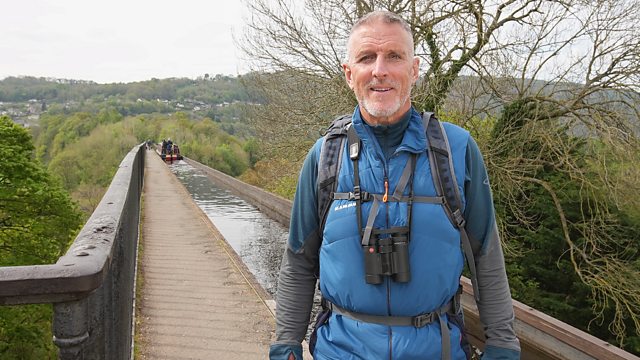
Iolo explores the stunning Dee valley, from wintering birds along the estuary to displaying black grouse on moorland, rare freshwater-pearl mussels and spawning sea trout.
Iolo explores the River Dee, north Wales's longest river. His 70-mile journey begins along the estuary, which marks the boundary between Wales and England. Iolo visits Flint on the Welsh side, where he witnesses an amazing show of wading birds, before heading to the English side to see spectacular views of marsh harriers and short-eared owls hunting the vast salt marsh.
Travelling inland, Iolo explores one of the last remaining flood meadows in Wales, a rare habitat that is surrounded by landscape dominated by intensive agricultural land. There, he sees the scarce great burnet flower and watches different pollinators like bees, ladybirds and butterflies.
The journey then heads west through the Vale of Llangollen, dominated by the Pontcysyllte aqueduct. This 220-year-old World Heritage Site, designed by Thomas Telford, once transported coal and iron during the Industrial Revolution and continues to connect the landscape today. Iolo heads to Llangollen next, overlooked by Castell Dinas Brân, translated as Castle of Crows, which according to historical chronicles was one of the last breeding sites of the golden eagle in Wales. While the eagles are gone, the valley now hosts the striking mandarin duck, a species that puts a smile on Iolo’s face.
On the heather moorlands above the valley, Iolo joins a RSPB conservation officer at the crack of dawn to watch the courtship display of the threatened black grouse, remaining hidden behind camouflage netting to observe this amazing spectacle. In the upper reaches of the valley, the River Dee feeds into Wales's largest natural lake, Llyn Tegid, where Iolo soaks in the beautiful view at lakeside.
Nearby, on one of the Dee’s tributaries, the Afon Tryweryn, Iolo joins a special licence holder from Natural Resources Wales to find the incredibly scarce freshwater pearl mussel, an ancient species that has disappeared from most other rivers. The changing seasons bring new wonders, including bioluminescent fungi in the damp autumn woodlands that glow under UV light.
Iolo heads to another upper tributary under the cover of darkness to look for the autumn migration of sea trout, also known as sewin, at a secret spawning ground. Using a pole camera and drones to minimise disturbance, he gets to see the fascinating behaviour of these migratory fish as they prepare their nests in the riverbed. The journey concludes high up in the mountains, where the River Dee begins as a mere trickle on the slopes of Y Dduallt mountain.
Last on

More episodes
Previous
Next
You are at the last episode
Credits
| Role | Contributor |
|---|---|
| Interviewed Guest | Anya Wicikowski |
| Interviewed Guest | Gethin Morris |
| Presenter | Iolo Williams |
| Series Editor | Bledyn Rhys |
| Director | Osian Griffiths |
| Producer | Osian Griffiths |