Filming the icons of evolution
By Alice Jones, Series Producer
The 4-billion-year journey of evolution is not a straightforward story to tell...
The 4-billion-year journey of evolution is not a straightforward story to tell, but we knew we wanted to showcase the richness and wonder of life on Earth, so each episode was framed around a modern-day iconic animal: the elephant, the ostrich, the bat, the dolphin and the horse. But Chris Packham’s enthusiasm for seeking out nature’s oddballs and weirdos gave us another focus, and this is how the elusive velvet worm came into our lives.
Velvet worms are mysterious creatures. They’re not really worms, and certainly not made of velvet. Rather, they’re a peculiar invertebrate with leg-like appendages that are believed to have branched off from their arthropod relatives on their own evolutionary journey around 500 million years ago. So, when the Evolution research team mentioned them as a ‘living fossil’ that show a key step to the evolution of complex eyes, they became a prime target for filming in their native habitat in Costa Rica. How hard could it be to film a little slow-moving worm? It turns out, very hard. Because the velvet worm is a master of disguise.
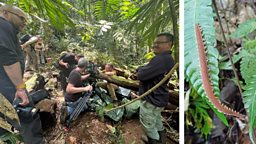
The Dolphin team – relieved after filming the elusive velvet worm in Costa Rica
Prior to departure, the producers worked with a local team in the field including an experienced naturalist with the correct permits for collecting and handling these delicate wild wonders… and set them the task of finding one.
From nudibranchs and newts, lungfish and lizards, to tunicates and tapirs... we ended up being spoilt for choice.
Chris Packham explains,
“They're very fragile and they're quite small and therefore difficult to find. Eventually, after an enormous endeavour, hours and hours, they found a velvet worm... It was put in a tank with a load of leaf litter so that it would be comfortable.”
So far so good, until… just before filming a routine check led to panic.
“All we had to do was get up the next day, tramp out there, bring the tank, get the velvet worm out. Except that when we get up in the morning, the velvet worm's not in the tank. There's talk of an escape. But the thing is that it’s highly improbable that this tiny, fragile animal could have escaped from the tank.”
The team were initially baffled, but a local expert advised them that this ‘disappearing act’ is quite common as they can contort their bodies in extraordinary ways to hide. Although we were told they often reappear, the team couldn’t just wait around.
A last-minute velvet worm search party was sent out and miraculously one was found just in the nick of time. It might have been smaller than a toothpick, but Chris was in raptures and the scene was ‘in the can’. After its 5 minutes of fame, it was returned safely to where it was originally found.
The velvet worm was not the only unusual animal interaction of the series as we discovered that living animals were often the best way to illustrate principles of evolution. We chose to restrict filming to one key geographical region per episode, giving us an opportunity to seek out peculiar often overlooked creatures – while also limiting our long-haul travel and thus carbon impact. From nudibranchs and newts, lungfish and lizards, to tunicates and tapirs... we ended up being spoilt for choice.
With all the animals filmed across the series, welfare was paramount. To reduce impact on wild populations we often sought out animals already habituated to humans – frequently in sanctuaries or reserves. We worked with experts to locate, source and handle wild animals appropriately to minimise any potential stress and we ensured local guidelines and laws were always followed.
It was important for us that Chris had a first-hand experience with each episode’s iconic animal in their natural habitat – and the giant elephants, hatching ostriches, intelligent dolphins, hungry bats and racing horses all proved to be challenging in their own way.
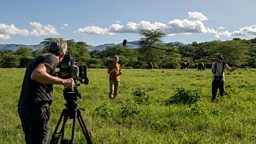
Chris Packham, Director of Photography Tom Hayward and Sound Recordist Seb Blach filming with elephants at The Sheldrick Wildlife Trust in Kenya.
The Elephant
Chris was even able to lead a small group through the forest...
Elephants can be incredibly dangerous – especially big ones - but thanks to the dedicated team at The Sheldrick Wildlife Trust, who care for orphaned and rescued elephants, the team led by Producer/Director Tom Hewitson, were able to film with a habituated group. After gaining the elephants’ trust, Chris was even able to lead a small group through the forest while masterfully delivering the final thoughts of that episode.
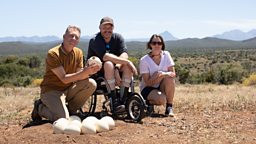
Chris Packham, Producer Niall Strawson and Producer/Director Laura Mulholland at an Ostrich Farm in Oudtshoorn, South Africa.
The Ostrich
Ostriches are also dangerous - especially when fully grown...
Ostriches are also dangerous – especially when fully grown – but in South Africa, they are routinely farmed, so a unique opportunity arose to allow Chris to witness the first moments of new life. The filming was meticulously planned with the help of the experts at the egg hatchery who regularly handle the incubating eggs. The filming was scheduled around the farm’s hatching cycle – allowing the team, led by Producer/ Director Laura Mulholland, to guarantee that Chris would get to witness the first moments an ostrich chick. The trouble is that this precision timed event coincided with a blistering heatwave – and so the team had to film in temperatures over 40 degrees. But even the heat couldn’t stop them all falling in love with the newly hatched fluffy chicks.
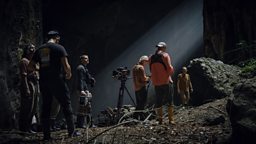
The Bat team led by Producer/Director Fleur Bone in Gomantong Gaves, Borneo – home to hundreds of thousands of wrinkle-lipped bats.
The Bat
The spectacular bat ‘exodus’ was also not the easiest to film...
Bats are incredibly difficult to handle, not least because they can bite and are vectors of disease – so to kick off that episode, rather than getting up close with an individual bat, the team, led by Fleur Bone, opted for sheer numbers and embarked on a trip to the spectacular Gomantong Caves in Sabah, Borneo. However, hundreds of thousands of bats roosting in one place has a rather unpleasant consequence: mountainous piles of guano building up beneath them. This was sheer delight for Chris, but also a health hazard, so the team had to follow a strict hygiene protocol and sanitize regularly. The spectacular bat ‘exodus’ was also not the easiest to film as the team needed to climb up 560 steps each night to see it - occasionally being stopped in their tracks by wild orangutans.
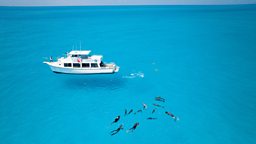
The Dolphin team led by Producer/Director Ross Kirby filming in calm waters off Bimini in The Bahamas
The Dolphin
Chris was able to encounter ‘dolphin heaven’ in an unforgettable shoot.
Just off the coast of Bimini in The Bahamas, Chris was able to encounter ‘dolphin heaven’ in an unforgettable shoot. The team, led by Ross Kirby, had chosen this site very carefully as these wild dolphins roam freely but have become well known for seeking out human encounters. We worked with local experts who knew some of them by name - and the team filmed by free-diving with them.
But once again, this magical moment didn’t come easy. The team had a very tight filming window, and the weather did not comply. They were greeted by torrential rain, and the first filming day was too windy to go out on the water. Then the water had been churned up and the sea was so choppy that everyone was terribly seasick – including Chris. Although he persevered and had a wild dolphin encounter, he came out worse for wear. Thankfully the conditions improved on the last day, the sea was a millpond, the water crystal clear and the dolphins were delightful.
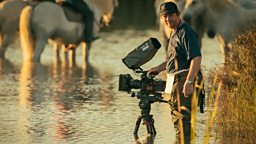
Director of Photography Will Edwards wading through the waters of The Camargue in France.
The Horse
They say “never work with children or animals”, I can’t imagine why!
Our final icon of evolution was the statuesque horse. Chris has previously visited The Camargue in France and knew it was a wonderful spot to photograph the white horses that roam freely in this region. But heat waves, nearby wildfires and cancelled trains made this shoot rather tense for the team led by Producer/Director Clementine Cheetham. To avoid the midday heat they all had to work in the early and late hours to get the glorious shots of horses running through the majestic wetlands – but the effort paid off. Since the remaining filming for this episode was based back in the UK, they were also able to film with Chris’s lovely but rather mischievous dogs, Sid and Nancy. They say “never work with children or animals”, I can’t imagine why!
We’d like to thank all the people who have dedicated their lives to caring for the animals we filmed across the series in numerous sanctuaries and reserves around the world – we are grateful for their help and support, and dedication to protecting these marvels of evolution - and of course thank you to the animals themselves for taking part!
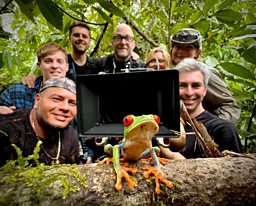
The Dolphin team in Costa Rica, with a very friendly red-eyed tree frog!

