| fountains abbey on telly! | Nature's Calendar is a new wildlife and natural history series on BBC Two. Shot in beautiful locations around the country, including Fountains Abbey, the series offers tips on where to go to spot some of the most rare and interesting animals, birds, trees and flowers across the UK. The winter series of Nature's Calendar begins on Monday November 27, and is on at 6pm every day for two weeks. |
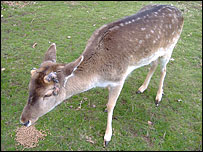
When Fountains Abbey deer warden John Corrigan does the feeding rounds, he always saves a bit for 'a very special deer'. And that's on top of the bag of chopped carrots and apples he already has prepared! If you knew Fred, you probably would too... Fred lives in a pen all his own. He can't live alongside the other deer because he doesn't see himself as one of them. Fred's much happier in the company of humans. Oh, and the friendly pheasant that visits him each day. Fred, a fallow deer, is nearly 16 years old, having been born on 28th July 1973. Shortly after his mother gave birth, he was picked up by a lady who thought he might have been abandoned. So she took Fred to the deer warden’s house. | "His mother wouldn’t have anything to do with him because he smelled of the lady's Chanel No 5 perfume" | |
Ernie, the deer warden at the time, knew that the deer's mother was most probably off finding food for her newborn, so he told the lady to take Fred back to where she found him. His mother did come back - three times, in fact - but she wouldn’t have anything to do with him because he smelled of the lady's Chanel No 5 perfume. Since Fred had no mother to raise him, there was only one thing Ernie could do: become Fred's dad. So Fred grew up alongside Ernie's own children and his dogs. Having spent so long in the company of humans, Fred doesn't relate to the other deer in the park. And for that reason, if he did go for a roam around the park, the others would attack him. Although he might try to defend himself, Fred wouldn't cope very well as he doesn't have any antlers. These were removed when Fred was a fawn, in the hope of avoiding otherwise inevitable 'teenage' urges! 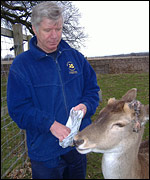 | | John the deer warden feeding Fred |
So, Fred has a pen of his own, with winter and summer shelters and a pheasant for a friend. He does occasionally escape, but luckily never ventures into the park - instead, he'll go to the old warden’s lodge and look into the living room, where he spent his childhood. Although Fred might miss the halcyon days of his childhood, he appears to be a happy deer. And why wouldn't he be? Fred gets lots visitors and lots of food! One woman from Ripon even makes sure he get special treats at Christmas time! Because he's used to humans, Fred lets them stroke and feed him. As John, the present day deer warden, explains, it's a peculiarity that comes in handy: "We bring partially sighted and blind children in here and they can touch him – you can explain as much as you like what a deer looks like, but once they’ve touched him they know exactly what he looks like. And he likes the attention!" So if you decide to go and see the deer at Fountains Abbey, don't forget to drop in on Fred and say hello. You never know, he might answer back! |