 | 13 November 2014 |

| |
| BBC Homepage BBC Northern Ireland | | |
| |||
| » | Newsline Meet The Team In Pictures NI News Online Politics Show Let's Talk Hearts and Minds Good Morning Ulster Talkback Evening Extra Titanic Journey | | |
| Contact Us | | |
Environment and ScienceYou are in: BBC Newsline > Environment and Science > Asteroid breakthrough 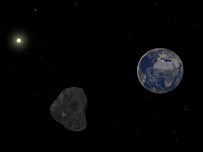 Asteroid breakthroughMike McKimm, Science Correspondent, BBC NI It was the stuff of science fiction. An 80 ton asteroid, 2008 TC3, hurtling towards the earth at 30,000 mph. Scientists had already worked out it was going to impact with our planet on 7th October, 2008 at around 0345 UCT. This was the first ever predicted earth impact of an asteroid. The problem was it had been spotted just a few hours before it would hit. 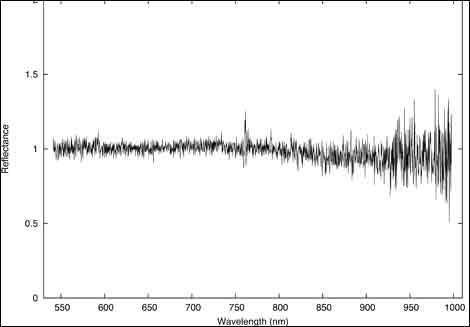 2008TC3 asteriod spectrum What happened next would make scientific history. A group of astronomers from Queens University, Belfast and The Armagh Observatory were scheduled to use the huge William Herschel Telescope on La Palma in the Canaries. Urgent phone calls took place and just four hours before impact, the team from Northern Ireland lined up the telescope and started to capture the asteroid's spectrum. That's a measure of the sun's light reflected by the asteroid as it speeds along. From this reflected light, scientists can work out what the asteroid is made from. Shortly after the data was collected, the asteroid passed into the earth's shadow but still on a collision course. Scientists held their collective breath and at around 37 km above the Nubian Desert in the Sudan, East Africa, the asteroid exploded. Small parts of it still made to earth. That's when Dr Peter Jenniskens of the SETI Institute in California teamed up with Dr Muawai Shaddad to try to recover any remains. With the help of 45 students from the University of Khartoum a 29 km search was made of the asteroid's approach path on the Nubian desert. They were rewarded with the discovery of 15 small meteorite bits. According to Dr Jenniskens: "The recovered meteorites were unlike anything in our meteorite collections up to that point. The asteroid has been confirmed as a rare type called F-class, corresponding to dark ureilite achondrite meteorites with a texture and composition unlike any other ureilite meteorites found on earth before." But would they match the spectrum recorded before the impact with out atmosphere? "Yes, quite convincingly", says Sam Duffy, the Queen's University astronomer who actually gather the spectrum data. "It was impressive just how well they matched up." Equally impressive was the fact that the team on La Palma were able to come up with the data at all. Normally such a project would need a lot of planning. The team just had a few hours warning. "These observations were technically quite difficult", explained Dr Gavin Ramsay of The Armagh Observatory. "The William Herschel Telescope really rose to the challenge, demonstrating what a versatile telescope it is. There was a great sense of excitement in the control room." Comparing the asteroid and its meteorite data tells us that 2008 TC3 may have only spent a few million years existing in the inner solar system before it hit our planet. Luckily the composition of the asteroid was lighter and less dense than a solid iron one. Its probably one of the reasons why it exploded so soon after entering the atmosphere. Had it been much tougher it could have left quite a dent. Help playing audio/video last updated: 26/03/2009 at 13:23 You are in: BBC Newsline > Environment and Science > Asteroid breakthrough
Latest Bulletins |
| | About the BBC | Help | Terms of Use | Privacy & Cookies Policy |

