Summary

  • A stray piece of a SpaceX rocket is travelling through space at about 5,400mph (8,690 km/hr) and is on course to collide with the Moon

  • Impact is expected around 07:35 BST - here's how we got here

  • The crash won't be visible to the naked eye, but people with access to a sophisticated telescope may see a flash from the lunar surface

  • In a statement, Nasa spokesperson Jimi Russell says the collision "poses no danger to Earth"

  • An estimated one million kilograms of debris will blast into space after the 4,000kg (8,800 lb) rocket part makes impact

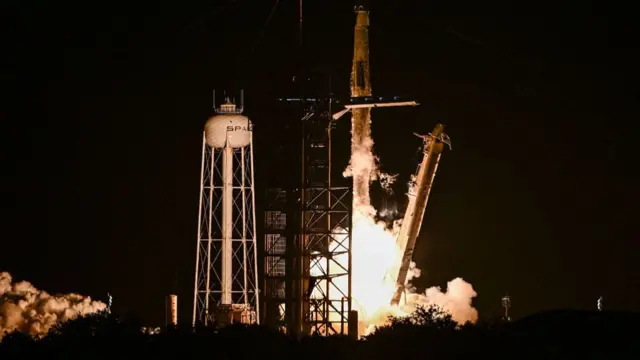
  • The SpaceX Falcon 9 rocket was launched in January 2025, with its upper section - now headed for the Moon - being discarded

Send your photos.

  1. No danger to Earth from collision - Nasapublished at 06:47 BST

    Matt Bothwell smiling in front of a black background
    Image caption,

    Matt Bothwell, astronomer at the Institute of Astronomy at the University of Cambridge

    The collision between the Moon and a drifting SpaceX rocket is not thought to be dangerous, including to Earth, according to experts.

    Nasa spokesperson Jimi Russel says while Nasa will continue to observe the site of impact for scientific purposes, "there is no danger to Earth".

    Nasa scientists are planning to collect lunar data from the event and refine techniques for tracking objects in space.

    "It's something really huge smashing into the Moon. It's not remotely dangerous, we can just watch the show," says Dr Matt Bothwell, public astronomer at the University of Cambridge.

  2. How a SpaceX rocket ended up hurtling towards the Moonpublished at 06:27 BST

    Pallab Ghosh
    Science correspondent

    The story began in January last year, when a Falcon 9 rocket blasted off from Florida carrying two lunar landers into space.

    The rocket's job was to fire its upper stage hard enough to send both landers out of Earth orbit and onto a path towards the Moon, and it succeeded.

    But the spent stage was left drifting in a long, looping orbit that swung it out towards the Moon and back again.

    Over the following 18 months, the gentle gravitational tug of the Earth, Moon and Sun - along with even the faint push of sunlight itself - gradually altered its path.

    Astronomers tracking the object eventually worked out that those small nudges had put it on a course toward the Moon, picking up speed by the day and heading for an almighty crash.

  3. SpaceX rocket travelling at 5,400mph set to crash into Moonpublished at 06:19 BST

    A SpaceX spacecraft during a night-time launch, showing a roar of white flames and smoke against a dark sky.Image source, AFP via Getty Images

    A stray piece of a SpaceX rocket that has been hurtling in orbit at around 2.43 kilometres per second (about 5,400mph) is expected to collide with the Moon.

    It's the upper section of a Falcon 9 spacecraft, about the size of a five-storey building and weighing at least 4,000kg.

    The collision, according to US space agency Nasa, is predicted to happen at about 07:35 BST.

    Experts say it will not be visible from Earth with the naked eye, but people with access to a sophisticated telescope may be able to see a flash radiating off the Moon's surface.

    It is also not thought to be dangerous - including to Earth - with scientists instead considering this to be a unique opportunity to study what happens when an object hits the Moon.

    Stick with us as we bring you the latest updates and expert analysis on what this all means.