Summary

  1. Trump says he told Netanyahu we have to 'use sense' after Iran and Israel exchange firepublished at 22:19 BST 8 June

    Caitlin Doherty
    Live reporter

    In a phone call with the BBC, US President Donald Trump said that when he spoke to Israeli PM Benjamin Netanyahu earlier today, he told him "we have to use sense".

    The two leaders spoke after Israel exchanged fire with Iran for the first time since a ceasefire with Tehran began two months ago.

    Our North America editor, Sarah Smith, asked Trump how he had persuaded Netanyahu to stop attacking, to which he responded, “All I did is say, 'We have to use sense'. We're very close to signing a very powerful deal, a very good deal".

    On Sunday, Iran launched a wave of missiles at Israel marking the first since the April ceasefire. Israel retaliated, saying it struck military targets in western and central Iran.

    Iran came out first to say it would be stopping strikes on Israel before Netanyahu followed suit saying Israel's attacks would stop "for now".

    Israel has since lifted some of its restrictions for the public, while flights within Iran have now resumed.

    However, Iran has threatened a "severe" response if the Israel Defense Forces (IDF) continues striking southern Lebanon.

    Evacuation orders were issued by the IDF in southern Lebanon - which has been separate from the April ceasefire deal - with the Israeli military saying this was due to “Hezbollah’s violation of the ceasefire agreement.”

    We're now closing our live coverage, but going forward the latest updates will be in our news story ,and you can read more from our BBC Persian editor on what this indicates about the Iranian regime's stance.

  2. Israel 'forced to beg' for ceasefire, says Iranian first VPpublished at 21:47 BST 8 June

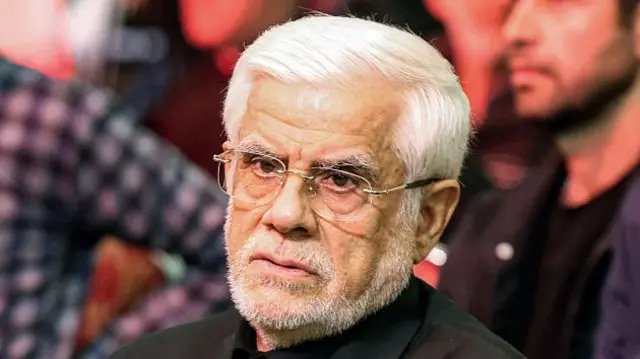
    Mohammad Reza Aref,Image source, Getty Images

    Iran's First Vice President Mohammad Reza Aref, says Israel "was forced to beg once again for Iran to accept a ceasefire",

    "We do not seek war,” Aref writes in a post X. “But in defending our soil and our values, we will not hesitate for a moment.”

  3. Is the US president losing control of the Iran war?published at 21:30 BST 8 June

    Gary O’Donoghue
    Chief North America correspondent

    Israel's war with Iran is now more than 100 days old and is threatening to spiral out of Donald Trump's control.

    During his re-election campaign, Trump promised no more wars. This one shows no sign of stopping soon.

    Watch more below.

  4. Trump denies in call with BBC that Netanyahu defied himpublished at 21:09 BST 8 June
    Breaking

    Sarah Smith
    North America editor

    I just phoned President Trump to ask him about Iran and Israel’s exchange of fire for the first time since the US agreed to a ceasefire with Tehran two months ago.

    Iran launched waves of attacks on Israel on Sunday, and Israel hit back.

    In our brief call, I asked the president how he had persuaded Israeli Prime Minister Benjamin Netanyahu to stop attacking Iran.

    Trump responded: “All I did is say, 'We have to use sense'. We're very close to signing a very powerful deal, a very good deal.

    “No nuclear weapons, no nothing. You know, we have to use a lot of common sense. It was fine.”

    I pointed out that Netanyahu had retaliated against Iran’s strikes, despite Trump urging Israel not to fire missiles in response.

    Trump replied: "No, no.They had already gone. They had already gone. They were already on their way."

    That’s convenient timing, and it may explain why there was not a furious response to that attack from President Trump.

    He said - about Netanyahu - "If I tell him to do something, he does it."

    Then the president said he had to go and ended our conversation.

  5. Trump tells Israeli media he warned Netanyahu he could soon be 'left alone against Iran'published at 20:43 BST 8 June

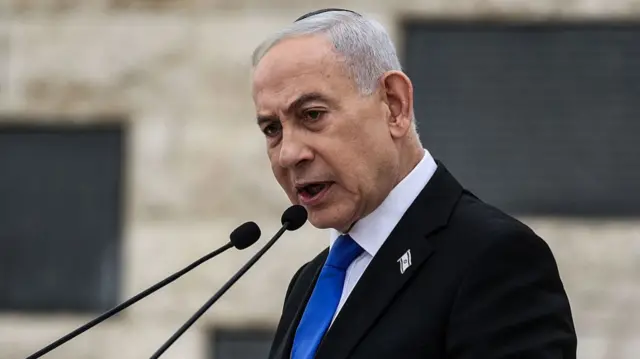
    Benjamin Netanyahu speaking at an eventImage source, AFP via Getty Images

    Donald Trump warned Israeli PM Benjamin Netanyahu that he could be left alone against Iran soon if escalations continue, the US president told Israel's Channel 12 in an interview.

    The Israeli news agency reported today that Netanyahu did not tell Trump about his final decision to strike Iran on Sunday, until very late stage in the planning.

    Trump asked Netanyahu on Sunday to avoid striking Iran in retaliation for strikes on Israel launched after Israel attacked the Lebanese capital Beirut.

    The conversation ended without agreement and Netanyahu did not inform Trump about his final decision on the matter, Channel 12 reported.

    Later, Netanyahu informed US Secretary of State Marco Rubio that he had decided to attack Iran. Trump told Channel 12 he was able to "reduce the scale" of the attack.

    Trump warned Netanyahu against escalating the exchange of fire with Iran into a full-scale war, saying to Channel 12: "I told Bibi, you'd better be careful what you do, because you could be left alone against Iran very soon."

  6. Analysis

    Truce remains fragile between Israel and Iranpublished at 20:33 BST 8 June

    Lyse Doucet
    Chief international correspondent

    Both Israel and Iran say they are holding fire - for now. And both countries are trying to signal that life will now return to what it was before this brief escalation.

    Iran announced that flights would resume. Israel said schools could reopen and people return to work.

    But it’s also clear that this fragile truce is certain to be shattered again. Both sides refer to a new equation – a reference to Tehran’s insistence that this ceasefire, which came into force in early April, includes Lebanon.

    Iran’s lead negotiator, Mohammad Bagher Ghalibaf, posted on social media, "We have disrupted the equation of a ceasefire on paper and its repeated violations in the field."

    But in his comments, Prime Minister Netanyahu accused Iran, and its Lebanese ally Hezbollah, of trying to impose a new equation on Israel – in his words, it was unacceptable and intolerable.

    What happens in Lebanon has a direct impact on the ongoing negotiations between Iran and the United States – they were said to be making progress although it was never clear how close they were to a deal.

  7. Lebanese president accuses Iran of using it as 'bargaining chip'published at 19:44 BST 8 June

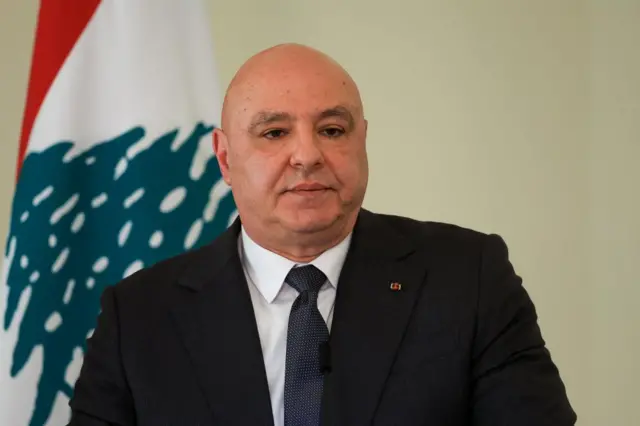
    Lebanese President Joseph AounImage source, Reuters

    Lebanese President Joseph Aoun has accused Iran of using his country as a bargaining chip in peace talks with the US.

    In an interview with CNN that aired today, Aoun addressed Iran's Islamic Revolutionary Guard Corps (IRGC), the main backers of Hezbollah, and said: "It's not your country, it's our country."

    "(Iran is) using Lebanon as a bargaining chip in their negotiation with US."

    He said: "You are not trying to help us... the people of Lebanon are paying the price... for the sake of your own interest."

    Aoun said he would take "whatever it takes" to save his country from conflict and that he is "committed" to negotiations to end the war. Addressing Israel, he said: "If you are not, you will never live in peace, safety and security."

    He criticised the Israeli military strategy in dismantling Hezbollah, saying they can only be "dealt with" by the Lebanese government if Israel withdraws.

    “They can invade the whole country, they can flatten the whole country, but they will never be able to achieve their objective,” Aoun said of Israel.

    In response to the interview, Iran's foreign minister Seyed Abbas Araghchi said on X that had Lebanon been a bargaining chip for Iran, "we'd have a deal long ago".

    He said: "Based on Mr. Aoun's comments, one would think it's Iran that has occupied 1/5 of Lebanon, displaced 1/4 of Lebanese and bombing his country on daily basis."

  8. 'We do not trust the other side' - Iran's top negotiatorpublished at 19:21 BST 8 June

    Iran's top negotiator Mohammad Baqer Qalibaf has issued a new statement in which he blames "recent tensions" on the US "violat[ing] the ceasefire" with the naval blockade.

    "Our goal is to end the war and create lasting security, not to normalise relations with the United States, and we do not trust the other side," Qalibaf writes on Telegram.

    He adds Iran will turn the blockade "into another defeat" for the US.

    As a reminder, the US Navy sought to blockade Iran's ports after Iran looked to control passage and impose tolls for ships passing through the Strait of Hormuz.

  9. EU sanctions mean nothing to Iran, minister sayspublished at 18:56 BST 8 June

    An Iranian foreign minister is slamming the EU's sanctions on Iranian individuals and entities - which were announced earlier today - as "hypocritical" and "fraudulent".

    "The EU member states themselves are among the biggest violators of the rights of the Iranian people and the EU has also deliberately remained silent about the US naval blockade of Iran, which is considered an act of war!" Kazem Gharibabadi, Iran's Deputy Foreign Minister for Legal and International Affairs, wrote on X.

    Gharibabadi added that Iran "does not place any value" on the EU's sanctions and that Iran will continue its sovereign rights over the Strait of Hormuz.

  10. Israel lifts some restrictions in north of the countrypublished at 18:31 BST 8 June

    The Israeli military has announced the lifting of restrictions in some parts of the country.

    Several areas of northern Israel including Sifsufa, Meron, Or HaGanuz and Sde Eliezer will move to a "partial activity level" beginning Tuesday morning.

    This means schools and workplaces can gather again indoors or in locations close to bomb shelters. Up to 100 people may gather outdoors and 400 indoors.

    The rest of Israel has no restrictions. The change comes as both Iran and Israel signalled a halt in the latest round of conflict which has seen missiles fired in each other's direction.

  11. Flights in Iran to resumepublished at 18:12 BST 8 June

    Ghoncheh Habibiazad
    Senior reporter, BBC Persian

    The head of Iran's Civil Aviation Organisation has said that Iran will be resuming flights hours after cancelling them earlier today.

    According to Iranian outlets, Abouzar Shiroudi has said that following the announcement earlier by the authorities that the "military operations have ended", the country's airspace has "returned back to normal" and aviation operations will "resume".

  12. The latest: Israel continues operations in Lebanon, while Masoud says Iran 'will not retreat'published at 18:05 BST 8 June

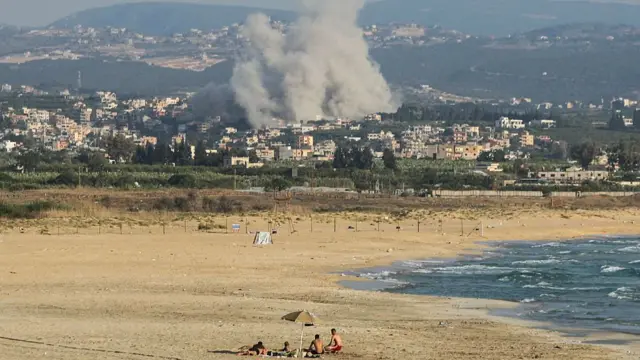
    A group sunvathes the beach in the southern Lebanese city of Tyre as smoke rises from the site of an Israeli airstrike in the village of Deir Qanoun Ras al-AinImage source, Getty Images
    Image caption,

    A group sunvathes the beach in the southern Lebanese city of Tyre as smoke rises from the site of an Israeli airstrike in the village of Deir Qanoun Ras al-Ain

    Here are the latest updates on the resumption of strikes between Iran and Israel.

    Today, Iran said it had ceased attacks on Israel, but would resume them if Israel continued strikes in Lebanon.

    Israel's defence minister Israel Katz recently said its military will continue to operate in southern Lebanon and Prime Minister Benjamin Netanyahu suggested the fight with Hezbollah and Iran was not over yet.

    The Israel Defense Forces (IDF) ordered residents in southern Lebanon to evacuate ahead of military action, citing "Hezbollah's violation of the ceasefire agreement".

    Iran's president Masoud Pezeshkian said in a post on X that the country would "not retreat in the face of any threat".

    Meanwhile, the White House confirmed that US President Donald Trump and Netanyahu had called to discuss the Iran-Israel exchanges of fire.

    And, Pakistan's Prime Minister Shehbaz Sharif urged "all sides" to exercise restraint, especially when "the final objective is just about to be achieved".

    In Europe, the EU's foreign policy chief Kaja Kallas said the bloc had sanctioned Iranians over "restricting naval traffic" in the Strait of Hormuz - more about that here.

    Reports emerged earlier today that Israel and Iran had both agreed to halt attacks on each other after Tehran attacked Israel in response to Israeli strikes on the Lebanese capital Beirut.

    Earlier, the Islamic Revolutionary Guard Corps (IRGC) said it had hit a petrochemical plant in northern Israel after the IDF said it launched strikes on targets at an Iranian petrochemical facility.

  13. Analysis

    Tehran senses Trump's appetite for risk is currently lowpublished at 17:45 BST 8 June

    Tom Bateman
    US State Department correspondent

    The Israelis will have calculated they could not let Iran's strikes - in retaliation for its attacks on Beirut - pass. But Iran's calculation here is critical too: The Iranian leadership were testing Trump as much as the Israelis.

    Tehran wants at least two things from Washington as a priority: One is access to money (it is under considerable economic pressure particularly with the US blockade). The other is to deter Israeli escalation against its ally Hezbollah in Lebanon.

    By striking Israel, Iran was also testing how far Washington would respond. Tehran senses Trump's appetite for risk is currently low, although each action may be pushing his patience. Trump responded to its ballistic missile strikes by - at least publicly - calling for restraint and by keeping the US itself out of the fight.

    So Tehran's leaders will sense that they still have considerable leverage: On the battlefield by forcing some brakes on Israel's actions in Lebanon, and on the negotiating table as they press the Americans for sanctions relief and access to tens of billions of dollars in frozen assets from its oil revenues.

  14. Analysis

    Did Netanyahu defy Trump? Almost certainly notpublished at 17:23 BST 8 June

    Tom Bateman
    US State Department correspondent

    After Iran fired ballistic missiles at Israel, Trump spoke to several journalists, telling one he was "going to call [Netanyahu] right now and tell him not to retaliate". The implication was an Israeli attack on Iran could jeopardise his already perilously fragile diplomacy with Tehran.

    Hours later, Israel attacked Iran with waves of airstrikes targeting air defences and a petrochemical complex.

    Did Netanyahu defy Trump? Although that's one prevailing narrative, the answer is almost certainly no.

    The US currently has its biggest military presence in the region since the invasion of Iraq. It has hundreds of military personnel in Israel liaising with the IDF. In this case Israel would have needed to coordinate with US forces based in the region over air routes. The IDF briefed Israeli journalists after the strikes there was "full coordination" with US Central Command. It said the US military also helped shoot down missiles fired by Iran at Israel.

    It is inconceivable that Israel could have attacked Iran without at least Trump’s tacit consent. As the veteran US negotiator Aaron David Miller told the BBC this morning, Trump would have given Netanyahu a "blinking yellow light".

  15. IDF urges southern Lebanon residents to evacuatepublished at 17:11 BST 8 June

    The Israel Defense Forces has issued an "urgent alert" to residents of southern Lebanon, particularly those in the Ziqoq Al-Mufdi area, urging them to evacuate their homes and move north.

    "In light of the terrorist Hezbollah's violation of the ceasefire agreement, the Defense Army is compelled to act against it forcefully," Arabic-language spokesman for the IDF Avichay Adraee wrote on X. "The Defense Army does not intend to harm you."

    "Anyone present near Hezbollah elements, their facilities, and their combat means is endangering their life!"

  16. Netanyahu says Israel is holding off from attacking Iran 'for now'published at 16:35 BST 8 June

    Media caption,

    'If Iran attacks Israel again, we will strike with full force'

    We have just heard from Israeli Prime Minister Benjamin Netanyahu.

    In a televised statement, he describes Iran and Hezbollah as weaker than ever, and says Israel is holding off attacks on Iran for now, but suggests a fight with them is not yet over.

    "At the moment, the fire is contained," because Israel has responded to Iran's strikes, he says.

    He says that if "Iran makes the mistake and attacks us again - we will respond forcefully," adding "Israel has a full right to self-defence and we exercise it to the extent necessary".

    Netanyahu also mentions his conversations with US President Trump, who he is known to have spoken to since strikes began on Sunday.

  17. Israel says military will continue to operate in Lebanonpublished at 16:24 BST 8 June

    Israel's defence minister Israel Katz says that the country's military will continue to operate in Lebanon, after exchanging strikes with Iran over the last day.

    Katz says that the IDF will continue to operate against Hezbollah and Israel rejects threats from Iran.

    Earlier Iran said that it had ceased its attacks on Israel, but would resume them if Israel continued strikes in Lebanon.

  18. BBC Verify

    Verified videos show aftermath of strikes in southern Lebanonpublished at 16:13 BST 8 June

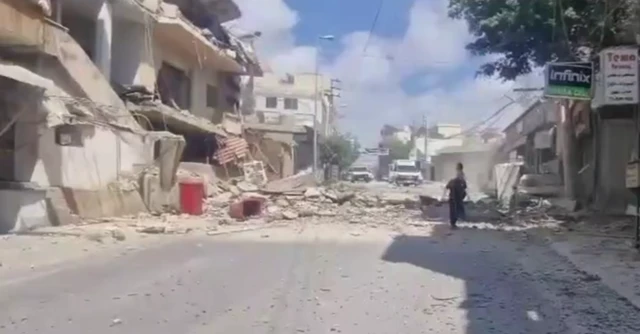
    The aftermath of an Israeli strike in southern LebanonImage source, Telegram

    By Kellie Highet and Kumar Malhotra

    We’ve verified two videos from today showing the aftermath of apparent Israeli strikes in the Tyre region of southern Lebanon.

    One was filmed from the port in Tyre and shows a large cloud of smoke rising up from elsewhere in the city. Buildings and other features on a jetty enabled us to confirm the location it was filmed from.

    Another video was filmed in Burj al-Shamali, east of Tyre, which shows extensive damage to buildings along one of its main streets. We matched some of the buildings to satellite imagery on Google Earth.

    As well as checking where the footage was filmed we also confirmed the videos were taken and uploaded today.

  19. Pictures show damage caused by missile strike in the West Bankpublished at 16:00 BST 8 June

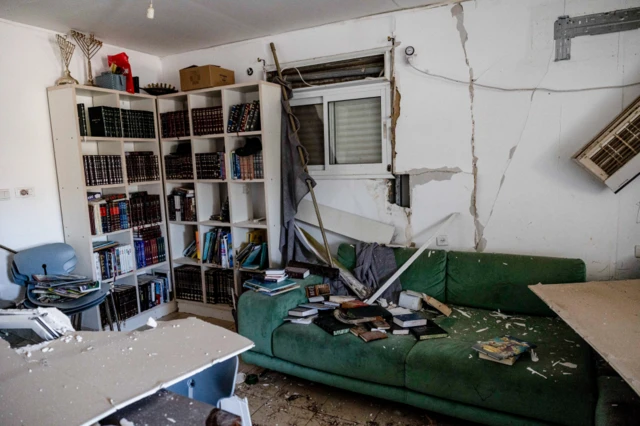
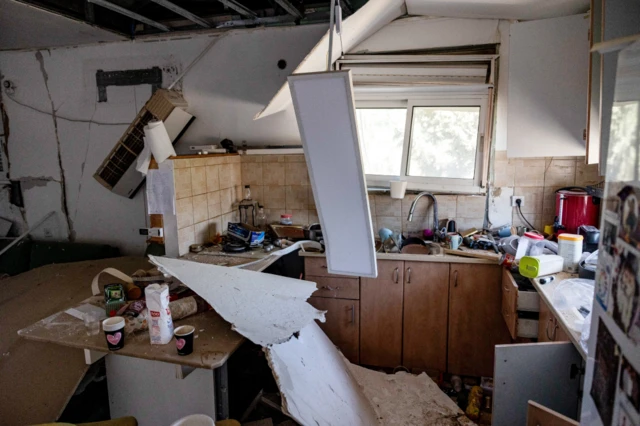
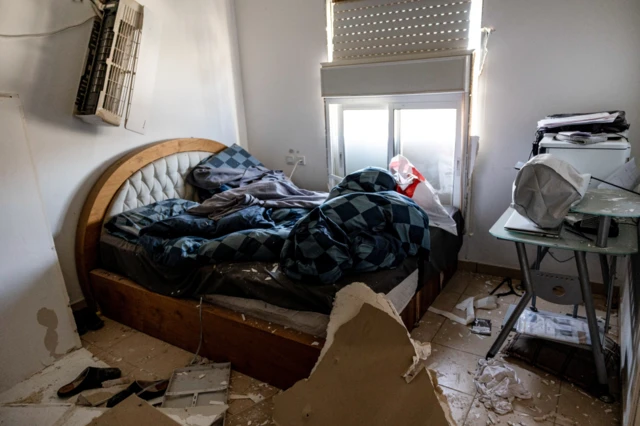
    We've received pictures from Reuters showing the damage caused to a building in an Israeli settlement in the Israeli-occupied West Bank.

    It comes after Iran launched missiles towards central and southern parts of Israel, which Israel says were intercepted.

    Books and other debris are scattered on a green sofa, which is next to a bookshelf, while large cracks have formed on a white wall in what appears to be a person's living roomImage source, Reuters
    A light is hanging from the ceiling above parts of broken plasterboard which have fallen from above onto a countertop inside someone's kitchenImage source, Reuters
    A wooden bed sits in the middle of a room which has been covered in debris and parts of plasterboard from the ceiling, while an electrical fan has been knocked out of place on the wallImage source, Reuters
  20. White House confirms Trump and Netanyahu callpublished at 15:47 BST 8 June

    Bernd Debusmann Jr
    White House reporter

    A White House official has confirmed to the BBC that President Trump called Netanyahu to discuss the Iran-Israel exchanges of fire.

    No further details have been provided.

    Earlier, Israel's Channel 12 news outlet reported that Israel would stop attacks on Iran "at Trump's request", citing a senior Israeli official.