Summary

Media caption,
BBC's Global Affairs correspondent on the US and Iran deal
  1. More world leaders welcome US-Iran dealpublished at 03:55 BST

    UN Secretary-General António Guterres has welcomed "the announcement that the United States and Iran have agreed on a peace deal".

    "This represents a critical step towards the peaceful settlement of the conflict," a spokesman said.

    Japan's Prime Minister Sanae Takaichi was among the latest group of world leaders to praise the deal.

    She says Japan "strongly hopes" that "free and safe navigation through the Strait of Hormuz will be ensured in practice, and that a final agreement on Iran's nuclear issue and other matters will be reached as soon as possible."

    Australia's Prime Minister Anthony Albanese says he hopes the deal will lead to a "durable and lasting peace".

    "While full recovery will take time, restoring this vital trade corridor is essential to easing pressure on energy prices and economies, including in our region," he says.

    New Zealand Foreign Minister Winston Peters said it was a "pivotal, constructive deal" and "a step towards reducing tensions and promoting stability in a region that is critical to global economic security".

    We heard before from the leaders of the UK, France, Germany and Italy.

  2. Analysis

    Oil reserves will not be replenished soonpublished at 03:35 BST

    David Waddell
    Business reporter

    It will take some time before global oil reserves recover.

    While some tankers are already positioned to sail straight back into the Gulf, many shipping lines are likely to wait for clarity on how the deal works in practice, and for signs of sustained de‑escalation.

    ADNOC, the UAE state-owned oil company, has suggested that full oil flows through the Strait of Hormuz may not resume until the first or second quarter of next year, even in the event of a firm peace agreement.

    In March, the International Energy Agency announced that its member countries would release 400 million barrels of oil from their strategic reserves. More than a third of that has already been drawn down.

    While producers will seek first to meet the global oil demand (around 104m barrels per day), it will take many months for those reserves to be replenished.

  3. BBC's Global Affairs Correspondent on the dealpublished at 03:16 BST

    The BBC's Global Affairs Correspondent, Sebastian Usher, talks through what we know so far about the initial agreement announced by the US and Iran:

  4. Analysis

    What the deal means for US and Iranpublished at 02:57 BST

    Tom Bateman
    US State Department correspondent

    This agreement was ripe for taking place.

    Donald Trump has been under growing pressure from the sustained hike in petrol prices which was feeding through to the highest inflation rate in the US in three years.

    Iran's economy was being throttled with long-term sanctions currently tightened by the US naval blockade of its ports.

    Both sides needed a reprieve.

    The deal's priority is to extend the 8 April ceasefire in time and scope – another 60 days pledging no hostilities, lifting the US blockade in return for Iran relinquishing its grip on the Strait of Hormuz, while both sides commit to talks.

    We don’t have the text yet but on the basis of how the deal was being briefed by the administration late last week it does not solve in any conclusive way the issues that apparently motivated Trump’s attack in the first place, nor those which drove Iran’s aggressive retaliation.

    To get to something each side can sell as a victory, Trump needs a long-term (at least 20 years), verifiable prohibition on nuclear enrichment by Tehran.

    Iran needs comprehensive sanctions relief and access to tens of billions of dollars in frozen oil revenues. Those issues and their sequencing have always been core sticking points.

    While the deal may contain commitments or "understandings" to talk further about, it does not, as far as we know so far, meaningfully agree on them.

    And that's before even mentioning the demands of Israel and hawkish Republicans in Washington that a final deal must also tame Iran's conventional weapons programme and the funding of its armed allies in the region.

  5. Former US officials weigh in on deal between US and Iranpublished at 02:29 BST

    In announcing the memorandum of understanding between the US and Iran, all sides are "frantically trying to spin the text to make themselves look like the victor" says Andrew Peek, a former Deputy Assistant Secretary for Iran and Iraq at the US Department of State.

    Speaking to the BBC, he said he thought all sides had "something to be happy and unhappy about".

    Iran will be pleased with the inclusion of Lebanon in the deal, said Peek, while the US would be happy that there was no mention of tolls for ships travelling through the Strait of Hormuz.

    Barbara Leaf, a former Assistant Secretary of State for Near Eastern Affairs, told the BBC that the "big get" of the new deal between the US and Iran is "restoring the status quo".

    She accused the Trump administration of "mincing around, using a lot of wordplay to suggest that what is not going to happen, is actually going to happen", pointing to the unfreezing of Iranian assets as a key example.

  6. Almost 15 hours of talks led to agreementpublished at 02:12 BST

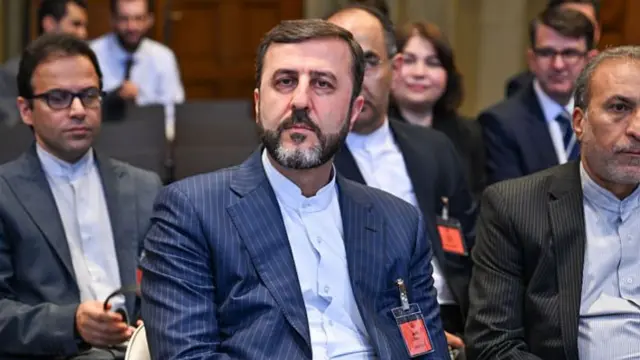
    Iran's deputy foreign minister Kazem Gharibabadi wearing a pinstripe suit, sitting in a room with other men in suits around himImage source, Getty Images

    Iran's deputy foreign minister says Qatari mediators held "nearly 14 to 15 hours of lengthy talks" in Tehran to reach an agreement on a draft memorandum of understanding between the US and Iran.

    ”This negotiation process took a long time," Kazem Gharibabadi told Iranian state media on Monday.

    "A Qatari delegation was in Tehran yesterday to finalise discussions on the text of the Islamabad memorandum of understanding between Iran and the United States.

    "Nearly 14 to 15 hours of lengthy talks took place, during which we presented the Islamic Republic of Iran’s final amendments to the text. Naturally, those amendments were accepted, and the text of the Islamabad memorandum of understanding was finalised.”

    The deputy minister said talks on a final deal will happen over a 60-day period where Iran has "several issues to address" with a top priority being the lifting of all sanctions against it.

  7. Analysis

    Measuring 'the deal'published at 01:56 BST

    Frank Gardner
    Security correspondent

    Anything that frees up the Strait of Hormuz is bound to be welcomed, not just by the global shipping industry and the wider world economy but by Iran too.

    The Islamic Republic has been trying hard not to give Donald Trump the satisfaction of knowing how much his naval blockade of its Gulf ports is hurting, but the damage to Iran’s economy has been huge.

    Yet the real measure of any "peace deal" is what has or has not been achieved after this war began on 28 February.

    Because up until that date, Gulf oil, gas, fertiliser, helium and everything else was flowing unobstructed through the Strait. Any deal that restores that flow is simply undoing the damage caused by this war.

    Beyond that, the real long-term test will be to see if, as the US President claims, the danger of Iran developing a nuclear weapon has really been reduced.

    Or, as some fear, whether the newly emboldened hardliners in the Islamic Revolutionary Guards Corps (IRGC) will now secretly try to race for a bomb as their best defence against being attacked again.

  8. US naval blockade to be lifted in 30 days, Iranian media reportspublished at 01:42 BST

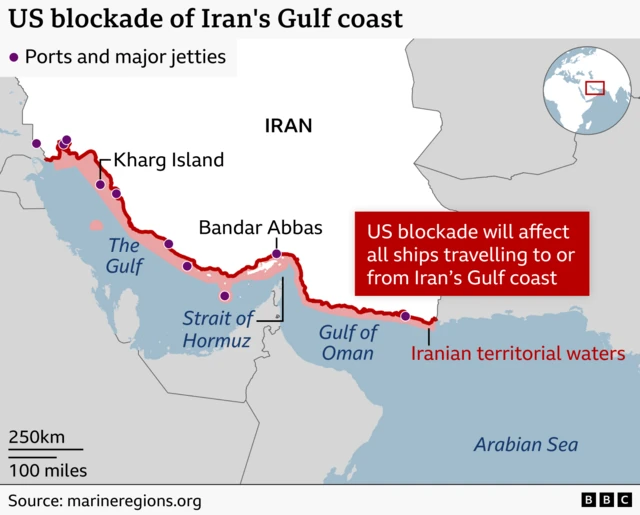
    As we reported earlier, Iranian state media says that one of the points included in the memorandum of understanding is the lifting of the US naval blockade within 30 days.

    The US military has been blockading Iran's ports after Tehran effectively closed the busy Strait of Hormuz through which about 20% of the world's oil and gas supplies are usually transported.

    Centcom says it had disabled nine vessels and redirected 135 more since since the blockade began on 13 April.

    Map titled “US blockade of Iran’s Gulf coast” showing Iran’s southern coastline along the Persian Gulf, Strait of Hormuz and Gulf of Oman highlighted in red to indicate a blockade. Iranian territorial waters are shaded, with a caption stating “US blockade will affect all ships travelling to or from Iran’s Gulf coast” Ports and major jetties are marked with purple dots, including Kharg Island and Bandar Abbas. Surrounding seas are labelled, including the Arabian Sea, and a distance scale, source credit, and BBC logo are visible.
  9. US senator 'somewhat concerned' by Iran's interpretation of agreementpublished at 01:26 BST

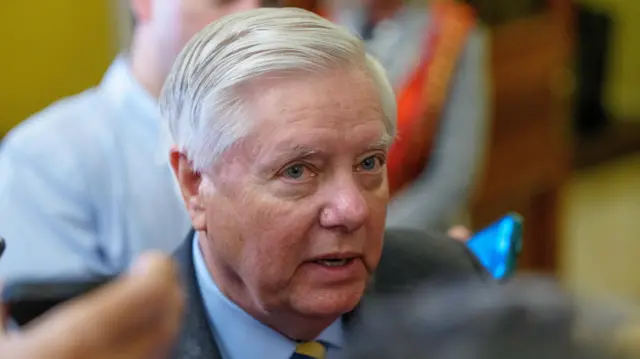
    US Senator Lindsey Graham says that while he is "pleased" that a memorandum of understanding between the US and Iran has been agreed, he is "somewhat concerned" that "Iran’s view of the agreement seems different than what the American negotiating team is claiming".

    In his post to X, the Republican senator said he would be watching the ensuing negotiations "closely", and looked forward to reviewing "the final product" in Congress.

    Graham wrote: "Congratulations to all in getting us to this point. Time will tell."

    Senator Lindsey Graham speaks to reporters outside the Senate Chamber of the Capitol Building in Washington DC on 19 November 2025.Image source, EPA
  10. Trump tells New York Times that Strait will be 'permanently toll free'published at 01:12 BST

    The US president gave an interview to the New York Times on Sunday afternoon, in which he says the agreement with Iran ensures the Strait of Hormuz is "permanently toll free".

    In what the paper says was a 28-minute phone call, Donald Trump also said that if Iran fails to reach a final nuclear accord with the US he would restart military attacks, or make the US "the guardian of the Middle East" in return for a fifth of the region's revenue.

    He remained steadfast in his previous assertions that the decision to attack Iran in February, and his subsequent naval blockade of its ports, has "remade the Middle East in America’s favor".

    It is not clear whether the president had spoken to the outlet further following the announcement of the deal between the US and Iran.

  11. Oil prices fall 3.8% after US-Iran deal announcedpublished at 01:01 BST

    Oil prices in early trade in Asia have fallen off the back of a US-Iran deal under which the Strait of Hormuz is set to be reopened.

    Brent crude, the global oil benchmark, was 3.8% lower at $84.02 (£62.48) a barrel, while US-traded oil was down 4.1% at $81.40.

    Pakistan says the agreement will be officially signed on Friday in Switzerland while US President Donald Trump has posted on social media about the deal, saying "oil will flow".

    The strait had been effectively closed since shortly after the US and Israel launched airstrikes on Iran on 28 February.

  12. Analysis

    Uncertainty partially lifted but signing of deal still days awaypublished at 00:55 BST 15 June

    Sebastian Usher
    Global affairs correspondent

    For Iran's Arab Gulf neighbours, there will be a sense of relief that at least for now there could be an end to the threat of Iranian missiles targeting them - a tactic that has raised questions about the very nature of the economic model followed by the UAE, Qatar and Saudi Arabia.

    As for the most essential element of any deal from the US perspective, it's unclear for now how far this agreement goes in providing guarantees and mechanisms that will prevent Iran from ever developing a nuclear weapon.

    That was the danger that the US and Israel said they were tackling in going to war.

    There are indications from what the Iranian media has reported to be in the deal that such a mechanism may have been set up, but that will need to be clarified and is likely to be the subject of intense negotiation after the deal is signed.

    That ceremony is still several days away.

    With all the dramatic twists and turns that this process has taken over recent weeks, no-one can be sure that the path towards that day will be straightforward.

    But for now, some of the uncertainty over the conflict – which for weeks had wavered between ceasefire and military confrontation – has at least been partially lifted.

  13. Analysis

    Respite for Lebanon unclearpublished at 00:47 BST 15 June

    Sebastian Usher
    Global affairs correspondent

    Finally after what has seemed like countless false starts, a deal has been agreed by the US and Iran.

    Both sides have predictably claimed victory. Donald Trump has boldly declared: "This Great Deal will bring Peace and Security to the whole Region." Iran's deputy foreign minister Kazem Gharibabadi hailed what he called his country's military achievements.

    All sides, and mediator Pakistan, say the deal will see the lifting of Iran's closure of the Strait of Hormuz and the US blockade of Iranian ports, although this may not be immediate.

    That will go some way to relieving pressure on Trump over the harm to the global economy caused by the former, while Iran's collapsing economy will gain some relief from the latter.

    Pakistani Prime Minister Shehbaz Sharif says the agreement also calls for the "immediate and permanent termination of military operations on all fronts, including in Lebanon".

    That could be a tall order.

    Israeli Prime Minister Benjamin Netanyahu has shown no sign so far of being prepared to end Israel's offensive against Hezbollah in Lebanon.

    Indeed, twice in just the past week, Israeli strikes on the southern suburbs of Beirut in response to Hezbollah rockets crossing into northern Israel have come close to derailing the whole process.

    Iran only just pulled back from responding with another missile attack on Israel in order to get the deal across the line.

    It's unclear if the agreement will provide a respite to Lebanon, where two recent ceasefires have failed to take hold.

  14. Iranian state media reports 14 points of memorandumpublished at 00:30 BST 15 June

    Iranian state media is reporting what is says are the draft details of a 14-point memorandum of understanding between the US and Iran.

    The specific points have not been officially confirmed by either country.

    Mehr News Agency, a semi-official Iranian state news outlet, says the points include:

    • A permanent ceasefire on all fronts, including Lebanon
    • US commitment not to interfere with Iran's internal affairs
    • Lifting of US naval blockade within 30 days
    • US withdrawal of forces from Iran
    • Reopening the Strait of Hormuz within 30 days "under Iranian arrangements"
    • The US and its allies delivering reconstruction plans for Iran worth at least $300bn
    • Ending sanctions on Iranian oil and energy products
    • Reiteration of Iran's commitment not to produce nuclear weapons
    • US commitment not to increase its forces in the region and not impose new sanctions

    Mehr also reported that "final negotiations will not begin before half of Iran's frozen funds are released, Iran's oil sanctions are suspended, and the naval blockade is lifted".

    It said the final agreement would be approved by a UN Security Council resolution.

  15. UK, France, Germany and Italy welcome peace deal to 'restore regional stability'published at 00:18 BST 15 June

    In a joint statement about the deal, the leaders of the UK, France, Germany and Italy say they will work closely with the US, Iran and regional partners to "seize this moment".

    "We congratulate the United States, the Iranian government and all those involved, including Pakistan, Qatar and all other mediators, on this diplomatic breakthrough," the group, known as the E4, says.

    “This is a moment of opportunity to restore regional stability and stabilise the global economy."

    The leaders called for the agreement to be "implemented rapidly and comprehensively" and that the "urgent reopening of the Strait of Hormuz with unconditional and unrestricted freedom of navigation is essential".

    The group emphasised that Iran "must never acquire a nuclear weapon" and that they are "prepared to lift relevant sanctions in response to clear, verifiable steps by Iran on its nuclear programme".

    "We will work intensively with the US, Iran and regional partners to seize this moment, maintain momentum and achieve a long-term diplomatic settlement."

    The leaders also reaffirm their support to the "stability, sovereignty and territorial integrity of Lebanon".

  16. Analysis

    How quickly shipping will return to Strait of Hormuz remains to be seenpublished at 00:08 BST 15 June

    Jonathan Josephs
    BBC business reporter

    Donald Trump's post suggests that the Strait of Hormuz will reopen as part of what has been agreed with Iran.

    It’s a vital waterway for global trade - before the conflict 20% of oil and gas supplies flowed through the Strait.

    But it's likely to take some time before maritime traffic returns to pre-war levels because shipping companies will want to see that the deal is holding.

    The world's biggest shipping lines have repeatedly emphasised that the safety of their crews and vessels is their top priority.

    The first movements are likely to be eastwards so that the approximate 2,000 ships with some 20,000 seafarers can leave the Persian Gulf for the first time since the fighting began at the end of February.

    The most relevant precedent is the closure of the Red Sea route in the aftermath of October 7 attacks. After that it took the major shipping lines two years to start to phase in a return.

    It's likely the return to the Strait of Hormuz will be faster because it is more important to global trade and there is no alternative route.

    But how quickly that happens remains to be seen.

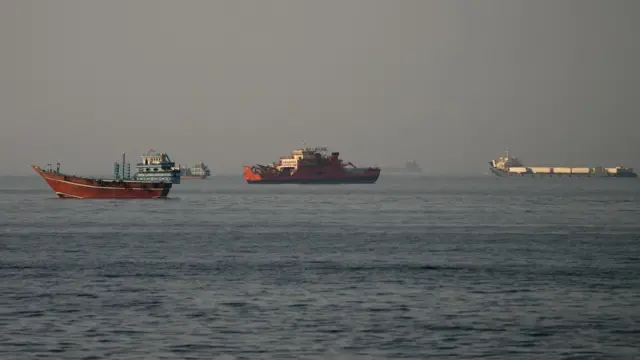
    Vessels at the Strait of Hormuz, as seen from Musandam, Oman, June 14, 202Image source, Reuters
  17. Macron says G7 leaders to discuss reopening of Strait of Hormuzpublished at 23:59 BST 14 June

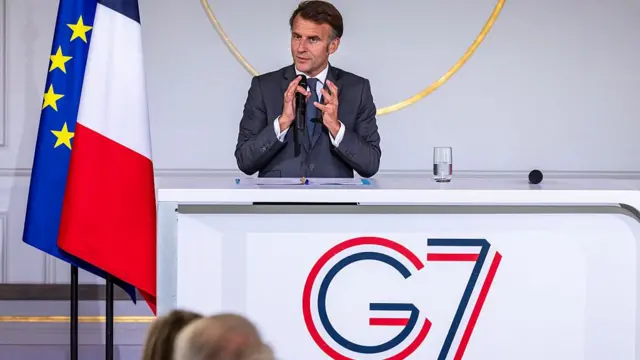
    Macron speaking into a microphone behind a white desk with "G7" written on itImage source, AFP via Getty Images
    Image caption,

    France's President Emmanuel Macron speaks during a 10 June meeting with leaders of the G7 Engagement Groups ahead of the upcoming G7 summit

    French President Emmanuel Macron says G7 leaders, who are meeting this week in the French resort town of Evian, will discuss the long-term reopening of the Strait of Hormuz as part of the US-Iran deal.

    "The aim will be to see the consequences of this agreement, support for Lebanon, the lasting reopening of Hormuz and of course the concluding of an accord on nuclear and ballistic activities in Iran," Macron said in a video on Instagram.

    Leaders from Britain, Canada, Germany, Italy, Japan and the United States are meeting from Monday 15 June for the three-day summit with other countries such as India and Brazil also taking part in the gathering.

  18. Iran top military command frames the deal as 'defeat' for US, Israelpublished at 23:51 BST 14 June

    Ghoncheh Habibiazad
    Senior reporter, BBC Persian

    Iran's top military command, Khatam al-Anbiya Central Headquarters, has said that Iranians, together with the country's armed forces and Tehran's proxies and allies in the region, have shown the US and Israel that they have "no option but to accept defeat and surrender".

    The statement is in line with the way Iran's state television has been trying to portray the deal as a victory for Iran. There had been mounting criticism within Iran from hardliners opposed to the deal.

    Some of those who criticised the deal accused Iran's foreign minister and parliament speaker, both of whom played key roles in the negotiations, of "betraying" Iran's late Supreme Leader, Ayatollah Ali Khamenei, who was killed in US-Israeli strikes on the first day of the war, on 28 February.

    Khamenei had said weeks before his death that negotiations with US were not "wise" and would not "resolve" the country’s problems.

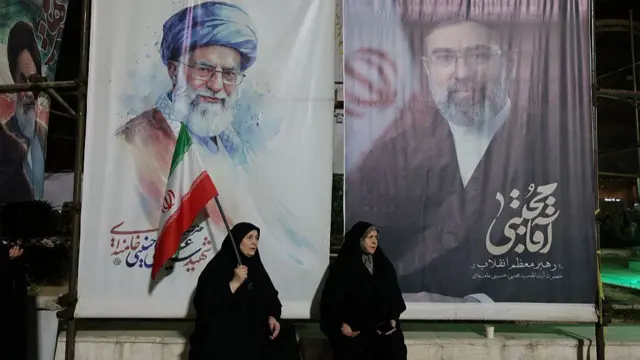
    two women sitting in front of large posters with the faces of Ali Khamenei and his son Mojtaba KhameneiImage source, AFP via Getty Images
    Image caption,

    A woman waves an Iranian flag in front of pictures of late Iranian Supreme Leader Ayatollah Ali Khamenei (left) and his successor, his son Mojtaba Khamenei (right) in Tehran

  19. Trump says 'oil will flow' once peace deal is signed on Fridaypublished at 23:42 BST 14 June

    US President Donald Trump has just posted again about the US-Iran agreement, saying he has succeeded where others have failed.

    "This Great Deal will bring Peace and Security to the whole Region," he writes on Truth Social.

    "Many presidents have tried to make Peace with Iran, and all have failed before me. The Leaders of the Region have, for the first time, found a President who can help them achieve real Peace.

    "With the opening of the Strait upon the signing of the Deal on Friday, for purposes of mine removal, oil will flow on both ends again for the Region, and the World!"

  20. Starmer describes deal as 'a hugely important step'published at 23:39 BST 14 June

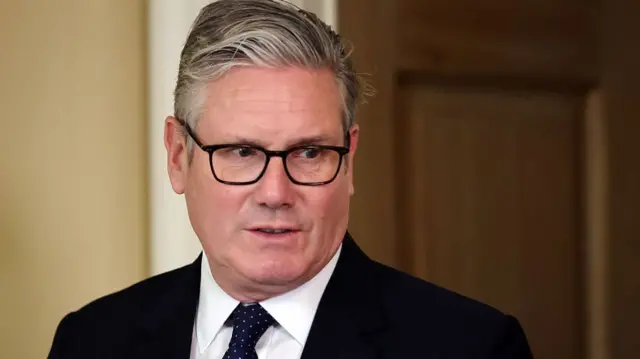
    close-up of Keir Starmer, wearing glasses and a suit and tieImage source, Bloomberg via Getty Images

    Responding to news of an Iran peace deal, UK Prime Minister Sir Keir Starmer calls it "a hugely important step forward in ending the war, ensuring regional stability, and re-opening the Strait of Hormuz".

    "I congratulate President Trump and the mediators from Pakistan, Qatar and elsewhere who have contributed to this breakthrough. We have long urged de-escalation and this is the progress we had hoped to see.

    "We are clear that toll-free freedom of navigation must now be restored in the Strait of Hormuz, to begin easing the severe economic impacts that have been felt for several months – on families here in the UK and around the world.

    "We will continue to work with partners to support this – including, if required, through standing up the defensive, independent multilateral mission which the UK and France have taken a leading role in planning up to this point, particularly to offer support on mine clearance in an agreed way.

    "For any peace to endure, it is essential that the commitments made, particularly in relation to Iran’s nuclear programme, are robust, verifiable, and fully implemented. It remains the UK's firm and longstanding position that Iran must never have a nuclear weapon."