Summary

  1. Analysis

    Is Nasa's Moon landing plan science fact or science fiction?published at 19:19 BST

    Pallab Ghosh
    Science correspondent

    The MoonImage source, NASA

    Nasa officials insisted today that the plan is still to land humans back on the Moon by 2028 as part of the Artemis programme, for which next year's Artemis III launch is meant to test various components.

    But the plan is already facing several hiccups.

    The private companies with which Nasa is partnering, SpaceX and Blue Origin, are way behind schedule in developing their lunar landers. SpaceX has not demonstrated its able to refuel its spacecraft in Earth orbit. And Blue Origin's launch pad blew up last month.

    But the message from spokespeople from both firms was essentially: "Don't worry, it'll be fine". But they gave no explanation of how they would catch up to be ready for even prototype spacecraft by next year.

    Nasa's head Jared Isaacman proudly proclaimed from the stage in Houston today that science fact was catching up with humans' imaginations, when he said "this seems like the beginning of Starfleet Command," a reference to the Star Trek franchise.

    But to many sceptics, Nasa's Moon timetable is still in the realms of science fiction.

    We're closing our live coverage of today's announcement, but you can stay up-to-date on the latest news here: Nasa names next astronauts for Artemis Moon programme
  2. Non-profit org The Planetary Society calls for more investment in space explorationpublished at 19:17 BST

    The world's largest space interest organisation, the non-governmental non-profit organisation The Planetary Society, called on the federal government to provide more funding for space exploration, in a statement issued on Tuesday during the announcement of the Artemis III crew.

    "Artemis stands as a testament to the achievements possible when America works closely with its allies in pursuit of a great challenge," Casey Dreier, The Planetary Society's space policy chief said.

    "Yet the agency faces some of its largest budget cuts in history, which undermine the very alliances, partnerships, and science needed to ensure our long-term success at the Moon."

    Dreier said the Artemis III announcement should remind the government of the cost of space endeavours, which includes "thousands of engineers, scientists, and technicians around the country and the world to make it all work".

    The Planetary Society has criticised Nasa and its funding levels under various presidents, including the Obama administration.

    It was founded by scientist Carl Sagan in 1980.

  3. How Artemis III's launch, tests and re-entry will workpublished at 19:03 BST

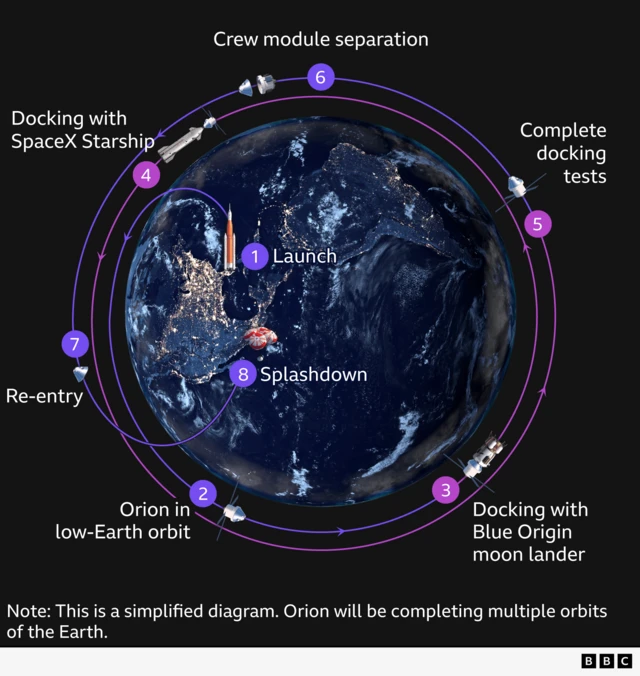
    A diagram of how Orion will meet up with other spacecraft during the Artemis III mission
  4. Artemis III will have no women on boardpublished at 18:56 BST

    Unlike Artemis II, when Artemis III takes off, it will do so without any women on board.

    It is rare for Nasa, but this upcoming mission will include four men.

    The last time that happened was in 2023, during a SpaceX mission that took four astronauts to the International Space Station (ISS).

    Since then, all other Nasa missions to the ISS have included at least one woman astronaut.

    Earlier this year, Artemis II had Christina Koch on board when that crew flew around the Moon and back to Earth.

    The Artemis programe is itself named after an ancient Greek goddess - the twin sister of Apollo.

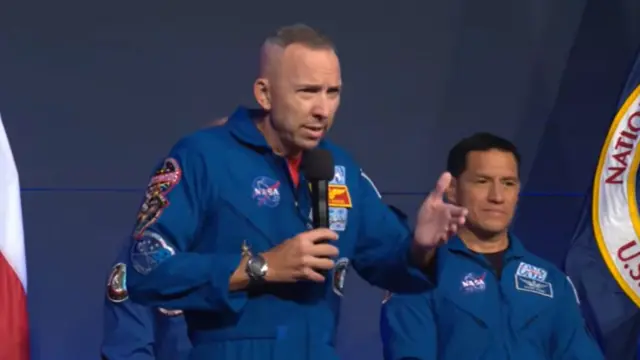
  5. Who is Artemis III commander Randy Bresnik?published at 18:46 BST

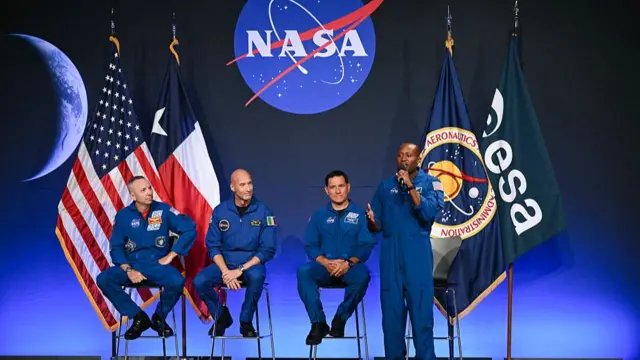
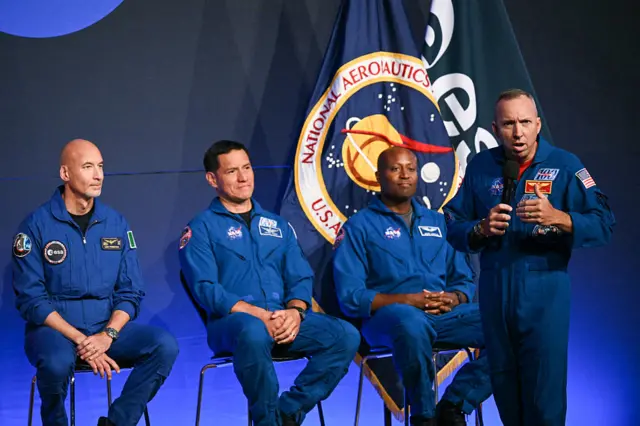
    Randy Bresnik on stage with the rest of the Artemis III crewImage source, Getty Images
    Image caption,

    Randy Bresnik pictured far right

    Randy Bresnik is the Artemis III flight commander whose lengthy trail of achievements includes 10,000-plus hours of flight time in over 95 types of aircraft and spacecraft.

    Born in Kentucky but raised in California, he earned a bachelor's degree in mathematics from The Citadel in South Carolina. He then joined the US Marine Corps in 1989. While there, Bresnik attended the Naval Fighter Weapons School - whose acronym is TOPGUN - and flew combat missions in Kuwait.

    He left the military, received a master's degree from the University of Tennessee-Knoxville, and was selected by Nasa as an astronaut in 2004.

    He has served as the lead astronaut on multiple space crews, including from 2012 to 2015 on the Dragon Capsule designed in partnership between Nasa and SpaceX.

    During his remarks on Tuesday, he thanked his family, including his wife, Rebecca, and said that "without their support and sacrifice, we would not be standing up here before you right now."

    He concluded by saying: "We will again be the first to land humans on another celestial body, that celestial body being our neighbour in the sky."

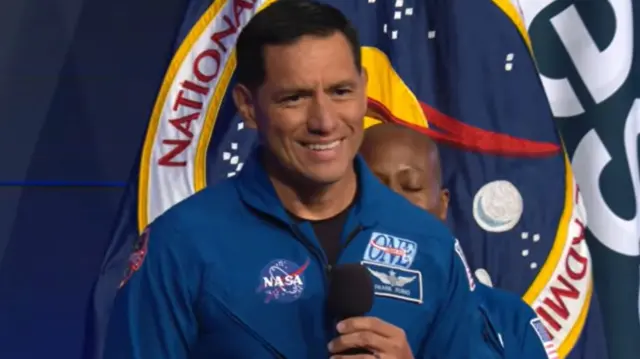
  6. Who is family medicine doctor-turned-astronaut Frank Rubio?published at 18:39 BST

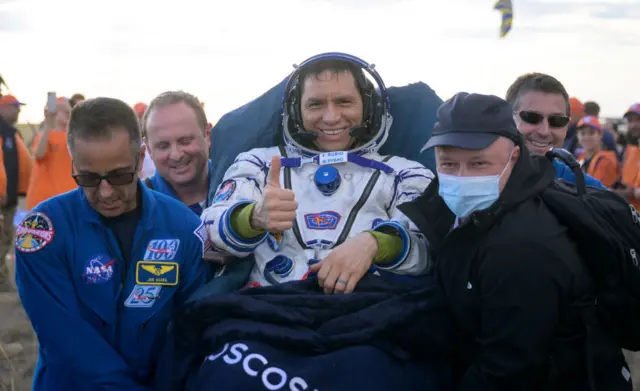
    Expedition 69 NASA astronaut Frank Rubio is carried to a medical tent shortly after he, and Roscosmos cosmonauts Dmitri Petelin and Sergey Prokopyev landed in their Soyuz MS-23 spacecraft on September 27, 2023 near the town of Zhezkazgan, Kazakhstan.Image source, NASA via Getty Images
    Image caption,

    Frank Rubio in September 2023 after spending a record-breaking 371 days in space

    Nasa just named Frank Rubio as a mission specialist in its Artemis III manned mission to the lower Earth orbit.

    Rubio, from Florida, is a Black Hawk helicopter pilot with several years of experience in the US Army, achieving the rank of colonel. He has logged more than 1,100 flying hours, according to his official Nasa biography and was deployed to conflict zones including the Iraq, Afghanistan and Bosnia.

    He trained to become a doctor while in the army and specialised in family medicine.

    Rubio joined Nasa's astronaut candidate pool in 2017.

    The Artemis III mission will not be his first time in space. In 2022, Rubio flew to the International Space Station where he broke the record for the longest single duration spaceflight by a US astronaut, spending 371 days on mission.

  7. A look back at the Artemis II missionpublished at 18:33 BST

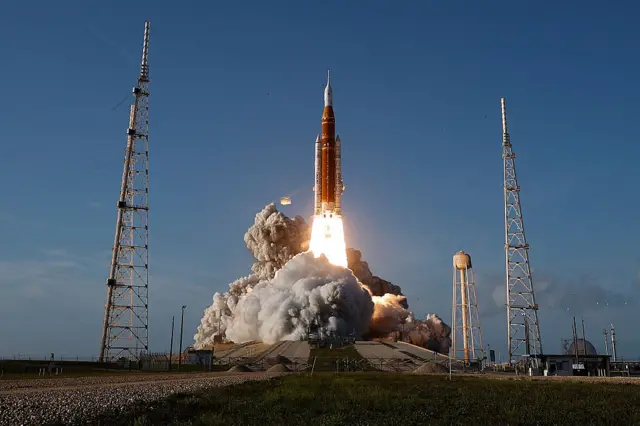
    NASA's 322-foot-tall Artemis II Space Launch System rocket and Orion spacecraft lifts off from Launch Complex 39B at Kennedy Space Center on April 01, 2026 in Cape Canaveral, FloridaImage source, Getty Images

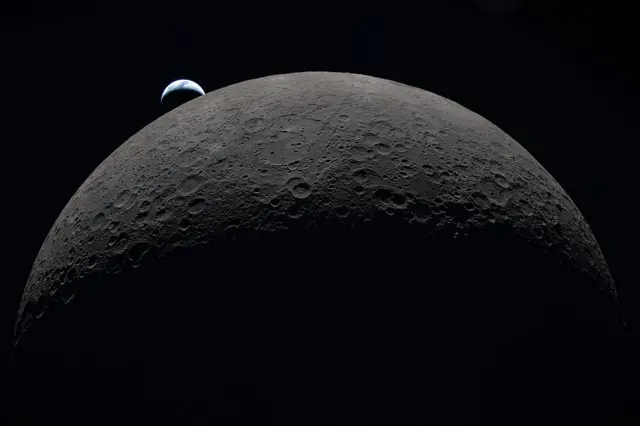
    In this handout image provided by NASA, Earth sets at 6:41 p.m. EDT, April 6, 2026, over the Moon’s curved limb in this photo captured by the Artemis II crew during their journey around the far side of the Moon.Image source, NASA via Getty Images
    Image caption,

    Moon’s curved limb with Earth in the distance

    NASA astronaut and Artemis II Commander Reid Wiseman peers out of one of the Orion spacecraft's main cabin windows, looking back at EarthImage source, NASA via Getty Images
    Image caption,

    Artemis II Commander Reid Wiseman looks at Earth from one of the Orion spacecraft's main cabin windows

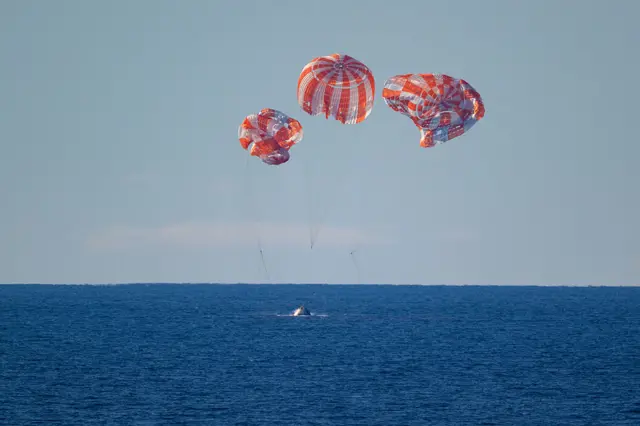
    NASA's Orion spacecraft with Artemis II crewmembers NASA astronauts Reid Wiseman, commander; Victor Glover, pilot; Christina Koch, mission specialist; and CSA (Canadian Space Agency) astronaut Jeremy Hansen, mission specialist aboard is seen as it lands in the Pacific Ocean off the coast of California.Image source, NASA via Getty Images
    Image caption,

    NASA's Orion spacecraft with Artemis II crewmembers lands in the Pacific Ocean

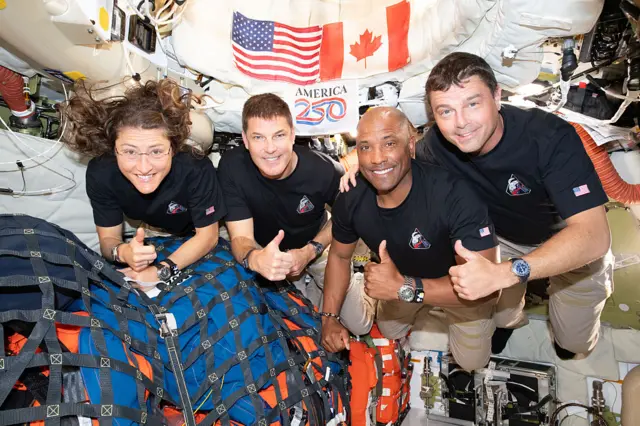
    The Artemis II crew pose for a photo with the US and Canadian flags behind them. Also behind them is a flag with "America 250".Image source, NASA via Getty Images
    Image caption,

    The Artemis II crew - Mission Specialist Christina Koch, Mission Specialist Jeremy Hansen, Pilot Victor Glover, and Commander Reid Wiseman - inside the Orion spacecraft

  8. Artemis III astronaut's colleague tells BBC he is 'just an amazing person'published at 18:29 BST

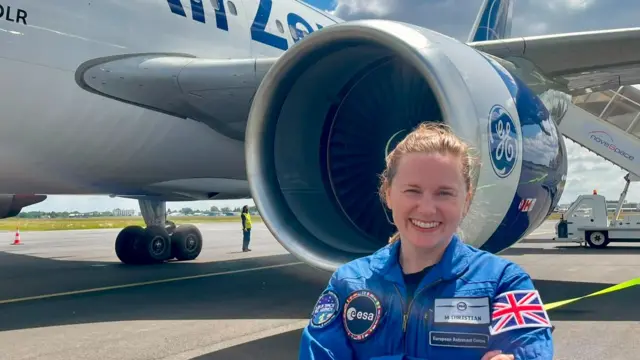
    BBC Outside Source radio has spoken to Meganne Christian, a Reserve Astronaut at the European Space Agency (ESA) and Senior Exploration Manager at the UK Space Agency - she knows one of the astronauts on the Artemis III mission, mission specialist Luca Parmitano

    "He's an incredible person," Christian tells the BBC.

    He was one of two Italians chosen for the 2009 ESA astronaut class, she explains, and began his career as a test pilot with the Italian Air Force - a position he still maintains.

    He's flown to space twice before, with a total of 366 days in space, she says.

    "He's had some interesting incidents," Christian recalls, referring to the time he nearly drowned during a spacewalk.

    "But all around, he's just an amazing person and I'm so proud that he gets to be in the Artemis mission," she says.

    Meganne ChristianImage source, Meganne Christian
  9. Analysis

    The cool new designer spacesuitspublished at 18:23 BST

    Pallab Ghosh
    Science correspondent

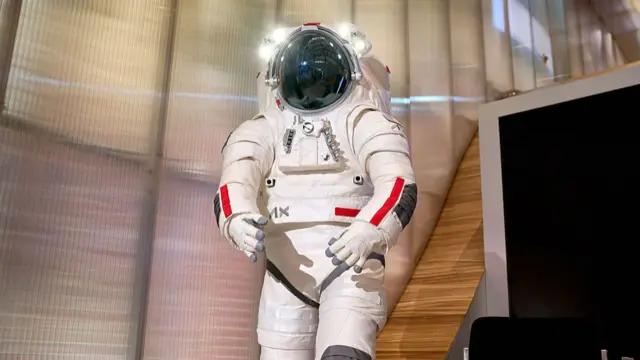
    Space suitImage source, Getty Images

    Nasa is designing new suits — formally called the Axiom Extravehicular Mobility Unit, or AxEMU — for its astronauts. They are being built by the Houston-based company Axiom Space in partnership with the Italian fashion house Prada.

    The outer shell, unveiled in 2024, is designed to survive the temperature extremes and micrometeoroid hits of the lunar south pole. On Sunday in New York, the two companies unveiled the inner layer: a Liquid Cooling and Ventilation Garment which the astronauts will wear directly against the skin.

    The engineering is Axiom's. Chilled water is pumped through a network of fine tubes woven into the garment to draw heat away from the body, while a separate ventilation network delivers oxygen to the helmet and carries exhaled carbon dioxide to a scrubber. The novelty is a redundant cooling loop: if the primary system fails on the lunar surface, a backup keeps the astronaut alive.

    Prada's contribution is the materials and the patternmaking. What looks like a single piece of fabric is in fact several yarns woven together in a way the fashion house developed using 3D modelling, intended to distribute the cooling evenly across the body and stay comfortable through spacewalks of up to eight hours.

    It is the same expertise Prada brings to high-performance sailing kit for the America's Cup — applied here to the problem of keeping a human being cool inside a pressurised suit on the surface of the Moon.

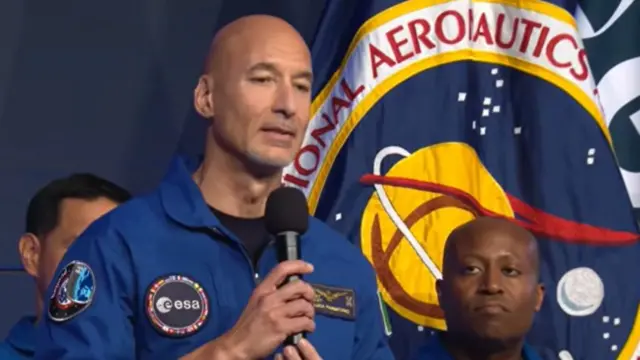
  10. Who is Luca Parmitano?published at 18:14 BST

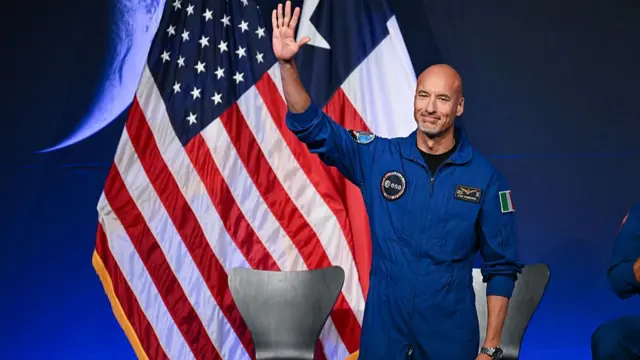
    Luca ParmintanoImage source, Getty Images

    Parmitano is the only non-American headed to space on the Artemis III mission.

    The Italian astronaut will represent the European Space Agency (ESA) after spending his career as a test pilot and colonel with the Italian Air Force.

    He has spent 366 days in space across two long-duration missions to the International Space Station, according to ESA.

    Among the things Parmitano is known for is a scary close-call he had in 2013.

    While on a spacewalk on 16 July 2013, Parmitano's helmet filled with water, nearly drowning him.

    The unexpected malfunction forced Nasa to abort the spacewalk in order to get him to safety.

    "[Parmitano's] calm demeanor in the face of his helmet filling with water possibly saved his life," members of the Mishap Investigation Board wrote in their report after the incident.

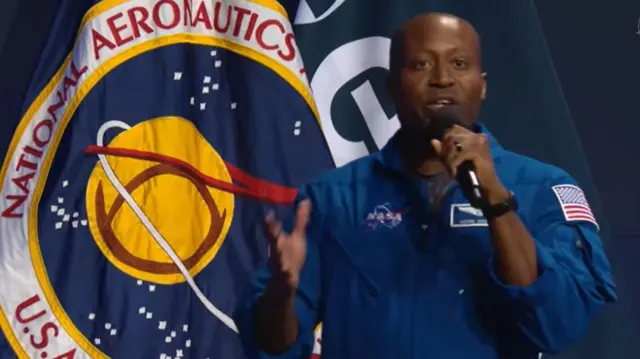
  11. Who is Artemis III crew member Andre Douglas?published at 18:08 BST

    Andre Douglas speaks on stage after being announced as the Artemis III mission specialistImage source, Getty Images
    Image caption,

    Andre Douglas pictured far right

    Andre Douglas - one of the four Artemis III crew members - will be making his first-ever space flight.

    He was given the role of mission specialist.

    Born in Florida but raised in Virginia, Douglas earned a bachelor's degree in mechanical engineering from the US Coast Guard Academy, then went on to earn three master's degrees, and a PhD in systems engineering.

    Douglas was invited by Nasa to join the 2021 Astronaut Candidate Class and reported for duty in January 2022.

    Part of his role was to identify lunar surface needs and recommend technology for development strategies.

    Douglas was among the most animated on stage on Tuesday, grabbing the baton presented by the Artemis II team - a symbolic passing of the torch - and pretending to run with it.

    He beamed with enthusiasm and gratitude.

    "My brain, it is going a mile a minute right now, but my heart, my heart, it is so warm, it is so full, and I can't thank everybody who's been along (on) my journey," he said.

    He thanked his mother, "for believing in me", his dad, "for the work ethic", and his "lovely wife" for her unwavering support.

  12. Who was the last person to set foot on the Moon?published at 18:00 BST

    Alison Francis
    Senior science journalist

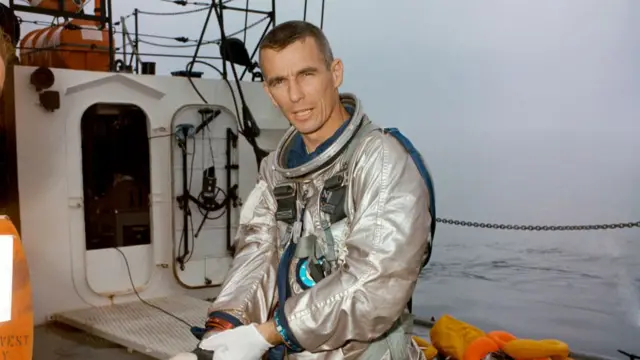
    Gene Cernan standing on deck of the NASA Motor Vessel RetrieverImage source, Getty Images
    Image caption,

    Gene Cernan

    The Artemis programme hopes to return human beings to the Moon - more than 50 years after we first set foot there.

    "As we leave the Moon… we leave as we came and, God willing, as we shall return, with peace and hope for all mankind. Godspeed the crew of Apollo 17."

    These were the words spoken in December 1972 by Commander Eugene "Gene" Cernan, the last astronaut to walk on the Moon, as he prepared to climb the ladder into the lunar module for the flight home.

    Cernan and his pilot Harrison Schmitt set several records during three days in the Taurus-Littrow valley: the longest stay on the Moon - 75 hours, the unofficial lunar rover speed record - 11.2 mph (18km/h), and the largest amount of rock-and-dust samples collected - 243.6lb (110.5kg), including some orange soil - small spheres of volcanic glass.

    Before leaving the Moon's surface, Cernan wrote his daughter Teresa Dawn Cernan's initials in the lunar dust. They're still there, undisturbed among the footprints and tyre tracks.

    Gene Cernan didn't know it would be more than 50 years before humans would make the journey back to the Moon. The next mission to land, scheduled for 2028, will be at a different location - the lunar South Pole.

  13. 'Pushing the boundaries of what's possible' - Johnson Space Center headpublished at 17:46 BST

    Vanessay WycheImage source, NASA

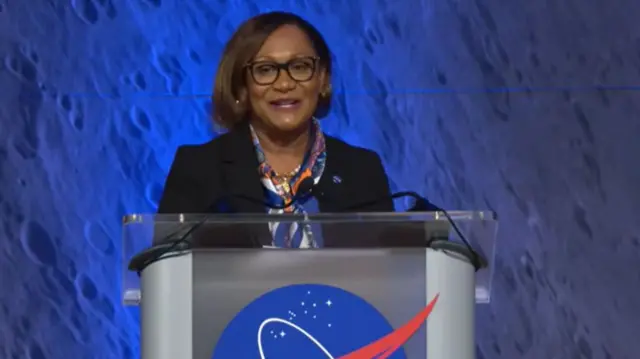
    Vanessa Wyche, director of Houston's Nasa Johnson Space Center, calls the newly announced Artemis III space crew forward to the front of the stage for a final round of applause.

    They stand cheerily, shoulder to shoulder, arms wrapped around one another, smiling upon the crowd.

    "As you prepare to embark on this next giant leap, know, we stand united, ready to support you at every turn with mission excellence, pushing the boundaries of what's possible for the benefit of all humanity," she says.

    And with that, the ceremony has concluded.

  14. US lawmakers praise Artemis missionpublished at 17:44 BST

    We are now hearing recorded messages from members of the US Congress.

    Up first is Texas Senator Ted Cruz, chairman off the Senate's Committee on Commerce, Science, and Transportation, who begins by congratulating the just named crew.

    "It is a big damn deal," he says. He says at a time of growing competition with China in space, "this mission will strengthen America's leadership, expand our economy, and help secure a lasting American lunar presence."

    "When America commits to a mission, we lead and we succeed," he adds.

    Representative Brian Babin of the US House Science, Space, and Technology Committee is up next.

    "Through your dedication, courage, and service, you will help open a new chapter in humanity's journey beyond Earth," he says. "Please know that you have the support of the American people," he says.

  15. Artemis II astronauts meet Artemis III crewpublished at 17:41 BST

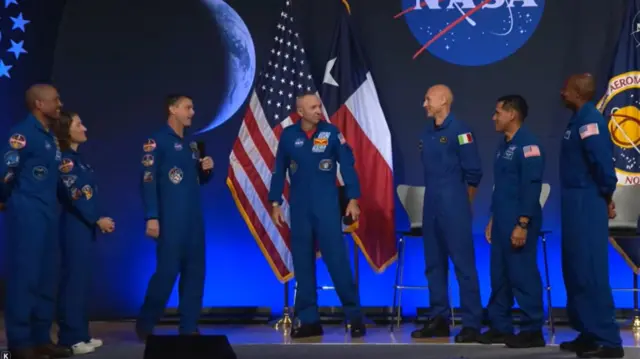
    Three astronauts from the Artemis II crew, who flew around the Moon earlier this year, have now taken to the stage to express their congrats.

    Reid Wiseman, the commander of Artemis II, says the group wanted say how "fired up" they were for Artemis III and handed Bresnick, the next commander, the baton.

    "You've got the controls," he says as the crowd applauds.

    Bresnick says he is touched by the symbolism, telling the Artemis II crew that they "inspired people worldwide".

    Then there's a moment of laughter when Douglas holds up the baton.

    Bresnick says they're happy to be carrying the fire to the next mission

    Artemis II and Artemis III astronauts meetImage source, NASA
  16. ESA director general praises Italian astronaut Parmitano's role in Artemis IIIpublished at 17:35 BST

    Josef Aschbacher, director general of the European Space Agency (ESA), heaps praise on Italian crew member Luca Parmitano and the ESA's partnership with Nasa.

    "I had the privilege of witnessing the launch of Artemis II," he says. "It was an unforgettable moment. Artemis III will be a different mission, but no less remarkable."

    To the crew, he says: "You will take a system of extraordinary complexity and make it work as one. In many ways you are unlocking the lunar landing itself."

    He then lists Parmitano's achievements, including being a colonel of the Italian Air Force and the father of two daughters. He also survived a situation where his helmet filled with water, a situation which Aschbacher says will allow Parmitano to bring "a touch of Italian ease to the cockpit"

    "To Nasa, to the United States of America. Thank you for your leadership and thank you for your partnership," he says.

    "To the crew of Artemis III, you carry something important for all of us."

  17. Randy Bresnick will command Artemis IIIpublished at 17:34 BST

    Artemis III Commander Randy Bresnick tells the crowd that the most important Artemis mission will be the next Artemis mission.

    Bresnick, who has been with Nasa since 2004, will lead the Artemis III crew in their mission.

    Randy BresnikImage source, NASA
  18. Artemis III astronauts Rubio and Parmitano speak nextpublished at 17:29 BST

    Frank RubioImage source, NASA

    Newly named Artemis III mission specialist Frank Rubio also thanks his wife, kids, friends, family, and the Nasa community.

    "You guys are the ones that make this happen, so thank you."

    Mission pilot Luca Parmitano, an Italian astronaut from the European Space Agency, takes the microphone next. He began by apologising in case he becomes emotional while speaking.

    "I am honoured by the role that I have been given," he says. "I am also very humbled by the task in front of us."

    He praises his Italian education and opportunities he received from the Italian air force, space agency and the European Space Agency that have helped him reach this milestone.

    Luca ParmitanoImage source, NASA
  19. Artemis III mission specialist Andre Douglas thanks familypublished at 17:21 BST

    Andre DouglasImage source, NASA

    Mission specialist Andre Douglas is the first of the astronauts up to speak.

    "My heart, it is so warm, it is so full," he says.

    He continues by thanking his parents and his wife, Rachel.

    "Mum, thank you so much for believing in me," he says before praising his father's work ethic.

    For his wife, he says: "I am so glad you are on this journey with us."

  20. Artemis III to be one of Nasa's most complex - director of flight operationspublished at 17:20 BST

    Norman D Knight, Nasa's director of flight operations, speaks after the Artemis III crew has just been announced.

    "I am excited to welcome you as the next crew in the Artemis journey to successfully return to the Moon," he says.

    "This mission will be one of the most complex that Nasa has undertaken, and we are counting on your courage and your dedication in fulfilling this critical role.".

    Knight also thanks the crew members' families who "allow us to accomplish these ambitious goals for our country and humanity".