David Tennant, Siobhan Finneran and Time series 3 cast and creatives discuss the powerful new story - "You’re not going be disappointed watching this one"
The third series of the BAFTA-winning hit drama is coming to BBC iPlayer and BBC One

Prison Chaplain Marie-Louise (Siobhan Finneran) comes to the young offender institution having lost her faith. When tragedy strikes in the prison, Marie-Louise clashes with veteran officer Bailey (David Tennant), a man in the midst of his own crisis. Bailey knows more about the circumstances that led to this major incident – but will he come clean before the guilt gets too much?
Meanwhile, two teenage young offenders, Peter (Ollie McNulty) and James (Louis McCartney), struggle through the terrifying first weeks and months of their incarceration. Can James ever face his broken parents after an unforgivable act of violence and will Peter tell the truth about the death of an innocent man, or does family loyalty mean more? An unlikely friendship between them looks to shift the trajectory of their futures, but in an increasingly unstable environment, is change ever possible?
Time series three (3x60’) is a BBC Studios Fiction production for BBC iPlayer and BBC One, co-produced by BritBox for North America, with support from Northern Ireland Screen. The series is written by Jimmy McGovern and Samuel Bailey, directed by Paul Whittington (Dear England, This Town) and produced by Amanda Black (Blue Lights, World on Fire). The executive producers are Josh Cole, Andrew Morrissey and Michael Parke for BBC Studios Fiction, Lucy Richer for the BBC, Jon Farrar and Jess O'Riordan for BritBox, and Jimmy McGovern. BBC Studios is handling global sales.
Watch Time series three on BBC iPlayer and BBC One on Sunday 11 October.
Episode one of Time series three will launch on BBC iPlayer at 6am on Sunday 11 October and on BBC One at 9pm. Episode two will follow on Monday 12 October, with episode three airing on Sunday 18 October.
The first two series of Time are available to watch now on BBC iPlayer.
MF3
Interviews with cast and creatives
David Tennant
Prison Officer Bobby Bailey
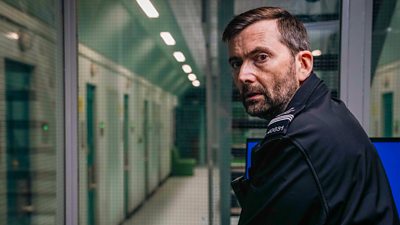
Can you tell us what’s happening in the series when we meet Bobby Bailey?
The series is set in and around a young offender institution where my character, Bobby, is an officer. We follow what’s happening to him both at the prison and in his home life. We also follow what’s happening to some of the inmates and find out about why they’re there and what’s going on in their lives. Something happens towards the end of the first episode and Bobby’s left in a position where he knows more than the authorities do. He has to reckon with himself as to whether it’s right to be honest and truthful or defend his mate.
Bobby is a complex character – can you tell us a bit more about him?
Bobby is written very obliquely and sparely in some ways. You build up who he is by lots of micro experiences of him. He’s very different at work to how he is at home. He’s holding secrets at work. He’s someone who, in some ways, has atrophied. His life was in a routine that he wasn’t particularly interested in challenging, but he has been forced to challenge it by circumstances, both domestic and professional. He’s forced into moments of crisis that he did not go looking for and doesn’t particularly thrive in, yet he is forced to move. I think that’s what Jimmy has always been famous for, he puts ordinary people in moments of extremis and sort of lets them be, lets them unfold. That’s what his work has always been for me, it’s the human experience kind of twisted and tested. That’s why a prison environment is such fertile ground for him because it’s people in a very unique, very difficult, very extreme situations. It’s like he gets humanity and puts it on a slow simmer and sees what happens. That’s certainly what’s happening to Bobby throughout this, the heat is just gradually being turned up and there’s nothing he can do to turn it back down again. From an acting point of view, that’s what’s appealing and exciting. That’s what draws you to a project like this. You’re telling a story that feels very relatable and rather panic inducing!
Do you think that Bobby is a good person?
I think he’s a very human person. He’s very explicable and easy to identify with. Sometimes he’s a very good man and sometimes he’s quite flawed. I think he has some very good intentions, but he’s also quite compromised. It’s very difficult to answer whether he’s good or bad – he's both, like all of us.
Time tells the human story of the people in these institutions, do you think things are elevated in a young offender institution?
Each series of Time has been very much its own thing – apart from Siobhan’s character, there isn’t really a link between the series other than it’s about life in prison – a male prison, a female prison, and now a young offender institution. They’re both similar and very different. The prison system is a necessary part of the justice system, but it’s often regarded as imperfect, and yet those working within it often have the best intentions. Clearly when you’re dealing with young men, boys, who are being excluded from society, being locked away, it’s particularly difficult to consider. They've done some very serious things and they’re paying the price for that, but I think it’s always important that, as a society, we look at what we’re doing – whether we’re doing the right thing and what it does to the boys we lock away.
Why is setting this story inside a young offender institution a compelling choice?
There’s something about it being boys who are not yet men, who are all potential, and that potential being incarcerated. There’s something very galling about that. It’s quite scary because there’s a lot of energy in that moment in a young man’s life, in a boy’s life. It’s all that potential and it’s bottled and contained, which doesn’t feel right somehow. There’s a real sense of danger in that.
The young actors are brilliant – can you talk about the dynamic working with them?
I think one of the most exciting things about this is some of the young actors that Amy Hubbard, our casting director, and Paul Whittington, our director, have found. It was a big old search and they found some actors who have quite a lot of experience, some lads who are absolutely brand new to it, others who are looking to go to drama school – all different stages of an acting career, yet they’ve come in with such enthusiasm and energy. They’re all so committed and full of life. Working in and amongst them has been quite humbling for me. It’s very moving to see what they’re all bringing to it, they’re all very individual. I think this is one of those series people will look back on in 20, 30 years – I’ll be long gone, I’ll be dust - but you’ll be going: ‘oh my god, that’s where he started! And him, and him, and him!’ I feel very proud to be standing alongside them. That will be the beating heart of the show, their performances.
How has it been working with Siobhan?
I’ve been a fan of Siobhan for years. We'd never worked together, our paths may have vaguely crossed at a do or something, but to get to work with her and to get to know her... She’s everything you hope she will be – as an actor, she’s sublime, and as a human, she’s hilarious. Siobhan Finneran, doesn’t disappoint. You can have that, Siobhan, you can put that on your CV!
Siobhan Finneran
Marie-Louse O’Dell
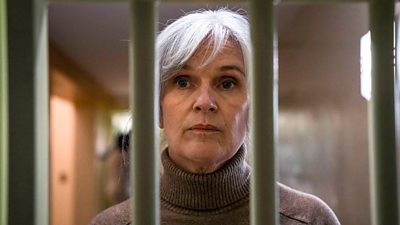
Where do we pick-up on Marie-Louise's story at the start of the series?
When we meet Marie-Louise at the start of series three she’s coming to start a new job, in a new place, but is carrying heartbreak with her. She still manages to do the job to the best of her ability - she’s still kind, non-judgemental and very supportive, to not only the young men, but the rest of the staff. She somehow manages to get on with it.
As the only actor who has starred in all three series, what is it about Jimmy's writing that draws you back in? How as Marie-Louise's character developed?
Well, I was blown away when I was asked to come and do the second one, so you can imagine how it was when they asked me to do the third one! I've been a fan of his most of my life. I think his writing feels really raw, but it's completely believable. It's always packed full of heart, isn't it? It's got a big beating heart going through it so that draws you in. He writes his characters so beautifully. I have to say, as an actor, if you get sent a Jimmy McGovern script, you've won the lottery! You read the first couple of pages and you're like, I'm already in. Marie-Louise still has the same responsibilities in terms of her role in the prison system, but what was only hinted at in series two – that she’s got her own personal problems and issues, on top of trying to carry out her job – we now see in series three. I just feel very lucky to have been in all of them and delighted that Jimmy and the other writers have wanted to develop her character throughout.
Have there been any particularly poignant conversations you’ve had when researching for the role?
For the first series, the production team put me in touch with a lady who worked as a chaplain in a prison. I found her incredible to talk to, she talked about the highs and lows of it, about working with people from different religions, all of that. But the one thing I took hold of and kept hold of is she said: “you will never not be needed in that job”. That's something that has stayed with me throughout filming all three series, that this is somebody in that position who is needed every day at work. As much as you're having to deal with really difficult situations, to know that you're going in to serve a purpose is a very good reason to get up out of bed every morning, isn't it? It's funny because since I've been doing this series, I've ended up in conversations, not in a research way, with different people who have worked inside the prison system. I remember speaking to one lady who said that somebody could come in struggling with addiction, go through a program in prison and get themselves back on track, but as soon as they come out of prison, if they've got to go back to the same area, the same house, the same place that they've grown up in where perhaps that addiction has started, it's very difficult for them to stay on track. That thought was in my head quite a lot doing this last series because it's young offenders. You really question how many young men are out there in the world and just taking the wrong path one day, right instead of left, they've got their entire lives in front of them and they’ve ended up in prison.
How does this series differ from the first two? Have you learnt anything new about the prison system this time around?
All of the series are heartbreaking, but I think this one feels harder because it involves young people. That’s not to take away from any of the devastating stories we’ve seen in series one and two, but these are young men who are only really starting out in life and they’re already in trouble. That’s what I’m finding upsetting about this one. What we cover in this series is the fact that these young boys are locked up for so many hours of the day. They haven’t got here because they’ve been behaving themselves, obviously, but it does feel like a very cruel way to treat somebody. I think, as human beings, we’re all very quick to judge somebody who is in prison.
Does it feel like a more volatile atmosphere in this series because the young offenders are kept apart?
I think if you go into the psychology of it all, if you’re going to keep somebody locked up for so many hours in a day, that anger, that hurt, that pain is going to come out if they’re released. It’s like being released out into the wild, isn’t it. I don’t know if this is the same in every young offender institution, but in the institution in the series, there’s a whole deal about boys coming from a similar postcode and how they shouldn’t be allowed to mix. It’s something that my character really finds shocking, and this is her line of work, so for her to find that shocking having worked in other prisons before... It’s a big thing.
Please could you tell us about the relationship between Marie-Louise and Bailey? How has it been working with David and the rest of the cast?
Marie-Louise and Bailey’s relationship is tense to say the least. He’s like Darth Vader with her! But she’ll crack him. What's fantastic about our characters is they are literally sparring partners from the get-go. Marie-Louise has no understanding of why this man cannot, will not, connect with her on any level. You've got two characters having the worst time of their lives in that prison with people who are also all having the worst times of their lives. It’s her nature to go, I can help you, I am here for you. But I think because there's so much going on, at times it's like, I can't deal with you as well as everybody else.
I've been watching David for years. My son was the biggest Doctor Who fan. We’ve had a great time, which sounds terrible given the subject matter, but it’s been amazing – with David, Dan Ryan and the boys. It was a really joyful job, even though the content's not joyful at all, I really loved working with them.
Please could you tell us about working with the younger actors?
It was a constant stream of chat! I absolutely loved them. I loved their energy, their enthusiasm. I loved that they really wanted to learn because, for a lot of them, it was their first time on set. It's really daunting because you've got a crew of, you know, even if it's 50 people, you're only aware of what about 5% of those people do. I thought they were all absolutely magnificent and really professional. I said to Paul [Whittington], the director, I'm gonna have to up my game!
Why is Time so powerful?
I think what's brilliant about the way that Time is written – and every single series has done this - we get to see some background so that hopefully, as an audience, you're not as judgmental as I think we all can be sometimes. I think sometimes we hear about a crime that's been committed and you do instinctively you go “oh, put them in prison, throw away the key”. Whereas what Time does brilliantly is it goes, just have a look at what was going on in this person's life before this happened. You've done something wrong, you should be punished for it, and there's a lot of cases in which that's right, but what I think what’s brilliant about Time is it says, just have a little longer look at this. We get to see in Time what's going on underneath the surface.
Daniel Ryan
Prison Officer Freddie Jennings
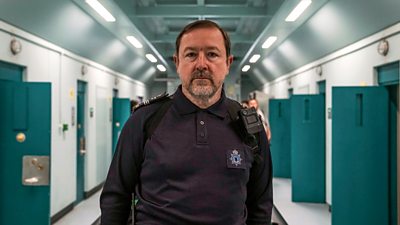
Please could you tell us what Time is about?
Time is a story about humanity, it’s set in a young offender institution and it shows our failures to look after our young people who are making terrible mistakes. It shows our failures as people trying to set them on the right path. If there is no path, where do they go?
Can you talk about Jennings’s situation at the start of the series?
Freddie Jennings is a hard-working prison officer, but I think like many people who have been in jobs for a long time, they can become as institutionalised as the place they work. He’s looking to the end of the career rather than at helping anyone get through their time locked up. Jennings isn’t strictly a bad person, I think he just wants to get through the day. There is respect from the lads who are locked up, but I think sometimes that respect has been won by means that you would certainly hope didn’t happen to your son in an institution like this. Conflict resolution is one of his specialities and he’s regarded as being good at that, but I guess we get a window into seeing how, if you don’t follow procedure, kids who are locked up for 23 hours a day will find a way of doing something that you hadn’t thought they would do.
What about the dynamic between Jennings and Bailey?
Jennings and Bailey aren’t a double act as such, but they’ve worked together for a long time. They know each other pretty well, but they’re very different people. Their concepts of how to rehabilitate and how to treat some of these lads come from very different places. I would say that Jennings is not the nicest of people, he makes an error that is the catalyst for the whole series, whereas I think there’s still hope for Bailey.
How does the young offender institution setting bring a different element to this series of Time?
I think having under 18s here will bring something very different to Time. The fact of the matter is, it’s Jimmy McGovern. We’d all run a million miles to do a Jimmy McGovern script. He doesn’t mess about, he doesn’t run away from the harsh realities, and he’s always got something to say and something for us to reexamine as an audience. I think that’s ultimately what Jimmy has shown through all three series, he’s a master of writing about human nature, forgiveness and hope.
What has it been like working with the younger actors?
The energy, enthusiasm and desire they have to tell the stories honourably has been brilliant to watch with these lads. There’s an energy you get – they don’t hold back. Take after take they are full throttle, they keep us on our toes as old lags! I’m feeding off their energy all the time. It’s a lovely reminder of the start of my career. I hope I haven’t done anything that’s going to make them take any bad habits into the rest of their careers, because they’re all going to have big careers!
If Jennings could say one thing to his younger self, what might he say?
Find another career. I think he might say that. He is cut out for the job, but there are times when people should leave the profession they’re in when they haven’t got any more to give. This is an environment where these lads need guidance, they don’t need to be locked away for 23 hours a day. The rehabilitation of these lads is paramount and they’re not getting it. I think that has jaded Jennings in his career.
What do you think audiences will take away from this series?
I think the two series that have gone before this one have been so moving and harrowing, a statement about the conditions that we find our criminals in in this country. You’re not going be disappointed watching this one. Jimmy’s brilliance at bringing humanity to the screen... no one does it like him. It’s probably more violent than the previous series because these institutions are places of violence. What you are going to get from it is a feeling that you’ve learnt something and been moved as only Jimmy McGovern seems to be able to do.
Louis McCartney
James
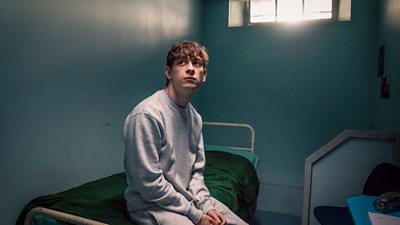
Please could you tell us about James and where we find him at the start of the series?
James has committed a terrible act of violence. At the start, he’s laughing and joking, but you learn throughout that that’s his way of coping, and you see him deal with the fall out of his actions, the consequences, the reconciliation with his family. He’s this iron wall of indifference, but we see these huge cracks form throughout the series. He’s patching them up, but they’re still there. There are moments of love and hope and you see the kid that he was before, but he’s just a mess. He’s feeling such extreme emotion.
What drew you to the character of James?
He jokes about everything and when you’re reading the scripts – I was talking to Paul Whittington, our director, about this and asking – which of it is actually true? What’s going on underneath? He’s probably dealing with anxiety, he’s probably lonely, dealing with his situation prior to the violent attack. Time series one is an adult male prison, series two is a female prison, and now we’re dealing with kids. It’s a totally different ball game. It’s so vulnerable and there are moments of hope. He just dances between all these different emotions as he’s trying to work out who he is. Meanwhile, David Tennant and Siobhan Finneran’s characters are trying to work with him, but disregard him when he’s freaking out and banging on the walls. It’s just this hotpot of emotion, it’s really interesting to work with Paul and dissect which bits are the real truth that are slyly, subconsciously coming out of him, or whether he’s messing with you and he wants a reaction, just to cope, just for some sort of distraction.
James has some huge chunks of dialogue, how was that to play?
It’s like a stream of consciousness. We did a scene which was just a handheld camera inside in the corner of the cell and they let us have free will with what we wanted to do. The props team and set designers were like ‘that’s breakable, you can touch that, you can throw that’ and then you do two or three takes. It’s human, it starts to not be acting. You’re given a space and you turn into this animal version of yourself where you’re using the lines as a backdrop for your emotion. That was such a release because there’s so much tension building and unresolved anger, so to let some of that out was really fun. The writing takes care of itself, it’s more in the actions, especially as we’re all getting to know each other. James and Peter have a friendship blooming throughout. You just start to create things because you have to world build, but you also like the guy you’re working with, so you want have fun with him.
Time shows people as humans, not just criminals. How does that evolve here?
When you’re young it’s all about status, it’s all about who you are and if you stand like this and talk like this. It’s about portraying the social ladder. It’s like a school, a school of criminals, you could say. These people are kids dealing with their actions, but trying to put a brave face on, all the while when they’re in bang up back in their cells and it’s just them in their heads.
How has it been working with David and Siobhan?
David is so talented. He’s so normal, he’s such a nice guy. And he’s fun! You’d think for a series like this it would all be big talks about the work, but you do a serious scene and he’ll look at you and pull a funny face and you realise it’s just a job. We’re all trying to do something authentic, grounded and heartbreaking, but at the end of the day it starts to be Louis and David. If I’m in a scene with him, it’s just two actors having a ball. He brings that familiarity to set every day and he always has a smile on his face. Siobhan is brilliant at being this light, when she says a line it’s like an exhale. It’s beautiful and she’s so good at that. She’s so nice and she means it in her eyes – she’s really listening to you on set or when you’re doing a scene, like the chaplain really would. I think Siobhan could be a chaplain in another life because she’s just the nicest person.
Chukwubuikem Molokwu
Christopher/Ushindi
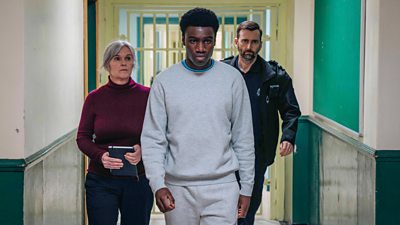
Please can you tell us about Christopher’s story?
Christopher is a teen who was abandoned at the age of around four by his mother. He can be defensive because he doesn’t know how to react when someone shows him attention or shows him they care for him. He didn’t have a role model, there wasn’t a father figure, and he didn’t have any siblings, or even friends really. He was very vulnerable. I think he’s a good-hearted kid and I don’t think he has any ill intent, so obviously gang members see someone who seems smart, but vulnerable. I think that’s how he got involved in the wrong stuff.
Can you tell us about the dynamic between the groups of boys in the series?
There are essentially two groups. There are the ‘bad kids’ - they want to fight people, they want to prove they’re ‘the guys’ in the prison. And then you have our group which is made up of the character I’m playing, Christopher, Jayden (Ethaniel Davy) and Jietang (Victor Zhao). I’d describe them as teens who are in prison not because they’re bad hearted, but because they just got involved in the wrong stuff. So that’s kind of the dynamic in the prison.
What’s the dynamic between the older and younger actors – have you learnt much from them?
It’s great. I had a really intense scene yesterday – we’d done a couple of takes but I felt it wasn’t going where I wanted it to go, so I asked Daniel Ryan who is obviously very experienced. He said ‘think about this, you could do it like this’ – not telling me what to do, but guiding me through it. For some of the younger actors, this is our biggest role, so getting to work with experienced actors such as David, Siobhan and Daniel... these people know what they’re doing, so let me learn from them and be professional.
How did you learn to stammer for the role?
Amy Morrison was my voice coach. We’d practise and practise because the main thing is stamina, it’s a physically tiring thing, you genuinely do feel tired. On set you have to be prepared to do the stammer over and over again.
Do you feel like Christopher is a good person?
I think Christopher is a good person. If you look at his personality, he does get aggressive, but not with people. He doesn’t want to harm people. I think you can tell from his character that he’s a good kid who has been put in bad shoes.
If Christopher could say one thing to his younger self, what would he say?
That’s an interesting question. I think he would tell himself that he’s a somebody. I feel like growing up he felt he wasn’t a person, he didn’t have any friends, he didn’t have family or siblings. And when you really put yourself in the character’s shoes, let’s say you’re walking down the street and you see a group of friends talking... he had no connection to that. I think as soon as he gets to learn more about his background and who is, then he gets to say, ‘oh, those people walking on the street who are talking to their friends, maybe I can have that, arguing with my siblings, maybe I can have that, a homemade meal, maybe I can have that too.’ I think he would tell himself that, because a younger version of himself probably didn’t know.
How do you think Time differs from other prison dramas?
It feels very real, the authenticity of the characters. When I read my character’s lines and I went through the storylines, not just mine, but Jayden, Jietang, Toby (Paul Smith Junior)... they feel like real characters. I don’t think I’ve seen that level of realism, which is something that’s exceptional about this versus other prison dramas.
Ollie McNulty
Peter
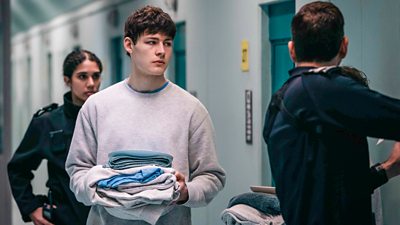
Please could you tell us about Peter, where do we find him at the start of the series?
Peter definitely had a rough upbringing – he grew up with heroin addicts as parents and most of his childhood was poverty and neglect, until his auntie took him under his wing and he lived with his cousin Toby. From then they were just like brothers, inseparable. But a series of bad choices led them and their two mates into jail. I think for Peter especially, the series shows that things aren’t black and white. It’s really complicated, especially when it comes to young offenders. There’s a lot of other factors that lead them to make the decisions that they make. I’d say for the most part Peter is a good person. He’s got a conscience that kicks in when things are going too far, but we’re seeing him at rock bottom.
How was it reading the scripts for the first time?
I read the script twice as soon as I got it. It’s a really intense script with so many different characters and sides of the story.
Could you tell us about the relationship between Peter and Toby?
One of the things that interested me the most about Peter’s character is this loyalty he has – he has this undying loyalty for Toby, for his boys, even when they’ve dragged him into a horrible situation. He does what Toby says most of the time, it’s been like that their whole childhood. That’s why it’s such a big deal when it comes to whether he tells the truth or not. Loyalty is survival. If he’s not got loyalty, if he’s not got his gang, he’ll get crushed in there.
Can you talk about the young offender institution setting – how is that for Peter?
There’s a lot of fighting and shouting and violence, it’s that kind of environment where you have to put on a front and be the ‘hard man’. I think in the rare moments where that’s stripped away and Peter has a chance to open up and talk about what he’s going through... that’s what hits the hardest, when he gets to show some vulnerability. It’s all this bottled-up emotion finally coming out.
How does this series differ from the first two?
The difference between this series and the other two is the exact same as you’re getting in real life. Adult prisons are violent places, but statistically YOIs have more assault, more self-harm... All prisoners are vulnerable in some way, but their age adds another layer of vulnerability.
Please could you tell us about working with David, Siobhan and Daniel?
It’s been amazing. I’m so lucky, the things that we’re learning. For example, how to switch it on and off. It’s mad how we can be having a chat and a laugh, but when it’s time to be professional, they can just switch into character. It’s great, I’ve learnt a lot.
Ethaniel Davy
Jayden

Please can you tell us where we find Jayden at this point in his life?
Jayden's caught in a really tough time of his life after losing someone very close to him in this hostile environment. He's had problems before and they’ve arisen again, so he's having to battle that in this new environment.
Please could you talk about the dynamics between the different groups in the young offender institution?
Jayden’s really close with Chris and Jietang in prison. They're his group, his comfort zone. And then the newcomers in the prison, Toby, Chaz (Jack Barnes), Mark (Finn Kearns) and Peter, they're on a different trajectory in life, I'd say. They're a bit more violent and hostile, bothering us a bit, and it changes the dynamic of everything. It’s two ends of the spectrum.
Please could you tell us a little bit about the dynamic between the prison officers and the young offenders?
That's one thing I love about this show. Even though the guards aren't the nicest to the prisoners, they have their own things going on as well. They're still human. They're not just caricatures, which flips it a little bit.
Can you please tell us about the young offenders about having to be locked away and the emotion that comes out?
I think it's because they're young, they've got energy and don't know where to place it. In the first two series, the people in prison are a bit more mature. But here, they're young, they're teenagers, and they don't really know what they're doing. They're not happy in the situation they're in, so they're just lashing out, whether it's at themselves or the prison guards or other lads.
How has it been working with David, Siobhan and Daniel?
It's been so lovely. All the young lads have had different trajectories in our careers so far, and there are a lot of us in our first roles. I've done a couple of things before this, but I'm not a household name or anything! Everyone has been so lovely from the get-go, so down to earth and willing to talk, so open and helpful. The main thing I've learned from the experienced cast members in Time is the balance of it all. We're doing such a tough project, the emotion... it's relentless and gritty. So when we're on our break and talking normally... It's easy to overthink and go into a bit of a rabbit hole thinking you need to stay in character to do the best job. But when you see David, Siobhan and Dan, they can turn it off, which is nice. The crew as well, it's just been a nice environment.
What do you hope audiences will take away the series?
I want the characters to feel real because everyone's got such different stories, everyone's going through so many things. So that's my main thing, the humanity in it, the honesty in it. For my character specifically, it's definitely the mental health side of things, and understanding where that comes from, especially in prisons. That is a massive thing that doesn't really get spoken about enough. Time is a story about real human beings, real stories, real struggles, and real conversations that need to be had in today's society. I think young lads have less opportunities to have passions now and socialise and make friends, so they make enemies online and whatnot. I'm fortunate because I’ve played football all for my life and acted, so I always had something to do. But I can imagine that if I didn't have that, I could have gone down the wrong path, like anyone could have. I think things could definitely be changed, opportunities could be opened for these lads, whether it be youth centres or more artsy things. I don't know... I think that's a major part of the whole conversation.
Jimmy McGovern (Writer)

What do you hope viewers will take away from this series of Time, which is set in a young offender institution?
I say the same thing I said about Time one and Time two: this must change. But because this is about young people, this must change urgently. These are young people, full of energy, who can't get out their cells. But all of them have got things to offer - train them, teach them.
There are a lot of individual storylines running throughout this series of Time – can you tell us about how they all come together?
We'd done pretty good stories about a male prison and pretty good stories about a female prison, but we went into our first young offender institution and honestly, we didn't have a single story idea at all. In the course of talking to people, somebody told a story about a young prisoner whose mother comes to visit him. The backstory was that it was the first time he'd ever had a visit from his mother, he wasn't born in this country. She comes and she cannot speak English and he cannot speak her language. That story was just told to us in passing, and from that story, everything developed. That story established every other story, it was such a wonderful moment to find that.
Lots of research has been done for the previous two series, but was there anything new you learned when researching this series of Time?
There was one overwhelming moment where I went into a cell – they don't call them cells now, they call them rooms, but they look like cells when you're in them – and there was a young boy there on the bed and he seemed so sad. I then got told, in his presence, that he killed somebody and he'd only recently been sentenced and obviously he was getting life. I remember kneeling down and talking to him and saying, “what's it like here? What are the officers like?” I remember him looking around like, am I able to answer this question? He was such a young man who could probably do 15 to 20 years, possibly even more. And when he should be looking upon life as a young man... It was overwhelming. That particular moment really sticks out. I always enjoyed having a chat to the chaplains. You'll often see them surrounded by people, people just want to talk to them and they seem to be at ease, which is a good sign, isn't it? I used to say about school teachers – you'll know a good school teacher when you cannot see them, they’re surrounded by kids.
Why do you think prisons and young offender institutions are such compelling settings for drama?
Things have changed over the years inside young offender institutions. There are fewer young people getting banged up these days, which is a good thing because prison does no good for anybody. On the other hand, those who are banged up, are often banged up for much more serious offences. These are not just scallywags, they have committed serious offences. The other thing that has changed is in the very recent past - we had COVID. That gave lots of prison officers, both in the male, female and young offender estates, the opportunity to see very little of the prisoners, to keep them all banged up and say it's for health reasons, you don't want the virus to spread... So you’ve got all these young men banged up for much more serious offences than in the past – they are full of energy and confined to these cells for many hours of the day. And on top of all that, you've got the keep apart system. If there’s the remote possibility of violence between two groups of young men, or between two young men, you kept them apart. They started using postcodes. So when people from one postcode were out in the fresh air for their one hour a day, nobody else was allowed anywhere near them. There might be four people and everybody else was banged up. I believe it suits a lot of prison officers very well, because there's only four people to look after now. There are officers who don’t support the keep apart system and they’re being told to enact it by their superiors even when they believe it is doing harm. In my opinion, what's going on in young offender institutions today is an absolute disgrace and why it's been allowed to continue for so long is beyond me.
Please could you tell us about working with Samuel Bailey, the co-writer on the series.
It was really nice because it wasn't the first time I'd met him. The first time came about because I got a phone call from Melvyn Bragg who runs the South Bank Sky Arts Awards [now the Sky Arts Awards] and this particular year it has been won by Sam Bailey for Shook, a play set in a young offender institution. So, we were looking for people who knew about young offender institutions and the name Sam Bailey came up, so I said, oh yeah, let's go for Sam. He wasn’t born with a silver spoon in his mouth, he's seen real life. I felt much more comfortable working with Sam because I think he captured the young voice.
Please could you tell us about David Tennant leading the cast for this series.
I think he's a great actor and he's done lots of interesting things in his career. He inhabits the roles superbly well, I think he's wonderful.
Please could you tell us about Siobhan returning for her third series.
I just love her to bits because she's one of the best actresses on the planet. But it's nice to be able to say a few of the things we've been allowed to say about organised established religion. You can argue that they do not do the work that God intended them to do because they are so wrapped up in institutional life. There's a basic thing that's wrong with our country and its institutions. We stumble upon a principle like love thy neighbour – be just, be fair, share things – and we build big institutions around them. We build the church, we build the justice system, and we get very proud of these big institutions, so we start to protect them at the expense of the principle. At the very end of the series, Marie-Louise says, “We will do the work of God and to hell with the bishops and their accomplices.” I think it's great that she can say that. She ends up more likely to do God's work than she ever was throughout the previous two series.
Can you tell us a bit about finding the younger cast members – what do they bring to the series and why is it important to give new actors these opportunities?
Well, it's always important to bring on new actors, isn't it? You want the industry to thrive, you always want young people coming into every aspect of the industry. I often get told I'm admired because I work with up-and-coming people, up-and-coming writers, but I always say I wouldn't do it unless I loved doing it. I love other writers, I hate working on my own! But I cannot claim finding the people we found – that was all down to Amy Hubbard [casting director]. What a job she did.
How does it feel when you watch your scripts come to life?
It's a strange thing. If you talk to the director, producer, etcetera, they will say it's frustrating to work with me because I simply sit down as a punter and watch it. I haven't got a pen and paper in hand or anything like that. I'll just watch the whole hour and I'll know whether I've enjoyed it or not. When I watched the first hour of this, I knew it was good. I always say, as a writer, when you walk on set, you've got two things to do: one, get in the way of everybody, and two, say the rushes are wonderful.
Could you please tell us about some of the brilliant actors from Liverpool and why it is so important to champion those voices?
They're just good lads. Bobby Schofield has set up an actor's workshop. I'm going there with Paul Smith Junior (Toby) – he's going to talk about his experiences on Time, and I can talk about my experience as a writer on Time. It's good to go down to those workshops, it's good for up-and-coming actors to meet people who've been in the game. I've been writing for something like over 46 years, it's just incredible that, isn't it? It is increasingly important to bring people into the business because what you want is a thriving television and film production sector, and how do you get that? You get that by bringing people in, training them, encouraging them. It’s essential for the industry to thrive, particularly in places like Liverpool, which has got a very vibrant TV production centre.
Samuel Bailey (Writer)
Please could you tell us about how you became involved in Time and what it was like working with Jimmy McGovern?
Jimmy presented me with an award for Shook which was a play that I wrote about six years ago set in a young offender institution. The first series of Time had just come out and we joked a little bit – I was like: “if you do another series, I'd love to...” And he said: “oh no, I think it might be a limited series, but maybe you've got some ideas.” I thought, well that's that, I've got to meet one of my heroes, what a lovely afternoon. The reason he presented me with the award was because during the whole process, they asked me who my favourite screenwriters were, and I said Jimmy McGovern because I'd grown up watching The Street, Moving On and Cracker. He was just a big part of my TV watching childhood really. The passion that comes across in his work is always very moving, so he’s been a dream to work with. It's my first proper TV job and I don't think you could ask for better. He's a great writer to work with, he knows so much about what he does, but he is also down to earth enough to know and admit maybe the things that he can't do, which is not always a given with somebody as experienced and brilliant as Jimmy. When I started, Andrew Morrissey (executive producer) said “you should feel quite honoured that Jimmy came down to present the award in London because there are two things that Jimmy doesn't like doing: public speaking and leaving Liverpool, so if he did those two things then he must think your play's alright!”
As you’ve said, Time isn’t the first time you've written about young offender institutions. Why did you want to return to this setting after Shook and why do you think they make such compelling settings for drama?
The reason I wrote about it then and the reason I'm interested in writing about it now is that I grew up with a number of young men who went to young offender institutions when we were teenagers. So it was an environment that I felt like I semi-knew, even though I'd never been there myself, and it was somewhere that I hadn't seen depicted. We've seen a lot of stuff in adult prisons, but a young offender institution was somewhere that I didn't really feel had been shown. I think there's a certain way that those young men are shown to be, and I wanted to try and show them to be more rounded. Yes, violent, yes, often in crisis, but also funny and warm and caring, and in need of affection and love and care themselves, wanting to show them as multifaceted as possible. It's a place where people live in extremes, especially when you put groups of young men together with their hormones raging, living in constant danger. One of the great questions is how you ever expect anybody to rehabilitate when they're living day-to-day in constant fear of assault. There are environments where there are a lot of people working to try and make these boys' lives better, but this is a very tough environment in which to do that. There's no perfect way of running these places, there's no perfect answer to an imperfect problem. But I think the way in which they're run now, keeping boys apart from each other and not socialising, keeping them locked up for so long, I don't know how you can ever expect them to re-assimilate into normal society after that.
Could you talk to us about some of the individual storylines and how they come together?
We're dealing with quite a few boys’ stories – we've got a group of four boys who are in on a murder charge. We've got James, a young man in complete crisis. He's a smart kid, he knows what he's done is wrong, but he can't admit it to himself. And then one of the stories that was quite personal for Jimmy is Chuk's character, Christopher. Christopher has a stammer and Chuk has done an amazing job of bearing the responsibility of that, something which is completely truthful to Jimmy. Living with something like that in a prison I think just makes the environment even more hostile and difficult. He’s also trying to form a relationship with his birth mother and there are a number of obstacles in the way. It's heartbreaking, Chuk is incredible. The boys are great, I could spend so much more time writing them. Then alongside them is David and Siobhan who you just can't take your eyes off. They're just so skilled. David's character is at the heart with a moral dilemma. Jimmy did a lot of the writing of Marie-Louise's storyline – Siobhan is such a brilliant actor and has been such a great thread throughout that we just wanted to make sure that she had as much screen time as possible. Part of it has been threading those stories together, making it feel cohesive and finding the balance of those stories and where those impactful moments can land.
Why do you think difficult moments and violence are important to be shown on screen for people to understand?
I had a friend who went to both a young offender institution and prison – when I was starting to write Shook, he told me that young offender institutions are way more violent. In prison, it can be quite serious – violent, but it's a lot less frequent and it's a lot more hidden, whereas in his experience of young offender institutions, it's usually groups of boys rather than one-on-one, and often groups on one person. They're often using weapons more than they do in male prisons and part of the reason that they do that is because there's a much higher ratio of staffing in a young offender institution. These young men know that the fight is going to get broken up quite quickly, so you need to get in and do as much damage as possible as quickly as possible. He told me that it’s something they call ‘ratings’, which I guess you can sort of loosely translate to reputation. It's very important to these young men, especially the ones who know that they will be going up to an adult prison, they want to be known as someone who is violent and not to be messed around with. It's important to show that for what it is. For us to judge them with our own framework I think is wrong because it's a different kind of environment and moral framework by the nature of where it is that they're living. For us to truly understand these young men, we have to know what it is that they go through, because if we don't see all that, then we can't ever really understand what it would be to change. These young men are often in crisis and it comes out through violence either enacted on others or themselves – it's not always violence towards another person, it can be turned inward.
Can you tell me about any research or poignant conversations you had whilst working on the series?
We visited some younger offender institutions and met a number of young men and had some great chats with them about where they came from. We were shown around by a prison officer who was very near to retirement, so he was quite open about his disillusionment with the job, but very insightful and had been there for a long time. We spoke to one person who didn't shy away from talking about some things that had happened to him. He'd look to the prison officer to see whether he was going to be allowed to say it, and the prison officer was like “That's your story, you're entitled to tell your side of things.” There was respect on both sides, you could see they had jokes between them. In that place, there was still warmth and connection and a sense of fun sometimes... The young offender institutions were eye-opening. You kind of can't quite put your finger on how it feels in the air, the tension and the noise of it. And the curiosity of the young boys – to us, the outsiders, they all wanted to know who we were and why were we there.
What do you hope audiences will take away from Time?
You want people to turn to each other and have a conversation about it. If all we're doing is punishing, then we need to question why we're doing it and to what end. I think a lot of what Jimmy does is to examine an institution, it's that socially conscious writing. So that would be my hope, that people turn it off and think about it, that they will be impacted and affected by it.
What has the BBC ever done for me?
Follow For More
Latest from the Media Centre
All newsSearch by Tag:
- Tagged with DramaDrama
- Tagged with Northern IrelandNorthern Ireland
- Tagged with Latest NewsLatest News
- Tagged with Media PackMedia Pack
