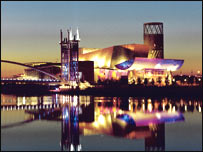
 | | The Lowry at night (pic: Len Grant) |
Greater Manchester’s industrial past is well documented, but the story of the region in recent times has been one of regeneration and reinvention, and nowhere is that better shown than down on Salford Quays at the Lowry Centre. The £106m art and theatre centre was opened in 2000. Housing two theatres, an interactive gallery and cafes, art shops and restaurants, it is a centre point of rejuvenation to an area that had seen massive industrial decline. How it came to beIt’s a far cry from the Quays’ beginnings. The docks were originally opened in 1894 by Queen Victoria, and standing off the busy Manchester Ship Canal, soon became Britain’s third busiest port. By the 1970s, all that had changed. The docks were struggling as the centres for trade shifted from the Americas to the Far East and the subsequent larger container ships were simply unable to reach the port. 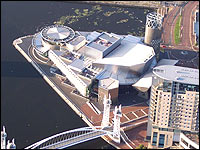 | | The ship shape from above (pic: James Anderson) |
In 1982, the last of the docks were closed and the area fell into severe decline, but all wasn’t lost. A year later, Salford City Council, having purchased the quays, launched a consultation on what to do with the land and the waterways. Private investment was found and the prologue to the area’s future was written. The infrastructure was improved, new buildings went up, and businesses moved to the area. What was missing, though, was a cultural side to match the growing commercial one. In 1989, an arts centre was proposed, though it would take another five years before its design was decided upon. That design is one that reflects both the area’s past and future. Contemporary and striking, with an aerofoil canopy at the entrance clad with perforated steel, Michael Wilford’s design actually takes its inspiration from a ship, its bow pointing out and down towards the canals that first made the area famous. 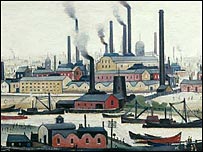 | | A Riverbank by LS Lowry |
As for its moniker, what else could they have called it? LS Lowry made his name painting the industrial landscapes and wearied people of Salford, the very things that originally stood on the site of the centre, so it was the famous painter who gave his name to the building. Indeed, it houses 55 paintings and 278 drawings by the artist, around a 100 of which are on display at any time. In the footstepsFor all its theatre productions, concerts, comedy gigs and exhibitions, what the Lowry strands for most is the great push to the future that Manchester and Salford have made. Since its opening, other major landmarks have appeared on the two cities’ skylines. 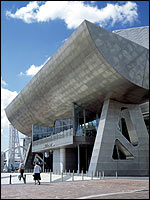 | | The Lowry's aerofoil (pic: Len Grant) |
Across the Quay from the Lowry, Daniel Liberskind’s Imperial War Museum North cuts a jagged vision, while elsewhere, the likes of Urbis, the City Of Manchester Stadium, a reinvented Piccadilly Station and most recently, the Beetham Tower have joined in a vision of the future as revolutionary as the industry that made this area a global destination in the first place. And still to come, there’s the UK’s first super-casino and the BBC-centred Mediacity:UK, which will join The Lowry Centre down on the Quays in 2012. Always innovative, always progressive, Greater Manchester’s story is less one of How We Built Britain and more one of How We Still Are. How We Built Britain starts on BBC One at 9pm on Sunday 3rd June. It comes to Greater Manchester in programme five of the series, The North: Full Steam Ahead, on Sunday 8 July. |