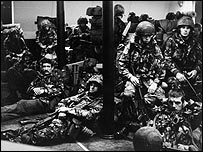
Why is it important for us to mark the 25th anniversary of the war?| The Falklands War | On 2 April 1982, Argentine forces overwhelmed the Royal Marine garrison in Port Stanley, the capital of the Falkland Islands. The retaking by British forces of these Islands, along with nearby South Georgia, was code-named Operation Corporate. 252 British and 655 Argentine servicemen died, as did three islanders, and over 10,000 prisoners of war were taken. |
"There are many reasons to commemorate this war, not least the loss of life and the scale of the achievement. War is the pursuance of political objectives through military means. It is the last resort. It is solemn and not celebratory, it is with great sadness that I look back at those events and consider our history, and hopefully learn a lesson from it. "The Falklands/Malvinas conflict is still with us, Argentina still makes a claim, but this war was not about geography but self determination liberty and the right to choose. For the Military Junta which 'governed Argentina' (and ruined it), the conflict was a misjudged act of national unity for a country which was economically and politically bankrupt; their situation was desperate and desperate situations often inspire desperate 'solutions'. "When established freedoms are threatened by aggressive military regimes, we have to make a stand and, in particular, we have to make a stand against fascist nationalist ideology." How do you feel about the war now?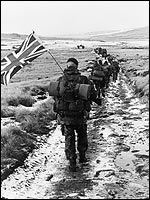 | | The Falklands Conflict, May 1982 © IWM |
"Uncomfortable. Sad." Would you ever like to return to the Falklands? "Sometimes I think it would be good to visit, but I'd like to sail there in a boat crewed by veterans of both sides, who are united by the ideas of reconciliation. I don't know how the islanders would feel about that, or the Argentineans, but perhaps there is a way, as human beings, that we can transcend history and build a better future." In hindsight, do you think that the war was right?"I do think that the principle of self determination is key here. Undoubtedly, the lives of the islanders have improved dramatically since the war and it's not a question of geography, but of democracy and sovereignty. | "I think it would be good to visit, but I'd like to sail there in a boat crewed by veterans of both sides, united by the ideas of reconciliation." | | Andy on his feelings about returning to the Falkland Islands |
"We have to defend our hard won democratic freedoms and resist the temptation to be ambivalent about the plight of others. I look on in horror at the terrible situation in Zimbabwe and would like to see an end to all dictatorship - unfortunately the world is still peppered with them and I am against them all. "So yes, it was very, very right for Great Britain to defend its democratic sovereignty. At the end of Bertolt Brecht's play, The Resistible Rise of Arturo Ui [a satire of the rise of Hitler], there is a little poem - 'Although the world rose up and killed the bastard, The bitch who bore him is on heat again'. "Brecht was right about Hitler, the world did rise up and get him out and his warning was right about the democratic vigilance and our moral and political obligations in the service of democratic values and visions." It's an unusual journey from serving in the war to being a playwright today. What took you from there to here?"I think it was the other way around. I think the writer in me took me round the world and via a war before I knew that I was a writer. A case of will before consciousness. "I believe that life is bit more effect then cause, rather than cause and effect. Aristotle talks about teleology [the philosophical study of finality in nature] - when you pick up an acorn, there is, held within it, the dream of being an oak tree. When I went to war, I was 19, and much more acorn than oak." Your talk discusses at the legacies of the war. What are the main ones?"Trauma. War is hell, let there be no doubt about that. There is a psycho-spiritual impact on the individual and archetypal upon a nation when we go to war. There is a terrible wounding that conventional medicine finds difficult to heal. The wounding to the psyche and to the spirit of the individual is what concerns and interests me, because of the profound ways in which it has affected my life. 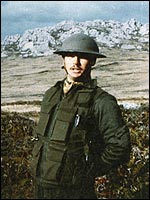 | | An Argentine soldier, May 1982 © IWM |
"Trauma is an interesting word because it means 'dream', so what is this dream that we keep having about war? How do we work with these historic ‘dreams’ to interpret them and salvage meaning, strength and healing from the narratives that we hold about ourselves, our county, our beliefs, the rationalisation of our actions and our (often clumsy) attempts to self-medicate through narcosis, the false wish to forget through drink and drugs? "There are some appalling statistics around servicemen/women and later civilian life. Homelessness, chronic drug and alcohol use, and, most alarmingly, a very high suicide rate. More British veterans of the Falklands have committed suicide than were actually killed in action. So what is going on and how do we as a society and as survivors assist those people who have suffered gravely?" What one lesson do you hope we have learned from the Falklands war? "There is no one lesson. Rather there is, as I see it, a whole matrix of learning around the Falkland/Malvinas conflict. We live in a complex and difficult world, a world torn apart by fighting and terror and brutality, and yet the world is all that we have and as unpopular is this may be, there is room enough for us all if we can find a way to transcend history and dream a better world in the future." Andy Farrell hosts a talk on The Falklands Legacy at 2pm on Sunday 8 July at the Imperial War Museum North's Learning StudioA Long Way From Home: The Falklands 25 Years On is at the Imperial War Museum North until Sunday 22 July |