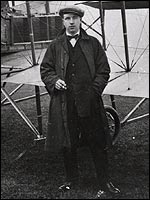
 | | John 'Jack' Alcock |
Born in Stretford in 1892, John, who was known as Jack, first became interested in flying when he was 17. Five years later, with the outbreak of the First World War, he flew with the RAF, achieving the rank of captain. He gained much valuable experience during the war, though he was shot down in a bombing raid over Turkey and taken prisoner. After the armistice, Alcock continued flying, finding work as a test pilot for Vickers Aircraft. It wasn’t long though, before he teamed up with navigator Arthur Whitten Brown, himself a Lieutenant in the RAF, to take up a £10,000 challenge posted in the Daily Mail newspaper in April 1919 to make the first non-stop flight across the Atlantic. Taking off into historyHaving sailed across to Canada, the pair took charge of a modified Vickers Vimy IV twin-engined bomber for their attempt and, at 1.45pm local time on 14 June, set off from St. John's, Newfoundland. 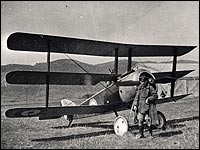 | | Jack with a Sopwith Triplane |
16 hours and 12 minutes later, the bomber crash-landed into Derrygimla bog near Clifden, in Ireland, having travelled 1890 miles. Thankfully, neither of the men were hurt in the crash, though the journey had not been without major dangers. Several times, the flight had been hit by engine trouble, fog and ice, with one particularly bad incident seeing the open cockpit fill with snow! It was only the combination of Brown climbing out on the wings to make repairs and Alcock's excellent piloting that led to the success. Their achievement saw the pair treated as national heroes. Not only did they win the prize, but they were granted knighthoods by King George V. And it wasn’t only Jack and Arthur who were honoured. On 15 December 1919, Alcock was present at London’s Science Museum to see the presentation of the recovered Vimy to the nation. Tragedy hits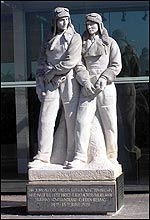 | | The statue at Heathrow Airport |
Sadly, it would be the last proud moment of Jack’s life. Three days after the presentation, he was flying to the first postwar aeronautical exhibition in Paris when he crashed his plane in fog near Rouen in Normandy, hitting a tree with one of the wings. The aviation hero died before medical assistance arrived, aged only 26. A memorial statue of both men stands at Heathrow Airport to celebrate their flight. There is also a monument at Manchester Airport, three monuments at their Newfoundland starting point and another at their landing point in Ireland. Jack's backIf you want to know more about Manchester flying star, Jack is being brought back to life by actor Lee Wolstenholme at the Museum of Science and Industry as part of a weekend of storytelling activities of heroes and heroines on Saturday 3 and Sunday 4 February. Alongside Jack will be another star of the sky, Lady Mary Heath (played by Sally Stevens), who was the first person to complete a solo flight across the length of Africa. |