Life Support
Hospital dramas on the BBC
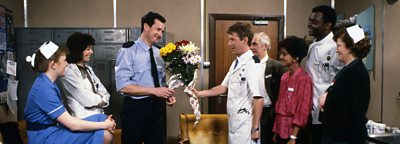

Casualty, the longest-running television hospital drama in the world, is forty years old – and still going strong - proof, not just of its own extraordinary success as ‘appointment viewing’ for millions of Britons, but of the enduring appeal of the medical drama as a prime-time television genre.
For Casualty stands in a long line of other drama series - some largely forgotten, others remembered fondly, yet more attempting to reinvent the genre for the twenty-first century. And all, in their different ways, have held up a mirror to the National Health Service itself.
Eastenders on Steroids
Casualty first went out at 8pm on 6th September 1986, sandwiched between The Russ Abbot Show and Saturday Night at the Movies.
BBC One on a Saturday evening was the most ferociously fought battleground in the Corporation’s ratings war with ITV. Only a year before, Eastenders had been launched to bolster the weekday evenings. Now Casualty was to inherit a slot vacated by the police drama Juliet Bravo.
In the opening episode we’re introduced to the night-shift turning up for work at the Accident and Emergency department of a hospital in Holby - a fictional version of Bristol. We get an early glimpse of the camaraderie - and the simmering tensions - which are typical of every workplace TV drama. But since the BBC’s new series was designed, as one of its makers put it, to be ‘Eastenders on steroids’, something more explosive was required from the start: in this case, an accident involving the leak of a toxic chemical gas. Which meant that a hum-drum evening was disrupted by a rush of critically ill patients arriving by ambulance:
The private life of characters like charge nurse ‘Charlie Fairhead’ was going to feature in every episode: relationships, drink problems, illness. So, too, would traumatic stories: a baby-snatcher in episode 2, domestic assault in episode 9, alcohol poisoning in episode 10. There’d also be quirkier incidents to leaven the plot: the macho man with the inconvenient boil, the older women who came to A&E as an anti-dote to loneliness.
The two writers of the series were Jeremy Brock, who worked as a junior script editor at the BBC, and an old university friend, Paul Unwin. They were young and inexperienced, but shared a love of American TV shows such as M*A*S*H and Hill Street Blues, admiring their free-wheeling ability to feature multi-strand storylines. It was these series that provided Casualty with the model for its ensemble acting. And if there was one theme that recurred more than any other in the BBC’s latest show it was this: the triumph of teamwork.
The Pioneers
Teamwork had also been at the heart of what might be regarded as one of the BBC’s earliest medical dramas: a one-off radio feature broadcast during the Second World War.
Blitz Doctors, made in 1941, portrayed what the Radio Times described as ‘Incidents in the life of the Emergency Medical Services in wartime’.

In Blitz Doctors, listeners heard a mobile unit coming to the rescue of people trapped in the debris of a bombed-out building in London, and eavesdropped on their treatment in hospital. Morphine is injected, gauze put over protruding bones, bleeding arteries tied-off.
The programme had originally been made for audiences overseas. The BBC knew it would be a hard listen. ‘The point we want to make is the minimising of horror by prompt blitz doctoring’, its producer Stephen Potter, explained, ‘therefore … there must be some horror to be minimised’. His editor agreed. ‘As far as horror is concerned, the more the better, particularly for the Americans’.
By the time the BBC launched its first big television medical drama more than twenty years later, the horror had been dialled right down. So, too, some of the wartime emphasis on teamwork.
In Dr Finlay’s Casebook, which began in 1962, viewers were taken back to the Glasgow of 1928, and the story of young Finlay, a man on the verge of completing his medical training.
In the opening episode Finlay shows the viewers just how good he is – and just how much he cares for his patients – when he diagnoses the mystery cause of a man’s limp:
Dr Finlay is very much the heroic male authority-figure: competent, correct in his judgments, kind. And although his casebook featured plenty of sensitive subjects, he invariably offered viewers a reassuring, even cosy portrait of the medical professional at work.
Yet even as it was being broadcast, television drama was undergoing radical change.
Just five months after Dr Finlay’s Casebook launched, the BBC appointed a new head of drama: the Canadian Sydney Newman, a man who described himself as ‘very much instilled’ with the traditions of documentary reality.
In this recently released interview from the BBC’s own oral history archive, Newman described his first impressions of the state of television drama when he first arrived:
It was under Newman that the BBC broadcast some of its most celebrated television dramas, including Up the Junction and Cathy Come Home – both emblematic of a new taste for using a fluid, documentary style of filming and a focus on working-class lives in order to explore social issues such as abortion or homelessness.
The new, grittier approach did not go unchallenged. Socially conservative campaigners such as Mary Whitehouse accused the BBC of projecting ‘the propaganda of disbelief, doubt and dirt’. And this charged political environment meant someone such as Newman having to perform a delicate balancing act. The fact that Dr Finlay’s Casebook ran until 1971 showed a BBC still attempting to provide audiences with a broad spectrum of dramatic styles, including series that wouldn’t have felt out of place a decade earlier.
But one trend that would prove irreversible by the 1970s was the belated attention being given to female characters. And there was one medical drama in particular which was at the forefront of this development: Angels.
‘There are no flippant romances...’
The very first episode of Angels, broadcast on 1st September 1975, introduced us to its leading characters: a group of young women arriving in London from all corners of the U.K. ready to begin life as student nurses.
In Angels, whatever the ups-and-downs the characters experienced, they still ultimately saw nursing as a noble profession.
Yet this was a show which also attempted a high degree of realism. A BBC insider described it as ‘a serious study of the young nurse … it has avoided the trivial. There are no flippant romances between doctor and nurse’.
In the first series alone, sixteen hospitals were consulted in order to ensure conditions were accurately portrayed. Nor were difficult subjects avoided. Its creator, Paula Milne, later explained how, in recruiting a team of young women scriptwriters she looked for people who ‘would get down and dirty’. The student nurses they created may have been angels. But they were also real, fallible, human beings.
While Angels portrayed the relatively closed working environment of a typical hospital ward, one of its most successful television descendants later broadened out the subject matter of the medical drama by using some of the big shifts in British society as its backdrop.
On the surface, Call the Midwife, appeared to be yet another cosy and nostalgic Sunday evening drama. But its portrait of a group of nuns and midwives in the East End of London placed issues such as poverty, poor housing and popular ignorance centre-stage. This ‘state of the nation’ approach was set out in the opening minutes of the very first series, broadcast in 2012:
Like Call the Midwife, Casualty had been commissioned by the BBC as a weapon in its prime-time ratings war. Its writers, Jeremy Brock and Paul Unwin, had also wanted to create drama that explicitly addressed the ‘state of the nation’. ‘Politics explains disease and disease explains politics’, Unwin said.
In pitching the idea to the BBC, the two writers had begun with the line, ‘In 1948, a dream was born. In 1985, that dream is in tatters.’ Unwin later explained what they’d meant by that statement. ‘We were certain that the NHS was in deep trouble … you could see the pressure on the staff.’ Both Brock and Unwin had recently been in hospital themselves as patients, and both had become ‘deeply concerned’ at what they saw as a ‘Thatcherite attack’ on the service.
Casualty rarely concerned itself with the upper reaches of hospital management. Its fictional characters represented ‘the frontline in the battle for the soul of the NHS’. They were conceived, Unwin said, as ‘a family against the world. When the worst happened they took you in and metaphorically held you in their arms. But they were also defending the family against cuts, against unfair working practices, against excessive shifts… those characters would be like a battalion or a regiment all working together.’
But, as Brock and Unwin later admitted in this 2013 radio interview, it was precisely this determination to show a group of NHS professionals under the cosh which provoked disquiet from both the Conservative government and some sections of the medical profession:
Press attacks soon forced the BBC on the defensive. Brock was asked to demonstrate that the series offered a realistic portrait of hospital life. He told his bosses that issues such as the sloppiness of private cleaning contractors were included in Casualty precisely because ‘what happened … has happened in reality’. He also responded robustly to several other complaints that were doing the rounds:


In fact, Casualty’s programme-makers had been careful to base their stories on real-life examples. The character of Charlie Fairhead, played by Derek Thompson, was, for instance, based directly on Peter Salt, a charge nurse at Bristol Royal Infirmary who eventually became a full-time adviser to the series.
Salt wanted Casualty to correct the tendency of most earlier medical dramas to portray ‘lots of very nice doctors and nurses making people better and everyone being happy at the end of it’:
It wasn’t always easy to make a hospital drama that was realistic while being suitable for family viewing. In 1993, a row erupted over an episode of Casualty which showed gang violence spinning out of control. Another in the same series showed an elderly man being beaten up. Both programmes had to be transmitted after 9pm rather than in the usual 8pm slot.
It was a scheduling decision that troubled the Controller of BBC One, Alan Yentob. He was clear that Casualty was too important in the ratings war to be shifted from its usual time before the watershed. He therefore told producers that while he was happy for it to engage in issues which ‘affect our society’, care was always needed to ensure ‘we don’t create circumstances in which people feel that their trust in the programme may have been betrayed.’
Remixes and Mix-ups
As far as many members of the cast and crew were concerned, a far bigger problem was that behind-the-scenes resources were being cut back, especially at its Bristol production base.
The issue was compounded by what seemed to be a near-insatiable public appetite for hospital dramas.
The mid-1990s saw two American imports arrive on British TV screens: ER and Chicago Hope. The BBC experimented with running more episodes of Casualty during the week. In 1999, there was the launch of a spin-off: Holby City. A year later, a shorter-lived day-time soap, Doctors, and, for two years in the mid-1990s, viewers enjoyed the high-octane Cardiac Arrest.

Cardiac Arrest had originally been conceived by Tony Garnett, and the BBC’s head of drama at the time, Charles Denton, described it as ‘the medical series from hell’. Its punchy style and post-watershed slot made it especially popular with 16-24-year-olds – a section of the audience which preferred it to Casualty.
But when it came to holding an unflinching mirror to the profound changes taking place in the way the NHS was being run, it was Jed Mercurio’s 2004 series, Bodies, which set a new high bar.
The series honed-in on the issue of medical mix-ups and managerial cover-ups in order to expose in gruesome detail the effects on patient care of years of health service ‘reforms’.
In the opening episode we see the first of several instances where staff who are overworked, and in some cases over-promoted, slip up badly, causing confusion in the operating theatre.
We are, it seems, a long way from the cosy competency of Dr Finlay in 1928 Glasgow:
There are obvious echoes of Bodies in one of the BBC’s most recent hospital dramas, the 2022 series This is Going to Hurt, set in a London labour ward and based on the memoirs of the real-life hospital doctor, Adam Kay.
Here, too, is a story of terrifying mix-ups that are the inevitable consequence of overworked staff and under-resourced facilities. Yet at the heart of the drama there are characters such as ‘Adam’, played by Ben Wishaw, who, amidst the chaos, still find a way to care deeply for their patient’s well-being:
It’s easy to imagine millions of viewers watching scenes such as this with hands half-covering their eyes. Like Bodies, it’s a million miles from the world of Dr Finlay. But part of what made This Is Going to Hurt so successful, was that it offered viewers a lead character who showed a very contemporary cynicism towards his workplace environment while also revealing himself to be, deep down, a competent and compassionate soul.
In the end, even ‘Adam’ turns out to be one of the thousands of men and women working in a system under pressure, who nevertheless still take us in when the worst is happening and then hold us in their arms. In that sense, he is just the latest in that long-line of NHS front-line ‘commandos’ that Jeremy Brock and Paul Unwin first conjured up in Casualty forty years ago.
David Hendy, author of The BBC: A People’s History (London: Profile Books, 2022)
Links
BBC iPlayer Casualty
BBC One Casualty
BBC OneCasualty Archive
BBC Sounds Britain in a Box - Casualty
YoutubeCasualty
FacebookCasualty
Instagram Casualty
The BBC is not responsible for the content of external sites. Read about our approach to external linking.
