| 13 November 2014 |

| |
| BBC Homepage | | |
| |||
| Contact Us | | |
Local HistoryYou are in: Essex > History > Local History > Miners' Strike 25 years on: An Essex bobby's tale 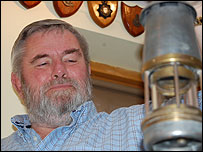 Barry has saved a number of artifacts Miners' Strike 25 years on: An Essex bobby's taleThese days, Barry Kaufmann-Wright is better known as 'The Wildlife Man', but 25 years-ago he was an Essex Police Constable policing the Miners' Strike. Now retired he reflects on his move from village bobby to riot officer. Barry Kaufmann-Wright joined Essex Police in 1972 and served for 33 years, but he was a recruit with a slightly different background. He'd spent five years studying at Jersey Zoo in the 1960s and worked under naturalist Gerald Durrell, the author of 'My Family and Other Animals'.
Barry says Durrell wasn't too disappointed when he became a police officer: "You didn't work in the Zoo for money; you did it for the love of the job. I got restless, I went out to Jersey very young. So, I decided to get some qualifications and came to Writtle College and then joined the Police Force." The early part of Barry's career in the police started in the south of the county. "I went to Ongar first, that was my training ground. I then moved out to Thaxted and was village bobby for around 19 years," he recalls. Rural Essex was a long way from the industrial northern cities that he'd find himself in during the year-long Miners' Strike, which started in 1984. 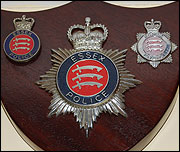 Essex Police badges over the years "It couldn't have been further away from what I was used to," he explains. "I didn't think I'd get involved in the Miners' Strike and I was quite surprised when I got called up during the second week of the strike. "I didn't know what to expect and I never realised for one moment the type of convoy we'd have. The Essex Police convoy was over a mile long with police transits." The BBC is not responsible for the content of external websites Barry's unit were deployed first to Bilsthorpe Colliery in Nottinghamshire, where he says: "The pickets wanted to stop the miners who wanted to work, so our role was to keep the peace and give the miners who wanted to work the right to work and we were there for a whole week. " The local communities were very hostile to the police at the time: "We were being called 'Thatcher's Thugs' by the pickets and the tension was running high." 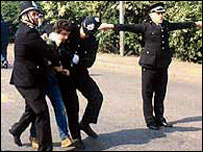 Picket arrest in Orgreave Orgreave was one of the famous 'battles' between police and strikers in May 1984 and Barry was one of the officers on duty that day. "The Metropolitan Police and other forces were there with their horses. And we were standing behind the pickets in a line and there we were facing charging horses and we had to move very quickly," remembers Barry. "Standing behind a clear plastic shield seeing bricks, iron bars and everything else being thrown at you is very disturbing. You're putting total trust in your equipment." Barry spent a total of 12 weeks but returning backwards and forwards to Essex: "It was physically draining, you'd be on 16 hour shifts," he says. He was sent back on the penultimate week of the strike in 1985. Barry says: "We knew that it was coming to end - sadly, for a lot of people who'd passionately fought for the right to strike and the right to carry on working. They was quite demoralised by then. "I felt sorry for both sides, as did many of my colleagues. We felt sorry for the flying pickets who wanted solidarity with the union and we felt sorry for those who wanted to carry on working." 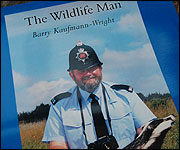 A book by Barry Kaufmann-Wright After the Miners' Strike finished, Barry returned to Essex and his usual beat. In 1987 he was appointed the wildlife crime officer and he remained with Essex Police until he retired in 2005. Shortly before retiring he was named 'Wildlife Enforcer of the Year' and was presented with a stuffed-toy panda! More recently he's written books including his an autobiography called 'The Wildlife Man' and 'Jack of All Trades' that deals with his life as a police constable and includes a chapter on the Miners' Strike. For Barry, the police officer's role during what became a very difficult industrial struggle was clear: "We had a role to play and that was it." The BBC is not responsible for the content of external websites last updated: 22/07/2009 at 09:17 Have Your Saymrs anne burton SEE ALSOYou are in: Essex > History > Local History > Miners' Strike 25 years on: An Essex bobby's tale |
| | About the BBC | Help | Terms of Use | Privacy & Cookies Policy |