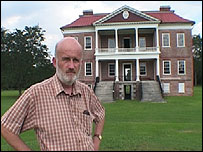
Bill had known he had ancestors who lived in America in the late 18th century - and that they had used slaves on their rice plantations. But with the next year's 200th anniversary of the abolition of the slave trade in mind, he made an emotional and revealing journey to Charleston in South Carolina. This is his account of his trip as he tried to come to terms with his family's complex past...Historic journeyDay one in Charleston was spent with George McDaniel, the director of Drayton Hall who took me to visit the house where the first of my ancestors lived. The Grimke sisters - Sarah and Angelina - had grown up here in the 1770s. They later campaigned for an end to the slave trade. In the morning I had been to the public library where I had found a photograph of two of Henry Grimke's (Sarah and Angelina's brother) sons. Their mother was Henry's second "wife", Nancy Weston who was actually one of his slaves - more about the name Weston later! The next day I went to Georgetown for a church meeting. I had already done some research from the 1880 census on the Georgetown Draytons. I discovered from a historian present at the meeting, that the names of three couples in the 1880 census were related to three Draytons present at the meeting that day. 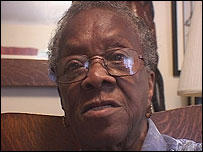 | | Minnie Kennedy |
I went to see a member of the church's congregation, Minnie Kennedy. She is a remarkable, spritely lady of 89 with an incredible story of courage and determination from the days of slavery to those of the civil rights marches in the 1960s. Minnie was present at the rally in Washington DC where Martin Luther King Jr gave the "I have a dream" speech. She grew up, resolved to get the best education she could and pass it on to others. She later taught African Americans to read and write so that they would be entitled to vote. In contrast, I later had drinks at the home of some relatives in downtown Charleston. The atmosphere was convivial. However, I got the impression that some older members of this closely knit, conservative society, at times felt under threat from a fast-changing outside world. Drayton HallOn Thursday we did some filming at Drayton Hall. I found a contradiction between the magnificent mansion house's beautiful setting, while knowing how all of this had come into being - ie through the wealth created from slave labour. 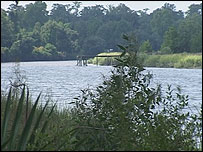 | | Drayton Hall's riverbank |
But I also found I could not condemn the family's role. It does appear that somehow, within the evil system of slavery, the Draytons did show humanity towards those who were working for them. This does need to be acknowledged. We drove to the riverbank at the end of the drive from Drayton Hall. Slaves who had been purchased for the Drayton plantations (of which there were at the very most 30) would be brought upstream to the landing, where I now stood. I thought of the African men and women, as they witnessed this unfamiliar scene, not knowing what was in store for them. And yet the landscape would have reminded them of what they had left behind. On Friday I went to see the house where my great-grandfather was born. His father was the younger brother of the owner of Magnolia Gardens, (the estate next to Drayton Hall). My great-great-grandfather, together with his family, emigrated to England shortly before the Civil War. He had married an English lady, whose father offered him a post in his firm in Lancashire. Family gatheringSaturday was the culmination of the visit, a special event billed as "Share the History: Tell the Story". The Draytons - both African American and Caucasian - and those connected with Drayton Hall and Magnolia Gardens, were able to come together for this special occasion. 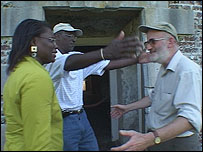 | | Bill meets his cousins |
Within 15 minutes of the start of the event at Drayton Hall, I met members of the Weston family - most probably related to Nancy Weston, mentioned above. I acknowledged them as cousins, however distant! After a tour of the house, the party moved on to the African American graveyard, where Charles Drayton, who sold Drayton Hall to the National Trust for Historic Preservation in 1974, spoke very movingly at the graveside of his close friend, Richmond Bowens, a descendant of slaves the Draytons had brought over from Barbados. When Richmond had come back to Charleston, after spending most of his working life in Chicago, he had requested Charles Drayton that he be buried at the Drayton plantation, where he had been born and had grown up. 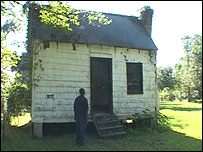 | | One of the slave cabins |
At Magnolia Gardens we were given a tour of the slave cabins, which are being renovated as part of an exhibition on slavery, emancipation and civil rights. We then went on to the African American graveyard, where we were unfortunately unable to locate Friday Johnson's grave. He was the great-grandfather of Rebecca Campbell and Catherine Braxton (the nieces of Richmond Bowens). According to the 1880 census, Friday Johnson is listed with his wife and 3 children, including Willis, the grandfather of Rebecca and Catherine. Rebecca mentioned that a whole plane-load of them would be coming over to England for the 200th anniversary of the abolition of the slave trade next year. We'll see! 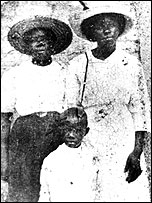 | | Young Richmond with Anna Bowens and Harriet May |
On my last day in Charleston, we went to the slave market and saw the the auction block, where slaves were bought and sold. The building was of classical proportions which spoke of unquestioned power. I was told the slaves would be brought from the cells below and up the flight of steps to the auction block, so that prospective buyers could look them over and then make bids. Lasting thoughtsIn my short address on Saturday at Magnolia Gardens I said that we were "one big family"! The meeting was just the start for everyone to make potentially life-changing connections and so break down barriers, which have been deliberately put up to maintain social divisions in a fractured community during the dark days of the South. As relationships are further developed, issues can be dealt with on the basis of mutual trust and respect - not in a confrontational way - in order to bring healing and reconciliation. Originally I had considered apologising for my ancestors' involvement in slavery. However, I realised we cannot alter the past nor are we responsible for what our forefathers did. We should be deeply concerned with the present and how it is affected by what has happened in the past. With reasoned argument, we must combat racism in all its forms. Bill Drayton Follow Bill's remarkable journey all this week on BBC South Today at 6.30pm. |