

EU 'big' brought to heel
- 1 Mar 09, 08:39 PM
The sting was drawn from this summit by the apparent French climbdown over its plans to link state aid to car plants, to putting firms on French soil first. Not that President Nicolas Sarkozy seemed that apologetic - more annoyed that he had been singled out for harsh words.
"Take my friend Gordon Brown - and you know how much I trust him - who owns 70% of a bank. Seventy per cent! It's nationalisation. So explain where is the logic in saying there's no problem when a state takes 70% of a bank but helping manufacturers to get credit, that is a problem. Who says Gordon Brown is a protectionist ? Who would say such nonsense? Nobody is a protectionist in Europe, nobody !"
He went on to suggest that, if nobody is protectionist, some are more in favour of free trade than others.
"I've never believed in protectionism. Never. And if the crisis of '29 was as bad as it was it's perhaps because the response was protectionism. So is it a bad word? Yes. It's a bad idea. But on the other hand I have never believed in being naive. I ask for reciprocity. Between protectionism and free-tradism, there can perhaps be a balance, meaning from my point of view there's no such thing as liberty without rules."
But he has signed up to the conclusions of the summit which said that leaders "agreed that Europe can only face this challenge and overcome the current crisis by continuing to act together in a coordinated manner, within the framework of the Single Market and EMU", and "stress that protectionism is no answer to the current crisis and express confidence in the Commission's role as guardian of the Treaty".
You can take these as the usual platitudinous expressions of unity but perhaps today they actually are important.
The most memorable phrase of this summit came from Hungarian Prime Minister Ferenc Gyurcsany.He said: "We should not allow a new iron curtain to set up and divide Europe into two parts."
His logic?
"This is the biggest challenge for Europe in 20 years. At the beginning of the 90s we reunified Europe. Now it is another challenge: whether we can unify Europe in terms of financing and its economy."
It's very important that the summit agree that deals to save banks could not be protectionist either: support for parent banks should not imply any restrictions on the activities of subsidiaries in EU host countries, is what they agreed. In other words, an Austrian bank cannot be bailed out on the condition that it pulls out of operations in Hungary."
So does today matter? I think it does.
You might not agree with it but there is no doubt that a core principle of the European Union is that the individual member states should not put their interests before the interests of Europe as a whole, or before the interests of each other. Of course, they always do, and probably always will. But the economic crisis is putting very real strains on the organisation.
As the job losses, plant closures, bank failures spin faster and faster, the centrifugal forces threaten to tear countries one from another and, in the end, if there is no countervailing force, the whole thing could fly apart.
Although the summit did more detailed work, it was called by the Czechs partly because of the deepening crisis in the East's banks but mainly because of their offense over Mr Sarkozy's remarks.
It suggests the "littles", as they are sometimes called in EU parlance, can call one of the biggest of the "bigs" to heel. This summit is just a staging post in a crisis that will run longer than is comfortable for any of us but it was a chance for countries to reaffirm their European spirit and economic orthodoxy.
French climbdown?
- 1 Mar 09, 11:03 AM
Even before today's summit begins the Commission are claiming victory over the French president and what has been seen as his determination to put French industry before that of other European countries.
The Commission says that the French have promised "the French authorities have undertaken not to implement aid measures to the automotive sector that would contravene the principles of the internal market. In particular, the loan agreements with manufacturers would not contain any condition regarding either the location of their activities or a preference for France-based suppliers".
The statement adds a comment from the competition commissioner Neelie Kroes that it is important to "remove all ambiguity in this case, as Europe must avoid a return to protectionism and its negative consequences for employment in Europe. I am particularly vigilant in this respect."
This may be a question of interpretation. When I was in Paris on Friday French TV was debating on and off all day the suggestion that their president talks too much. It may well be that in this case the rhetoric that angered so many ran ahead of actual measures in the plan. The French Industry Minister, Luc Chatel, who gave the Commission the reassurances it required yesterday, explicitly denied in a BBC interview (on Thursday morning) that the plan was protectionist:
"Once again, there is nothing protectionist about this plan. It is aimed at companies which make cars on French territory, whatever their nationality. It comes with conditions which have always existed at the heart of the European Union. I was elected mayor: when I asked for economic help from the EU, it always came with obligations. The EU would say 'What investments will you match it with? How many jobs will be created?' and we'd have to accept certain obligations. Our plan for the car industry is directly inspired by this mechanism."
How this will all play out when the prime ministers and presidents are all in the same room we will see in a few hours.
By jingo what a crisis
- 1 Mar 09, 08:20 AM
Many of the prime ministers and presidents will arrive at this EU emergency summit in a fractious and irritable mood. And not just because of their broken weekend. It will probably end in bland conclusions and half-smiles because there is almost an obligation to put on the brave face of unity for the cameras. 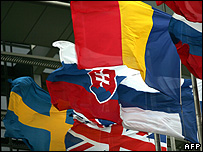
But make no mistake, the world's economic crisis is putting this unique institution, the European Union, under very serious strain. The jeopardy is financial, political and philosophical.
Item number one on the agenda is not written up as "smack Sarko", but the whole meeting is aimed at dealing with what is seen as the French president's economic jingoism and defiance of the expected European spirit. In the dock is his plan to rescue his country's car industry at the expense of other countries.
Protectionism may or may not be a good thing, but it is undoubtedly true that it flies in the face of the whole raison d'etre of the EU, as a single market, a community with a common purpose, an organisation committed to free trade.
This goes to the heart of the argument that I often read here in the comments to my posting. Many claim the EU simply cannot work in the long run, because people do not think of themselves as European citizens but as French or British or Latvians, first and foremost.
In the crucible of recession this stops being academic. As factories close and jobs are lost many people and politicians do want to guard jobs in their own country first. This seems obvious, but I wonder how far this spirit is devolved. Is a Suffolk boy really happy to see jobs go to, say, Stirling or Southampton rather than his home city?
Economists of course argue protectionism by one nation leads to retaliation by another. It happens in politics too. This summit will be preceded by a gathering of the nine Eastern European countries (the Czech Republic, Hungary, Poland, Lithuania, Latvia, Slovakia, Estonia, Bulgaria and Romania).
Such pre-summit caucusing has happened before, when the Eastern countries had a common position on climate change. But some regarded it as a worrying trend if the EU is breaking into semi-formal groupings based on both politics and geography, rather than the usual ad hoc shifting kaleidoscope of alliances. The fracture could become permanent.
The strains are economic too. Those who are hostile to the euro, and said it would never work, cross their fingers that they will be vindicated this year and the single currency will fly apart. I am willing to bet a very small proportion of the ever-dwindling euro buying power of my sterling salary that that won't happen. But there may have to be considerable sacrifice by Germany and others to damp things down. It will be another practical test of the European spirit.
If this wasn't all serious enough, the Commission itself is feeling bruised, because of the many criticisms that it has been hopeless in the face of the crisis. Some ask if it's no good now, what good is it? The French president has more or less criticised a lack of a plan and a lack of ambition in public, and others mutter in private that President Barroso has been well behind the curve.
I mentioned economic jingoism earlier, but the Commission's retort is rather the reverse of the song that gave rise to that word for bellicose nationalism.
In British music halls before the Crimean War they sang: "We don't want to fight but by jingo if we do, We've got the ships, we've got the men, we've got the money too."
The Commission might sing: "We'd love to plan and love to fund, but by jingo we cannot do either, We ain't got the power, we ain't got the men, we ain't got the money, neither."
Which is to say that the Commission feels it is unfair to moan at them when it is the nation states that haven't given them a budget or the competence to produce a Europe-wide plan for the car industry, or any other industry.
It will be intriguing to see how the leaders behave today, when the strains on the EU are so great, and the challenges ahead so daunting.
The BBC is not responsible for the content of external internet sites
Description
Archive
« March 2009
| Sun | Mon | Tue | Wed | Thu | Fri | Sat |
|---|---|---|---|---|---|---|
| 1 | 2 | 3 | 4 | 5 | 6 | 7 |
| 8 | 9 | 10 | 11 | 12 | 13 | 14 |
| 15 | 16 | 17 | 18 | 19 | 20 | 21 |
| 22 | 23 | 24 | 25 | 26 | 27 | 28 |
| 29 | 30 | 31 |
Being Discussed Now

Latest from BBC News blogs
Nick Robinson: |  |
Douglas Fraser: |  |
Brian Taylor: |  |
 |
Richard Black: |  |
Jonathan Amos: |  |
- News Editors
- Sport Editors
- Journalism Labs
- BBC Internet Blog
- Radio 4 Blog
- Peston's Picks
- Nick Robinson's Newslog
- Stephanomics
- Mark Easton's UK
- Mark Mardell's America
- Nick Bryant's Australia
- Andrew Harding on Africa
- Gavin Hewitt's Europe
- Soutik Biswas' India
- dot.Rory
- Science: Jonathan Amos
- Richard Black on environment
- Today: Tom Feilden
- Fergus Walsh's medical files
- Newsnight: Paul Mason
- Newsnight: Mark Urban
- Torin Douglas
- Will Gompertz's arts
- Phil Coomes on photojournalism
- Magazine Monitor
- Mark D'Arcy in Westminster
- NI: Mark Devenport
- Scotland: Brian Taylor
- Scotland: Douglas Fraser
- Wales: Betsan Powys
- Martin Rosenbaum on FOI
- 5 Live Breakfast
- Newsnight
- PM programme (iPM)
- World Tonight: Robin Lustig
