<?xml version="1.0" encoding="utf-8"?>
<!-- Atom RSS Feed, index template, v1 -->
<feed xmlns="http://www.w3.org/2005/Atom">
    <title>Radio Labs</title>
    <link rel="alternate" type="text/html" href="https://meleleh.pages.dev/blogs/radiolabs/" />
    <link rel="self" type="application/atom+xml" href="https://meleleh.pages.dev/blogs/radiolabs/atom.xml" />
   <id>tag:www.bbc.co.uk,2013:/blogs/radiolabs//100</id>
    <link rel="service.post" type="application/atom+xml" href="https://meleleh.pages.dev/cgi-perlx/blogs/mt-atom.cgi/weblog/blog_id=100" title="Radio Labs" />
    <updated>2010-10-11T17:20:46Z</updated>
    <subtitle>This is our new blog for BBC Radio Labs - a place where we show some of our prototypes for new sites and services. They are all at an early stage of development and some of them might not work quite right, some might look a bit sketchy and they may never be taken any further. They&apos;re what we call &quot;betas&quot;. 

We&apos;ll write about every new beta we release on this blog so please play with them and come back here to let us know what you think. We&apos;ll also be writing about other things we&apos;re working on, how we do our work and anything else we think you might be interested in. </subtitle>
    <generator uri="http://www.sixapart.com/movabletype/">Movable Type 4.33-en</generator>
 

<entry>
    <title>Radio Labs - Closed for business</title>
    <link rel="alternate" type="text/html" href="https://meleleh.pages.dev/blogs/radiolabs/2010/10/radio_labs_-_closing.shtml" />
    <link rel="service.edit" type="application/atom+xml" href="https://meleleh.pages.dev/cgi-perlx/blogs/mt-atom.cgi/weblog/blog_id=100/entry_id=263995" title="Radio Labs - Closed for business" />
    <id>tag:www.bbc.co.uk,2010:/blogs/radiolabs//100.263995</id>
    
    <published>2010-10-11T16:23:14Z</published>
    <updated>2010-10-11T17:20:46Z</updated>
    
    <summary> Sorry but after 2 years the Radio Labs blog is now closed. The extensive archive will of course remain online and the BBC still has a number of blogs devoted to research and development, technology and radio. Blog posts...</summary>
    <author>
        <name>Jem Stone</name>
        
    </author>
    
    <content type="html" xml:lang="en" xml:base="https://meleleh.pages.dev/blogs/radiolabs/">
        <![CDATA[<p><a title="Zippy Shut Up. by stev.ie, on Flickr" href="http://www.flickr.com/photos/winton/12630541/"><img src="http://farm1.static.flickr.com/10/12630541_0900e3005e.jpg" alt="Zippy Shut Up." width="600" height="450" /></a></p>
<p>Sorry but after 2 years the Radio Labs blog is now closed. The extensive archive will of course remain online and the BBC still has a number of blogs devoted to research and development, technology and radio. Blog posts about DAB, semantic web, radio streams, innovation using the <a href="https://meleleh.pages.dev/programmes/developers">BBC programmes platform,</a> visualising radio and Radio Labs bloggers; Alan, Michael, Tristan and others who blogged here will continue to appear on other BBC blogs such as:</p>
<ul>
<li><a href="https://meleleh.pages.dev/blogs/radio/">BBC Radio blog:</a> "BBC Director of Audio &amp; Music Tim Davie and his team explain their decisions, highlight changes and share important news from all of BBC radio.</li>
</ul>
<ul>
<li><a href="https://meleleh.pages.dev/blogs/researchanddevelopment/">BBC Research and Development blog:</a> "where researchers, scientists and engineers from BBC R&amp;D share their work in developing the media technologies of the future"</li>
</ul>
<ul>
<li><a href="https://meleleh.pages.dev/blogs/bbcinternet/">BBC Internet blog: </a>"Senior staff from the BBC's online and technology teams discuss issues raised by you about BBC Online, BBC iPlayer, the BBC's digital and mobile services, and the technology behind them. </li>
</ul>
<p>Thanks for subscribing.</p>
<p><em>Jem Stone is Executive Producer, Social Media, BBC Audio and Music.</em></p>
<li> The photo <a title="Zippy Shut Up" href="http://www.flickr.com/photos/winton/12630541/">"Zippy Shut Up"</a> is by Steve Winton and is used <a href="http://creativecommons.org/licenses/by/2.0/deed.en_GB">under  licence</a>.</li>]]>
        
    </content>
</entry>

<entry>
    <title>Podcast OPML - change</title>
    <link rel="alternate" type="text/html" href="https://meleleh.pages.dev/blogs/radiolabs/2010/04/podcast_opml_change.shtml" />
    <link rel="service.edit" type="application/atom+xml" href="https://meleleh.pages.dev/cgi-perlx/blogs/mt-atom.cgi/weblog/blog_id=100/entry_id=210727" title="Podcast OPML - change" />
    <id>tag:www.bbc.co.uk,2010:/blogs/radiolabs//100.210727</id>
    
    <published>2010-04-28T09:17:39Z</published>
    <updated>2010-04-28T10:43:18Z</updated>
    
    <summary>Just a quick note to say that the OPML formatted feed that we have available for our Podcasts is having a slight format change. This posting describes the changes.</summary>
    <author>
        <name>Alan Ogilvie</name>
        
    </author>
    
        <category term="Radio" />
    
    <content type="html" xml:lang="en" xml:base="https://meleleh.pages.dev/blogs/radiolabs/">
        <![CDATA[<p>Just a quick note to say that the <a href="https://meleleh.pages.dev/blogs/radiolabs/2008/04/opml_feed_of_podcasts.shtml">OPML formatted feed</a> that we have available for our Podcasts is having a slight format change.</p>
<p>Because any change to the structure of an XML document like this will probably cause some minor headaches to you - we've set up a new feed in the new format, and kept the old one running for a while. This is notice that in a few weeks we'll simply redirect the old one to the new one.</p>
<p>The new feed is available here: <a href="https://meleleh.pages.dev/radio/opml/bbc_podcast_opml_v2.xml" target="opml">https://meleleh.pages.dev/radio/opml/bbc_podcast_opml_v2.xml</a></p>
<p>A <a href="http://optimalbrowser.com/optimal.php?url=http%3A%2F%2Fwww.bbc.co.uk%2Fradio%2Fopml%2Fbbc_podcast_opml_v2.xml&submit=Submit" target="opml">nice view of this</a> can be seen via Optimal's OPML browser.</p>
<p>A summary of the changes between the old (v1) and the new (v2):</p>
<ul>
  <li>We took out the top level 'BBC Station List' outline - it didn't make sense. So now the Radio Networks are the first thing in the XML.</li>
  <li>We changed the <code>outline</code> node to better include the display name of the Radio network rather than the id - but kept the id for you in a new attribute called <code>networkid</code>. This makes it a bit more 'friendly' when just using a podcatcher that can directly read our OPML:
    <ul>
      <li>this (v1):<code> &lt;outline text=&quot;radio2&quot; fullname=&quot;BBC Radio 2&quot;&gt;</code></li>
      <li>to this (v2):<code> &lt;outline text=&quot;BBC Radio 2&quot; fullname=&quot;BBC Radio 2&quot; networkid=&quot;radio2&quot;&gt;</code>      </li>
    </ul>
  </li>
  <li>We changed the title of the OPML document
    for the same reason of 'friendliness' - from:
    <ul>
      <li>this (v1): <code>BBC Podcast OPML</code></li>
      <li>to this (v2): <code>BBC Radio Podcasts</code></li>
    </ul>
  </li>
  <li>We didn't change <code>outline/outline</code> - the actual reference to the RSS feed for the podcasts. So you can be assured nothing changes there. As an example - here is a podcast outline picked from the latest feed - there is no difference from v1 to v2:
    <ul>
      <li>(v1): <code>&lt;outline type=&quot;rss&quot; imageHref=&quot;https://meleleh.pages.dev/podcasts/assets/artwork/oddcast.jpg&quot; xmlUrl=&quot;http://downloads.bbc.co.uk/podcasts/radio2/oddcast/rss.xml&quot; imageHrefTVSafe=&quot;&quot; text=&quot;Alex Lester's Oddcast&quot; keyname=&quot;oddcast&quot; active=&quot;true&quot; allow=&quot;all&quot; networkName=&quot;&quot; networkId=&quot;&quot; typicalDurationMins=&quot;15&quot; page=&quot;https://meleleh.pages.dev/radio2/shows/lester/&quot; flavour=&quot;Programme Highlights&quot; rsstype=&quot;&quot; rssenc=&quot;&quot; language=&quot;en-gb&quot; description=&quot;Alex Lester's latest musings on 'Alex World', featuring listener contributions, taken from his Best Time Of The Day show, broadcast weekdays on Radio 2, 2-5am.&quot; bbcgenres=&quot;Comedy &amp; Quizzes|Entertainment&quot;/&gt;</code></li>
      <li>(v2): <code>&lt;outline type=&quot;rss&quot; imageHref=&quot;https://meleleh.pages.dev/podcasts/assets/artwork/oddcast.jpg&quot; xmlUrl=&quot;http://downloads.bbc.co.uk/podcasts/radio2/oddcast/rss.xml&quot; imageHrefTVSafe=&quot;&quot; text=&quot;Alex Lester's Oddcast&quot; keyname=&quot;oddcast&quot; active=&quot;true&quot; allow=&quot;all&quot; networkName=&quot;&quot; networkId=&quot;&quot; typicalDurationMins=&quot;15&quot; page=&quot;https://meleleh.pages.dev/radio2/shows/lester/&quot; flavour=&quot;Programme Highlights&quot; rsstype=&quot;&quot; rssenc=&quot;&quot; language=&quot;en-gb&quot; description=&quot;Alex Lester's latest musings on 'Alex World', featuring listener contributions, taken from his Best Time Of The Day show, broadcast weekdays on Radio 2, 2-5am.&quot; bbcgenres=&quot;Comedy &amp; Quizzes|Entertainment&quot;/&gt;</code>  </li>
    </ul>
  </li>
</ul>]]>
        
    </content>
</entry>

<entry>
    <title>RealMedia - follow up</title>
    <link rel="alternate" type="text/html" href="https://meleleh.pages.dev/blogs/radiolabs/2010/03/realmedia_follow_up.shtml" />
    <link rel="service.edit" type="application/atom+xml" href="https://meleleh.pages.dev/cgi-perlx/blogs/mt-atom.cgi/weblog/blog_id=100/entry_id=203306" title="RealMedia - follow up" />
    <id>tag:www.bbc.co.uk,2010:/blogs/radiolabs//100.203306</id>
    
    <published>2010-03-26T15:30:54Z</published>
    <updated>2010-03-26T15:41:08Z</updated>
    
    <summary>As I said in the previous post in October - we evaluate our   streaming services against our four test of public value (Reach, Quality, Impact   and Value) and those showed us that our RealMedia streaming services were   something we need to continue to justify. The posting was to advise listeners   that the RealMedia services would be discontinued.</summary>
    <author>
        <name>Mark Kortekaas</name>
        
    </author>
    
        <category term="Radio" />
    
        <category term="RealMedia" />
    
        <category term="Windows Media" />
    
        <category term="streaming" />
    
    <content type="html" xml:lang="en" xml:base="https://meleleh.pages.dev/blogs/radiolabs/">
        <![CDATA[		<p>I wanted to update you on our <a href="https://meleleh.pages.dev/blogs/radiolabs/2009/10/realmedia_an_update.shtml" target="_blank">previous statement about RealMedia deprecation</a>.</p>
		<p>As I said in the previous post in October - we evaluate our   streaming services against our four test of public value (Reach, Quality, Impact   and Value) and those showed us that our RealMedia streaming services were   something we need to continue to justify. The posting was to advise listeners   that the RealMedia services would be discontinued.</p>
		<p>The date on which these services should be treated as   <a href="http://en.wikipedia.org/wiki/Deprecation" target="wikipedia">deprecated</a> is still the 30th of March 2010. We have kept an eye on the metrics   we used to evaluate RealMedia for this, especially in the last few months, just   in case these changed. One of our metrics was to monitor the trend for RealMedia   usage compared to uptake of alternatives (Flash, Windows Media, 3G...) &ndash; and as   expected, we've seen the steady decline of users requesting RealMedia over the   alternatives. Indeed, on devices like Internet Radios, the majority of   manufacturers have been offering our Windows Media streams, both Live and   On-Demand, for some time now.</p>
		<p>All-in, our decision to deprecate RealMedia has not   changed.</p>
	<p>What does this mean to you? It means that, if you haven't   already done so, you should shift to using the other available   services::</p>
		<ul>
		  <li>Internet Radios, Wifi Radios: all the common devices that we know about can make use of our Windows Media   services, and communications with key manufacturers have allowed them to provide   live and listen-again services on those devices. If you have one of these   devices and this isn't working - speak to the manufacturer in the first   instance. </li>
		  <li>Web: <a href="https://meleleh.pages.dev/iplayer/radio" target="_blank">https://meleleh.pages.dev/iplayer/</a> - for UK listeners this offers you a high-quality version by default, though you   can choose to listen to a low-bit rate stream (48kbps).</li>
		  <li>Mobile: 3GPP streaming is available on mobile - for more information check: &quot;<a href="http://iplayerhelp.external.bbc.co.uk/help/mobile/mobile_phone" target="_blank"><em>Can I access BBC iPlayer on my mobile phone?</em></a>&quot;</li>
		  <li>Alternative devices or other streaming players: &quot;<a href="http://iplayerhelp.external.bbc.co.uk/help/streaming_programmes/real_wma_streams" target="_blank"><em>Where can I find the Windows Media streams to listen live to National BBC Radio?</em></a><em></em>&quot;</li>
    </ul>
		<p>While RealMedia streaming services have been with us since 1996 and helped   pioneer the streaming media experience with us, this move largely completes the   modernisation of our media formats. &nbsp;This allows us to offer industry standards   by platform and as a result of this simplification we&rsquo;re hoping and expecting   better reliability and a simpler user experience.</p>
]]>
        
    </content>
</entry>

<entry>
    <title>Windows Media - Listen Again - Update 2</title>
    <link rel="alternate" type="text/html" href="https://meleleh.pages.dev/blogs/radiolabs/2010/01/wma_listen_again2.shtml" />
    <link rel="service.edit" type="application/atom+xml" href="https://meleleh.pages.dev/cgi-perlx/blogs/mt-atom.cgi/weblog/blog_id=100/entry_id=187629" title="Windows Media - Listen Again - Update 2" />
    <id>tag:www.bbc.co.uk,2010:/blogs/radiolabs//100.187629</id>
    
    <published>2010-01-25T18:20:48Z</published>
    <updated>2010-01-25T18:23:11Z</updated>
    
    <summary>... we now accept that Windows Media Listen Again is available for developers, manufacturers and aggregators to be exposed in their respective services and devices.</summary>
    <author>
        <name>Alan Ogilvie</name>
        
    </author>
    
        <category term="Radio" />
    
        <category term="Windows Media" />
    
        <category term="streaming" />
    
    <content type="html" xml:lang="en" xml:base="https://meleleh.pages.dev/blogs/radiolabs/">
        <![CDATA[<p>As a follow up to my previous posting <a href="https://meleleh.pages.dev/blogs/radiolabs/2009/12/wma_listen_again.shtml">"Windows Media - Listen Again - Update"</a> I would like to give you a quick status report on our fixes, and some good news.</p>

<p>We have fixed/addressed:

<ul>
	<li>FIXED: ASX files now contain the correct protocol moniker - 'mms://...'</li>
<li>FIXED: ASX files now don't contain any spurious metadata, though they don't currently contain any useful metadata about the programmes themselves. This metadata is embedded in the ASF/WMA itself.</li>
<li>FIXED: ASX files are served using the correct mime-type</li>
<li>IGNORED: We have not addressed the issue about having a file extension of '.asx' on the end of our Mediaselector generated URLs as we decided, through testing on a number of players, that this made no difference.</li>
</ul>

<p>Any fixes listed above have been deployed into our live service - so you should now see these changes.</p></p>

<p>The only outstanding issue from my previous posting is about getting stream URLs for the other geographic footprint than the one your client is in. (If that doesn't immediately make sense - check the previous posting, "Getting UK and International stream details"). The 'work around' suggested remains in place until we can address some fundamental logic within the system that produces this information - perhaps in the region of several months (I'll update the minute I know a more accurate date for this).</p>

<p>To this end, I am happy to say that we now accept that Windows Media Listen Again is available for developers, manufacturers and aggregators to be exposed in their respective services and devices.</p>]]>
        
    </content>
</entry>

<entry>
    <title>Windows Media - Listen Again - Update</title>
    <link rel="alternate" type="text/html" href="https://meleleh.pages.dev/blogs/radiolabs/2009/12/wma_listen_again.shtml" />
    <link rel="service.edit" type="application/atom+xml" href="https://meleleh.pages.dev/cgi-perlx/blogs/mt-atom.cgi/weblog/blog_id=100/entry_id=176454" title="Windows Media - Listen Again - Update" />
    <id>tag:www.bbc.co.uk,2009:/blogs/radiolabs//100.176454</id>
    
    <published>2009-12-15T14:59:00Z</published>
    <updated>2009-12-15T14:57:57Z</updated>
    
    <summary>I wanted to give you some information on the status of our tests of the Listen Again service in Windows Media. This will be available for UK and International users, as a replacement to the RealMedia offering (which is being...</summary>
    <author>
        <name>Alan Ogilvie</name>
        
    </author>
    
        <category term="Radio" />
    
        <category term="RealMedia" />
    
        <category term="Windows Media" />
    
        <category term="streaming" />
    
    <content type="html" xml:lang="en" xml:base="https://meleleh.pages.dev/blogs/radiolabs/">
        <![CDATA[<p>I wanted to give you some information on the status of our tests of the Listen Again service in Windows Media. This <strong>will be available for UK and International users</strong>, as a replacement to the  RealMedia offering (which is <a href="https://meleleh.pages.dev/blogs/radiolabs/2009/10/realmedia_an_update.shtml" target="_blank">being deprecated</a>)  - and will cover National, Nations and Local radio services.</p>
<p>We are currently in testing stages with the ASX metafiles required to allow the Windows Media Audio files to be linked to correctly. Secondly we need to expose the relationship between our schedule programmes and the ASX files. At the moment the latter is done using our <a href="https://meleleh.pages.dev/blogs/radiolabs/2008/09/xml_feeds_for_listen_again_con.shtml" target="_blank">AODFeed</a> which we'll be overhauling in the new year given the feedback we've received, but in the meantime I want to use this in my examples below.</p>
<p>Many eagle-eyed developers spotted our testing in the feeds. However we never announced that this was just testing, we wanted to wait until we were 100% sure that it was all correct and working before we made a proper announcement. Some were eager to get this stuff working on their devices or services but we have found a couple of problems that we're busy trying to address. </p>
<p>Unfortunately the forthcoming holiday period limits our abilities to roll out fixes to the live servers as our annual 'lock down' (change freeze) happens and we really wanted to have this available for the holidays - bad news! However - if you wish to get your hands on the streams, we've worked out a couple of simple ways to reliably work-around the issues - good news!</p>
<h2>Getting UK and International stream details</h2>
<p>Firstly, as happened with our RealMedia RAM metafiles, the ability to easily get both the UK stream details and the International stream details from one IP address is broken at the moment (or rather - it works too well... we need to protect our rights holders content - this always comes first). If you use the example from the <a href="https://meleleh.pages.dev/radio/aod/availability/radio4.xml" target="_blank">Radio 4 AODFeed</a>. If you request the MediaSelector XML from within the UK you get different results from outside the UK. Try it (if you've got access to an IP address in the UK and outside).</p>
<blockquote>
  <pre><a href="https://meleleh.pages.dev/mediaselector/4/mtis/stream/b00p4jtn" target="_blank">https://meleleh.pages.dev/mediaselector/4/mtis/stream/b00p4jtn</a> - &quot;Today&quot; 9th Dec 2009.</pre></blockquote>
<p>(Note: if you are trying this test after the 16th of December, you'll need to pick your own test MediaSelector request from the AODFeed - as the 7 day availability window will have shut on this example)</p>
<p>If you compare the results of your two requests, you'll see that the reference to the ASX files for this programme are slightly different. Further - requesting those ASX files is restricted in the same way. However - there is a work around until we can address this.</p>
<p>WORK AROUND: and once you get the ASX file contents you'll see that the only significant difference is the server farms and the paths from which you request the underlying streams. (I'm giving the exact details from the example 'Today' programme - note that I've dropped the streaming protocol from the front, I'll come to that in a moment)</p>
<p>For UK users:</p>
<ul>
  <li class="prem">wm-acl.bbc.co.uk/wms/radio4fmcoyopa/radio_4_fm_-_wednesday_0600.wma</li>
  <li class="prem">wm-acl.bbc.co.uk/wms2/radio4fmcoyopa/radio_4_fm_-_wednesday_0600.wma</li>
</ul>
<p>For International users:</p>
<ul>
  <li class="prem">wm.bbc.co.uk/wms/radio4fmcoyopa/radio_4_fm_-_wednesday_0600.wma</li>
  <li class="prem">wm.bbc.co.uk/wms2/radio4fmcoyopa/radio_4_fm_-_wednesday_0600.wma</li>
</ul>
<p>So, though we know it's not ideal, it is simply a case of requesting the ASX file and then parsing to get hold of the clip filename and then it's easy to tag on the appropriate 'wm' (International) or 'wm-acl' (UK) and then the redundant path ('wms' and 'wms2'). The reason why one farm is called 'wm-acl' is because 'acl' means access control list and, basically, these servers check the IP requesting the stream and only delivers it if the IP is within our database of UK providers. Which is why, if your device or app is distributed inside and outside the UK you either check your users IP address first and then only give them the correct stream, or you list both and highlight the appropriateness (perhaps by adding '[UK]' or '[Intl]' to the end of the stream description).</p>
<h2>When is a streaming protocol a deprecated streaming protocol?</h2>
<p>Answer - when it isn't a streaming protocol anymore and just a <a href="http://bit.ly/5nypbY" target="_blank">'moniker'</a>, a nickname. </p>
<p>Windows Media Servers <em>offered</em> three flavours of delivering a stream - <abbr title="Microsoft Media Server"><a href="http://bit.ly/5wdjUw" target="_blank">MMS</a></abbr>, <a href="http://bit.ly/5PtMMy" target="_blank">RTSP</a> and <a href="http://bit.ly/8UV8hx" target="_blank">HTTP</a>. As of Windows Media Services 9 Series, for Windows Server 2003, Microsoft deprecated the MMS protocol in favour if RTSP and HTTP. Whilst that was quite some time ago, we've always found that it takes a while for this to filter through embedded devices or applications that have followed the Microsoft Windows Media SDK and licensing information. There is a particular good Microsoft Technote that covers reasoning <a href="http://bit.ly/6Ibpqc" target="_blank">why it was deprecated and proposes the best way to handle this</a>. In summary it recommends that broadcasters of streams continue to use the 'mms://', because this will continue to work with client players who have followed the aforementioned SDKs - correctly rolling over to RTSP, then HTTP.</p>
<blockquote>
  <p>&quot;To support the widest range of streaming Player versions, you should  use the MMS URL moniker (mms://) in the connection URL to your  streaming content. The MMS URL moniker allows all connecting Players to  use protocol rollover to stream the content using the optimal streaming  protocol. If you use an announcement to enable the Player to access  your content, the MMS URL moniker is used automatically, ensuring that  protocol rollover will occur if necessary. Be aware that users can  disable protocols in the property settings of the Player. If the Player  only supports a single protocol, rollover cannot occur.&quot; - <a href="http://bit.ly/6Ibpqc" target="_blank">Microsoft Technote - 'About protocol rollover'</a></p>
</blockquote>
<p>So, this is the best option than specifying RTSP or HTTP uniquely in ASX files - if you specify RTSP it tells the client to only use RTSP, similar for HTTP.</p>
<p>PROBLEM: In our current ASX for Listen Again - the confusion crept in and the implementation currently has RTSP and HTTP links. We need to change this back to MMS.</p>
<p>WORK AROUND: if you are consuming our feeds, and access the ASX files and are parsing them - we recommend strongly you <a href="bit.ly/6Ibpqc" target="_blank">read the Microsoft Technote</a> and understand the implications for your device, application or solution. At some point in early January we expect to change our ASX output to only list MMS 'moniker' links. [For those interested in what supports which protocols - take a look at another Microsoft Technote called 'Windows Media protocol reference']</p>
<h2>Odds and ends</h2>
<p>So the other issues are mainly around poor metadata within the ASX file - not a showstopper in terms of delivery, but not how we'd like it. This is a bit more complicated to fix as it's around where data is available and what produces the ASX file dynamically - unfortunately not in the same place. So we have that to fix but it doesn't stop you using things.</p>
<p>ASX dynamic URLs don't have a file extension (.asx), and we've had some test reports about the mime-type not being served correctly. Fairly minor things - hopefully - but we'd like to get it as good as we can.</p>
<h2>Summary</h2>
<p>I hope I've been able to give you an overview of how close we are to launching the Windows Media Listen Again services officially, and that the work arounds for those impatient to get their hands on them are acceptable in the interim (I am just as eager to get this up and running myself!)</p>
]]>
        
    </content>
</entry>

<entry>
    <title>More Mooso</title>
    <link rel="alternate" type="text/html" href="https://meleleh.pages.dev/blogs/radiolabs/2009/12/more_mooso.shtml" />
    <link rel="service.edit" type="application/atom+xml" href="https://meleleh.pages.dev/cgi-perlx/blogs/mt-atom.cgi/weblog/blog_id=100/entry_id=175074" title="More Mooso" />
    <id>tag:www.bbc.co.uk,2009:/blogs/radiolabs//100.175074</id>
    
    <published>2009-12-10T16:25:41Z</published>
    <updated>2009-12-10T16:35:17Z</updated>
    
    <summary>This is a brief update on Mooso, our recently launched game. I&apos;ve just written a rather in-depth article about how Mooso works and how it was developed over on the BBC R&amp;D blog so head on over there if you...</summary>
    <author>
        <name>Tristan Ferne</name>
        <uri>https://meleleh.pages.dev/radio/</uri>
    </author>
    
        <category term="Gaming" />
    
        <category term="Music" />
    
        <category term="Radio" />
    
    <content type="html" xml:lang="en" xml:base="https://meleleh.pages.dev/blogs/radiolabs/">
        <![CDATA[<p>This is a brief update on <a href="http://www.mooso.fm">Mooso</a>, our recently launched game. I've just written a <a href="https://meleleh.pages.dev/blogs/researchanddevelopment/2009/12/mooso-developing-a-tagging-gam.shtml">rather in-depth article about how Mooso works and how it was developed</a> over on the BBC R&D blog so head on over there if you want to know a lot more.</p>

<p>And <a href="http://www.mooso.fm/leaderboards/last_week">last week's Mooso winner</a> was <a href="http://www.mooso.fm/users/Chronpics">Chronpics</a> with 2429 points. See if you can beat that!</p>

<p>Don't forget you can sign up at <a href="http://www.mooso.fm">www.mooso.fm</a> and play between 7am and 7pm on weekdays (lunchtimes seem to be the most popular time).</p>]]>
        
    </content>
</entry>

<entry>
    <title>Mooso</title>
    <link rel="alternate" type="text/html" href="https://meleleh.pages.dev/blogs/radiolabs/2009/12/mooso.shtml" />
    <link rel="service.edit" type="application/atom+xml" href="https://meleleh.pages.dev/cgi-perlx/blogs/mt-atom.cgi/weblog/blog_id=100/entry_id=171282" title="Mooso" />
    <id>tag:www.bbc.co.uk,2009:/blogs/radiolabs//100.171282</id>
    
    <published>2009-12-03T09:54:09Z</published>
    <updated>2009-12-03T09:57:42Z</updated>
    
    <summary> We&apos;ve just launched the latest Radio Labs prototype: Mooso. It&apos;s a game you play while listening to 6 Music, in which you enter tags and suggest similar artists to describe the current track. If what you enter matches what...</summary>
    <author>
        <name>Chris Bowley</name>
        <uri>http://www.fridayforward.com</uri>
    </author>
    
        <category term="Gaming" />
    
        <category term="R&amp;D" />
    
        <category term="Radio" />
    
        <category term="beta" />
    
    <content type="html" xml:lang="en" xml:base="https://meleleh.pages.dev/blogs/radiolabs/">
        <![CDATA[<p><span class="mt-enclosure mt-enclosure-image" style="display: inline;"><a href="http://www.mooso.fm"><img alt="mooso_logo.jpg" src="https://meleleh.pages.dev/blogs/radiolabs/mooso/mooso_logo.jpg" width="415" height="157" class="mt-image-center" style="text-align: center; display: block; margin: 0 auto 20px;" /></a></span></p>

<p>We've just launched the latest Radio Labs prototype: <a href="http://www.mooso.fm">Mooso</a>. It's a game you play while listening to <a href="https://meleleh.pages.dev/6music">6 Music</a>, in which you enter tags and suggest similar artists to describe the current track. If what you enter matches what other players enter you get points. We give more points for matching similar artists than tags and you also get a point just for playing.</p>

<h2>How to play... in three easy steps</h2>

<p><strong>Step 1: Listen to 6 Music.</strong><br />On your digital radio, TV or on the web it doesn't matter. 6 Music will automatically start playing when you hit Play on the site.</p>

<p><span class="mt-enclosure mt-enclosure-image" style="display: inline;"><img alt="mooso_play.jpg" src="https://meleleh.pages.dev/blogs/radiolabs/mooso/mooso_play.jpg" width="320" height="480" class="mt-image-center" style="text-align: center; display: block; margin: 0 auto 20px;" /></span></p>

<p><strong>Step 2: Enter tags and similar artists for the track playing.</strong><br />Hit the Play button on the site to open the pop-up play window. When a song plays on 6 Music, a new round starts and you can start entering tags. Tags are words or short descriptions of the music that could be genres, instruments or even moods. You can also suggest similar artists (you get more points for this!) or anything else, it's up to you. But be quick, you've only got two minutes from the start of the song.</p>

<p><strong>Step 3: Match tags and artists with other players to score points.</strong><br />You get points by matching tags and similar artists with other players, but you can't see what those other players are entering so you'd better make sure you're entering good tags. For example in <a href="http://www.mooso.fm/rounds/7460">this round</a>, the track played was 'New Fang' by Them Crooked Vultures and the players matched with the tags <a href="http://www.mooso.fm/tags/rock">rock</a> and <a href="http://www.mooso.fm/tags/classic">classic</a> and with artists <a href="http://www.mooso.fm/artists/4d5f891d-9bce-45ae-ad86-912dd27252fa">Dave Grohl</a>, <a href="http://www.mooso.fm/artists/de11b037-d880-40e0-8901-0397c768c457">Eagles of Death Metal</a>, <a href="http://www.mooso.fm/artists/67f66c07-6e61-4026-ade5-7e782fad3a5d">Foo Fighters</a>, <a href="http://www.mooso.fm/artists/678d88b2-87b0-403b-b63d-5da7465aecc3">Led Zeppelin</a> and <a href="http://www.mooso.fm/artists/5b11f4ce-a62d-471e-81fc-a69a8278c7da">Nirvana</a>. The more tags you match with other players the more points you win, the higher up the leaderboard you go and the closer you are to becoming a Mooso.</p>

<p><span class="mt-enclosure mt-enclosure-image" style="display: inline;"><a href="http://www.mooso.fm/rounds/7460"><img alt="mooso_round.jpg" src="https://meleleh.pages.dev/blogs/radiolabs/mooso/mooso_round.jpg" width="530" height="656" class="mt-image-center" style="text-align: center; display: block; margin: 0 auto 20px;" /></a></span></p>

<p>You can play <a href="http://www.mooso.fm">Mooso</a> between 7am and 7pm Monday to Friday along to Shaun Keaveny, Lauren Laverne, Cerys and Steve Lamacq. The more people playing the better, so why not join in at lunch time with Cerys' slot at 1?</p>

<h2>Sign up and join in</h2>

<p>There are a couple of ways in which you can join in and start playing. You can sign up on the web site (OpenID is supported) and play in your web browser (you'll need Flash Player 9+ and either Chrome, Firefox 3+, Internet Explorer 7+, Opera 9+ or Safari 3+) or if you have a <a href="http://www.jabber.org">Jabber</a> or <a href="http://mail.google.com/mail/help/chat.html">Google chat</a> account you can play over instant messenger. Simply add <strong>moose@mooso.fm</strong> to your contacts to start playing. More information is available at <a href="http://www.mooso.fm/help#im">http://www.mooso.fm/help#im</a>. You can also follow <a href="http://www.twitter.com/moosofm">Mooso on Twitter</a>.</p>

<h2>Game with a purpose</h2>

<p>So what's the point? <a href="http://www.mooso.fm">Mooso</a> is a <a href="http://en.wikipedia.org/wiki/Game_with_a_purpose">Game With a Purpose</a> (or GWAP) - a game which while (hopefully) being fun to play, produces another useful output. Another GWAP is <a href="http://images.google.com/imagelabeler/">Google's Image Labeler</a> which collates user input to annotate images and make them easier to search for. With Mooso, we hope to generate some rich data which describes tracks and artists and links them all together which in turn can be used to help you discover new music. You can look back through <a href="http://www.mooso.fm/rounds">previous rounds</a> on the Mooso site to see what people entered and browse through artists and tags which, we hope over time, will form an interesting web of information. </p>

<p><span class="mt-enclosure mt-enclosure-image" style="display: inline;"><a href="http://www.mooso.fm/tags"><img alt="mooso_tags.jpg" src="https://meleleh.pages.dev/blogs/radiolabs/mooso/mooso_tags.jpg" width="530" height="364" class="mt-image-center" style="text-align: center; display: block; margin: 0 auto 20px;" /></a></span></p>

<p>For example, navigating to <a href="http://www.mooso.fm/artists/4bc09c51-5d42-4c93-9ba6-8cc21a0edb8d">Them Crooked Vultures</a> displays the their suggested related artists and tags created in the game, along with a link to read more about them on <a href="https://meleleh.pages.dev/music/artists/4bc09c51-5d42-4c93-9ba6-8cc21a0edb8d">BBC Music</a>.</p>

<p><span class="mt-enclosure mt-enclosure-image" style="display: inline;"><a href="http://www.mooso.fm/artists/4bc09c51-5d42-4c93-9ba6-8cc21a0edb8d"><img alt="mooso_them_crooked_vultures.jpg" src="https://meleleh.pages.dev/blogs/radiolabs/mooso/mooso_them_crooked_vultures.jpg" width="530" height="381" class="mt-image-center" style="text-align: center; display: block; margin: 0 auto 20px;" /></a></span></p>

<p>You could say this is an investigation into user-generated music recommendation but we have designed Mooso first and foremost to be an entertaining game to play so please sign up, play, score points and tell us what you think.</p>

<p><a href="http://www.mooso.fm">Mooso</a> was developed by Radio Labs in collaboration with <a href="https://meleleh.pages.dev/rd">BBC R&D</a> and <a href="https://meleleh.pages.dev/6music">6 Music</a>. We will also be posting about how it works and how we developed it.</p>]]>
        
    </content>
</entry>

<entry>
    <title>Identifying your Internet Radio services</title>
    <link rel="alternate" type="text/html" href="https://meleleh.pages.dev/blogs/radiolabs/2009/11/identifying_your_internet_radi.shtml" />
    <link rel="service.edit" type="application/atom+xml" href="https://meleleh.pages.dev/cgi-perlx/blogs/mt-atom.cgi/weblog/blog_id=100/entry_id=164880" title="Identifying your Internet Radio services" />
    <id>tag:www.bbc.co.uk,2009:/blogs/radiolabs//100.164880</id>
    
    <published>2009-11-16T15:00:28Z</published>
    <updated>2009-11-16T15:01:57Z</updated>
    
    <summary>After the IMDA released their first device profile, baselining what an Internet Radio device is, they have been working in parallel on some metadata guidelines.</summary>
    <author>
        <name>Alan Ogilvie</name>
        
    </author>
    
        <category term="Radio" />
    
        <category term="Technology" />
    
        <category term="streaming" />
    
    <content type="html" xml:lang="en" xml:base="https://meleleh.pages.dev/blogs/radiolabs/">
        <![CDATA[<p>A quick posting about our involvement with the <a href="http://www.imdalliance.org/" target="imda">Internet Media Device Alliance</a> (IMDA). The organisation began in late 2008 and the BBC is a <a href="http://www.imdalliance.org/founders/" target="imda">founding member</a>.</p>
<p>We are seeing many devices that have been associated with traditional broadcasting methods starting to capitalise in the <abbr title="Internet Protocol">IP</abbr> world to give listeners new experiences either not provided by, or that improve on, traditional broadcasting methods. We've seen a lot of activity recently around Internet Radio devices and the <abbr title="Internet Media Device Alliance">IMDA</abbr> has released their <a href="http://www.imdalliance.org/2009/09/imda-announces-global-certification-standard-for-internet-radios/" target=imda">first device profile</a> setting out the functional features of these devices. The IMDA has also been working, in parallel, on some metadata guidelines.</p>
<p>I chair the IMDA's Metadata Working Group (MWG). We've been hard at work trying to specify how broadcasters, big or small, can expose their Internet Radio services in an agreed way - quite a challenge. Members include device manufacturers, aggregators of internet radio streams and broadcasters. It has been great to see the views from the different angles of the industry and see them working together for a shared purpose: to make the internet radio experience better for listeners.</p>
<p>Working for a broadcaster, I understand that in order to maximise the potential of our media we need to be able to support its delivery by exposing appropriate metadata - ranging from a completely low-level functional aspect, through to services experienced directly by the listener. Through the <abbr title="Internet Media Device Alliance's Metadata Working Group">MWG</abbr> we have been able to begin specifying how the industry could do this. Initially we've been focussing on how to identify a broadcaster's live internet streams. For example, how does the BBC properly expose the various formats, transports and metadata of our live internet streams that would allow device manufacturers and aggregators to consistantly give our listeners the best experience through their Internet Radio device? It requires all those involved in the chain to be aligned to certain working practices, and perhaps standards.</p>
<p>It's early days yet, and the IMDA is reviewing existing standards to see if anything is suitable or could be extended - no point in re-inventing the wheel. They want to make sure that any hurdles to adoption for broadcasters are small or non-existent, so that broadcasters across the world are able to follow these guidelines and make their media available in the same way.</p>
<p>I should have an update in January about this.</p>]]>
        
    </content>
</entry>

<entry>
    <title>LiveText-via-IP upgrade and other synchronously delivered content</title>
    <link rel="alternate" type="text/html" href="https://meleleh.pages.dev/blogs/radiolabs/2009/11/pushfeeds.shtml" />
    <link rel="service.edit" type="application/atom+xml" href="https://meleleh.pages.dev/cgi-perlx/blogs/mt-atom.cgi/weblog/blog_id=100/entry_id=161925" title="LiveText-via-IP upgrade and other synchronously delivered content" />
    <id>tag:www.bbc.co.uk,2009:/blogs/radiolabs//100.161925</id>
    
    <published>2009-11-03T18:04:29Z</published>
    <updated>2009-11-04T16:53:22Z</updated>
    
    <summary>For such a seemingly simple service, pushing out strings of text synchronous to our broadcasts can be a complicated process. LiveText, as it&apos;s commonly referred to, is available on FM, DAB, Freeview, FreeSat... and on the web.
The text itself is crafted by production staff in our systems and then we distribute it to these platforms.
I specifically wanted to talk here about &apos;the web&apos; - and our IP delivery mechanism for LiveText - what I call &apos;LiveText-via-IP&apos;.</summary>
    <author>
        <name>Alan Ogilvie</name>
        
    </author>
    
        <category term="Radio" />
    
        <category term="Visualising Radio" />
    
    <content type="html" xml:lang="en" xml:base="https://meleleh.pages.dev/blogs/radiolabs/">
        <![CDATA[<p>For such a seemingly simple service, pushing out strings of text synchronous to our broadcasts can be a complicated process. LiveText, as it's commonly referred to, is available on FM, DAB, Freeview, FreeSat... and on the web.</p>
<p>The text itself is crafted by production staff in our systems and then we distribute it to these platforms.
I specifically wanted to talk here about 'the web' - and our IP delivery mechanism for LiveText - what I call 'LiveText-via-IP'.</p>
<p>You may have noticed that LiveText appears on many of our national radio networks' web sites and we had it on the original Radio Player through a Flash client. When we started this a few years ago, it was an initial offering that would give us some feedback about how we should implement the service fully... and whether we should implement it at all!</p>
<p>Having collated all the feedback, and reviewed the delivery solution - we started to plan a new infrastructure.</p>
<p>Meanwhile - new services that also provide content synchronous to our broadcasts were being trialled - we have <a href="https://meleleh.pages.dev/blogs/radiolabs/visualising_radio/">previously spoken about our Visualising Radio trials</a> - you can see the parentage from the LiveText service. So delivering other media-types synchronously with our live streams is just as important.</p>
<p>What we needed was a way of implementing an infrastructure that could replace our existing LiveText-via-IP service, making sure we can deliver that and provide a system that is scalable and stable for new services.</p>
<p>Through a tendering process we eventually agreed on picking an open-source protocol and a company known for its expertise for server side implementations. We chose <a href="http://xmpp.org/extensions/xep-0060.html" target="jabber">XMPP PubSub</a> as the technology, and <a href="http://www.process-one.net/" target="processone">ProcessOne</a> as the company. (XMPP used to be called Jabber, just in case you knew it by that name.)</p>
<p>Some of the considerations we had around this tender process:</p>
<ul>
	<li>we wanted an open-source protocol, to allow anyone to be access it and where libraries for consuming the 'messages' were available in a <a href="http://xmpp.org/software/libraries.shtml" target="chatter">variety of languages</a></li>
<li>if we were going to use open-source, then any development should give back to the community - in the end with ProcessOne's <a href="http://www.process-one.net/en/ejabberd/">ejabberd server</a> nodes any extensions are <a href="http://www.ejabberd.im/">fed back into the development of ejabberd</a> and XMPP protocol</li>
<li>picking anything requires us to investigate the 'pedigree' of such a system - so we wanted something that had evidence of widespread deployment and scale of delivery (how many concurrent users can connect at once) -  XMPP <a href="http://www.jabber.com/CE/JabberHome2">hit</a> <a href="http://xmpp.org/about/history.shtml">the</a> <a href="http://www.process-one.net/en/customers/">mark</a></li>
<li>we also wanted some flexibility - so a protocol and server that would allow us to deliver what we need right now (simple text strings), and then grow with our ambitions - the XMPP protocol might seem a little bloated for delivering simple text strings, but as we develop the LiveText service over the next few years it allows us to, for example, mark up different languages, alternative messages for different clients/services. It also lets us provide new services using the same protocol - so the learning curve is lowered and hopefully reusability of code is improved.</li>
</ul>

<p>So - where can you see this in action right now? </p>
<p>On the websites we have upgraded our Flash-based LiveText clients so they are consuming messages from our ejabberd services. Check it out on <a href="https://meleleh.pages.dev/asiannetwork/">Asian Network's homepage</a>.</p>
<p>Our Flash clients are built using the <a href="http://www.igniterealtime.org/projects/xiff/" target="xiff">XIFF client library</a> - an open source ActionScript library - we made some tweaks that we're feeding back to the XIFF developers.</p>
<p>There are currently two connection methods for our XMPP service - direct connection through sockets or via <a href="http://xmpp.org/extensions/xep-0124.html" title="Bidirectional-streams Over Synchronous HTTP">BOSH</a> over port 80. If you are behind a firewall that blocks the XMPP ports then your client will connect using BOSH.</p>
<p>If you are using Firefox and have the <a href="https://addons.mozilla.org/en-US/firefox/addon/1843">FireBug addon</a> installed - you can see some comms in the console. If you are behind a firewall which blocks our sockets you will also see activity in the network activity section in Firebug - showing the BOSH connection - just look for 'http-bind'.</p>
<p>We are now referring to our infrastructure solution as <strong>'PushFeeds'</strong>. (We couldn't keep referring to them as 'a set of nodes of ejabberd that provides XMPP PubSub and BOSH' - just too lengthy to repeat all the time!)</p>
<p>Coming up - we are looking at other places to put LiveText-via-IP, whether on our websites or syndication locations. Also looking at devices on IP that could support this. And, of course, other services that could take advantage of push messaging like this - I'll take this opportunity to ask any BBC Staff interested to check out our <a href="http://bit.ly/17Zv1y" target="bbc" title="Internal Wiki Page about 'PushFeeds' - only available to BBC Staff">internal wiki pages</a> about the service.</p>
<p><em>Alan Ogilvie</em><br /><em>Interactive Platform Producer, Audio & Music Interactive</em></p>
<hr />
<p>Further information: </p>
<ul>
<li><a href="http://xmpp.org/" target="jabber">XMPP website</a></li>
<li><a href="http://xmpp.org/extensions/xep-0060.html" target="jabber">XEP-0060: Publish-Subscribe</a> - the XMPP PubSub specification</li>
<li><a href="http://www.process-one.net/" target="processone">ProcessOne</a> - the company we worked with to setup our service</li>
<li><a href="http://xmpp.org/extensions/xep-0124.html" target="jabber">XEP-0124: Bidirectional-streams Over Synchronous HTTP</a> - the XMPP BOSH specification</li>
<li><a href="http://www.igniterealtime.org/projects/xiff/" target="xiff">XIFF Actionscript client library</a></li>
<li><a href="http://xmpp.org/software/libraries.shtml" target="chatter">XMPP libraries</a>are available in many common languages, if you don't want to write one from scratch.</li>
<li><a href="http://www.process-one.net/en/ejabberd/">ejabberd</a> - the open source server technology behind our service, supported by ProcessOne</li>
<li><a href="http://www.ejabberd.im/">ejabberd developer community</a> - find out how feed into ejabberd development, or make use of the technologies</li>
<li><a href="http://bit.ly/17Zv1y" target="bbc">BBC Wiki page (Internal)</a> - an internal page for BBC staff to find out about the service. (Link only works from within the BBC network)</li>
</ul>]]>
        
    </content>
</entry>

<entry>
    <title>Upgrading to BBC iD</title>
    <link rel="alternate" type="text/html" href="https://meleleh.pages.dev/blogs/radiolabs/2009/10/upgrading_to_bbc_id.shtml" />
    <link rel="service.edit" type="application/atom+xml" href="https://meleleh.pages.dev/cgi-perlx/blogs/mt-atom.cgi/weblog/blog_id=100/entry_id=161304" title="Upgrading to BBC iD" />
    <id>tag:www.bbc.co.uk,2009:/blogs/radiolabs//100.161304</id>
    
    <published>2009-10-29T17:17:45Z</published>
    <updated>2009-10-29T17:24:12Z</updated>
    
    <summary>BBC iD is the new sign in system for BBC Online. It&apos;s currently being rolled out across all services that require a user to register or sign in. But Radio Labs is in the vanguard and has already switched systems....</summary>
    <author>
        <name>Tristan Ferne</name>
        <uri>https://meleleh.pages.dev/radio/</uri>
    </author>
    
    <content type="html" xml:lang="en" xml:base="https://meleleh.pages.dev/blogs/radiolabs/">
        <![CDATA[<p>BBC iD is the new sign in system for BBC Online. It's currently being rolled out across all services that require a user to register or sign in. But Radio Labs is in the vanguard and has already switched systems. So if you want to comment on the blog you will need to use the new BBC iD system. If you have an existing BBC membership, you can use your existing membername and password to sign in to BBC iD. The first time that you do this you'll be prompted to upgrade to a BBC iD and update and confirm your personal details.</p>

<p>You can r<a href="https://meleleh.pages.dev/blogs/bbcinternet/2009/10/welcome_to_bbc_id.html">ead more and comment on the Internet blog</a> and there is <a href="https://id.bbc.co.uk/users/help">more help on BBC iD here</a>.</p>]]>
        
    </content>
</entry>

<entry>
    <title>Immersive audio for Planet B</title>
    <link rel="alternate" type="text/html" href="https://meleleh.pages.dev/blogs/radiolabs/2009/10/binaural_audio_for_planet_b.shtml" />
    <link rel="service.edit" type="application/atom+xml" href="https://meleleh.pages.dev/cgi-perlx/blogs/mt-atom.cgi/weblog/blog_id=100/entry_id=161113" title="Immersive audio for Planet B" />
    <id>tag:www.bbc.co.uk,2009:/blogs/radiolabs//100.161113</id>
    
    <published>2009-10-29T10:31:40Z</published>
    <updated>2009-10-29T10:44:51Z</updated>
    
    <summary>Planet B is a science fiction series on BBC 7, the second series starts on the 29th November. You can read more about series two of Planet B on the Radio 4 blog. Before you read on, you should put...</summary>
    <author>
        <name>Caleb Knightley</name>
        
    </author>
    
        <category term="Radio" />
    
        <category term="Technology" />
    
    <content type="html" xml:lang="en" xml:base="https://meleleh.pages.dev/blogs/radiolabs/">
        <![CDATA[<p><i>Planet B is a science fiction series on BBC 7, the second series starts on the 29th November. You can <a href="https://meleleh.pages.dev/blogs/radio4/2009/10/planet_b_series_two.html">read more about series two of Planet B on the Radio 4 blog</a>.</i></p>

<p>Before you read on, you should put your headphones on and listen to this...</p>

<p><!--#include virtual="/radio/ssitools/simple_emp/emp_v1.sssi?Network=radio4&Brand=blog&Media_ID=planetb&Type=video" --></p>

<p>With any luck you should have just had an interesting if not mildly disturbing sonic experience. And - by the way we don't really have your brain on a database; it was all just a sonic illusion..... As with all great Sci Fi special FX techniques it was done using a technique that was created a very long time ago and then re hashed in the 70s. The technique is called Binaural and has more or less been around since the dawn of broadcasting, when the French used it to broadcast operas though the telephone network to paying customers. It was originally patented in 1931 by Alan Blumlein as part of his pioneering research into Stereo for EMI.</p>

<p>Now if your not really interested in recording techniques you can stop reading now, as the rest of this blog will be as painful as sitting next to the really boring guy at a dinner party who talks about how the ABS in your car works...for hours. For those of you who are interested, you can read this and laugh at me, saying 'no, no, no - you so called BBC so called expert, you clearly have done it all wrong!'</p>

<p>Anyway, Binaural is a stereo recording and playback technique that tries to recreate sound in a three dimensional way. Surround sound for headphones. For true modern binaural recordings a 'dummy head' should be used with microphones placed inside replica ears, but there are a few variations on that theme. The basic idea is that two omni-directional microphones are placed a heads-width apart and are separated by a head-like object. So when listened to on headphones the sound appears as it would if you where really there. The drawback is that it only works on headphones and is in no way compatible with summed mono, i.e. the single speaker DAB radio in your kitchen. Also, as it is still just an illusion that tricks your brain, people can experience dummy head binaural in different ways. A common complaint being that all the sound seems to be coming from behind the listener.</p>

<p>A clever person has already written this <a href="http://en.wikipedia.org/wiki/Binaural_recording">wikipedia page on Binaural</a> if you are interested in finding out more. And there's more on <a href="http://en.wikipedia.org/wiki/Dummy_head_recording">Dummy Head recording here</a>. And a <a href="http://www.youtube.com/watch?v=h564qjkJ-5I&feature=player_embedded#">clear demonstration by a very nice chap on YouTube here</a>. And there are other binaural shorts on You Tube including <a href="http://www.youtube.com/watch?v=IUDTlvagjJA">a virtual haircut</a> which is fun;</p>

<p>BBC Radio Drama did an excellent play using binaural called The Revenge in the 70s with no dialogue. It's totally gripping and well worth a listen if you can find it. There are also many music recordings using binaural including some tracks on <a href="https://meleleh.pages.dev/music/artists/83b9cbe7-9857-49e2-ab8e-b57b01038103">Pearl Jam's</a> 'Binaural' album.</p>

<p>For the Planet B Immersive trail you just heard we actually used three different types of stereo. Those being 2 track Mono, L and R stereo and Quasi Binaural stereo.</p>

<p>The Quasi Binaural elements were captured in a few different ways. For the opening scene the voice of planet B says 'Thank you for choosing to upload your brain' while the probe moves around your head - we used two different techniques. For the vocal element I recorded the actress in a standard voiceover way with a Mono cardioid large diaphragm condenser mic; in this case a Neumann U87. This was then played back through speakers in the studio's live area positioned at opposite poles around a Jecklin Disk microphone array. (The disk was chosen over the dummy head for its better compatibility with data compression techniques).</p>

<p>The probe effect in the first scene was achieved by playing back the probe sound FX through a Fostex self powered speaker which was moved around the mic array manually. In the end it took three very quiet people to move the speaker, and my Phillips Shaver for extra intensity.</p>

<p>For the three scenes Spy world, Jurassic Adventure and Operation Extreme Glory, all the vocal elements were recorded using the Jecklin Disk, including the background voices in Spy World and the screaming soldiers in Extreme Glory.</p>

<p>The final binaural elements are the brain removal sequence. We again used the three person Fostex speaker dance for the sawing of the skull. The disk was then replaced by a melon and a coconut. These were operated upon with various implements and much fun was had by those of us listening on headphones to the squishing and scraping. </p>

<p>The rest of the sound design was done in L and R Stereo, and panned Mono using some spatial plugin's. It was all recorded, designed and mixed within the excellent Pro Tools HD. The in-studio SFX playback was done using Spot On play out software. We monitored using Sennheiser HD25-1s and Beyerdynamic DT250s. The recording console was a Studer Vista 6.</p>

<p>For me it was an interesting experiment in sound, combining different stereo techniques to create a unique listening experience. But really it was all down to the BBC Radio Drama Development team in coming up with such an excellent idea, and a brilliantly imaginative script!</p>

<p><i>Caleb Knightley is a Senior Studio Manager and Sound Designer for BBC Radio Drama.</i></p>]]>
        
    </content>
</entry>

<entry>
    <title>What happens to The Proms after the Royal Albert Hall? </title>
    <link rel="alternate" type="text/html" href="https://meleleh.pages.dev/blogs/radiolabs/2009/10/what_happens_to_the_proms_afte.shtml" />
    <link rel="service.edit" type="application/atom+xml" href="https://meleleh.pages.dev/cgi-perlx/blogs/mt-atom.cgi/weblog/blog_id=100/entry_id=155346" title="What happens to The Proms after the Royal Albert Hall? " />
    <id>tag:www.bbc.co.uk,2009:/blogs/radiolabs//100.155346</id>
    
    <published>2009-10-19T15:17:38Z</published>
    <updated>2009-10-19T15:35:18Z</updated>
    
    <summary>Earlier this year, we broadcast another fantastic season of the BBC Proms. Every concert is broadcast live on BBC Radio 3, with some concerts also broadcast on television - mainly BBC Four, but also BBC HD, BBC Two and BBC...</summary>
    <author>
        <name>Mark Kortekaas</name>
        
    </author>
    
        <category term="Radio" />
    
        <category term="Technology" />
    
    <content type="html" xml:lang="en" xml:base="https://meleleh.pages.dev/blogs/radiolabs/">
        <![CDATA[Earlier this year, we broadcast another fantastic season of the BBC Proms. Every concert is broadcast live on BBC Radio 3, with some concerts also broadcast on television - mainly BBC Four, but also BBC HD, BBC Two and BBC One. That meant many live broadcasts live from the Royal Albert Hall - a building which is a number of miles away from Radio 3's studios in Broadcasting House.

So how does the audio get from the Royal Albert Hall into my FM/DAB/Internet Radio at home? And what happens to it along the way? How much is the audio in the Royal Albert Hall "dynamically compressed" (where the quiet bits get louder and the louder bits get quieter), and is any of the audio signal chucked away by using bandwidth limiting? And how might you get the best quality from our Proms coverage?

I've always been interested in this; so here's what happens:
 
For Radio 3 transmission, on iPlayer and others
<ul>
	<li>The Radio 3 stereo mix is sent from the Albert Hall to Broadcasting House via a high-quality 24-bit 48 kHz digital circuit and then fed to Radio 3 FM, DAB, Freeview, Freesat & Online services.  The microphones within the Royal Albert Hall handle frequencies from a few Hertz to over 20kHz and there is no LF or HF filtering added to the main microphone feeds. </li>
	<li>Radio 3 FM is bandwidth-limited to 15 kHz, with DC filtering applied. The FM signal has dynamic range compression applied via an Optimod processor. The signal is NICAM encoded at 676kbps and fed to the FM transmitters via the BBC's distribution network.  No further bandwidth limiting is applied. </li>
	<li>The feed from the Royal Albert Hall is also fed to Radio 3 on DAB, Freeview and Satellite.  These operate at 192kbps, although this reduces to 160kbps on DAB at some points in the schedule to accommodate 5 Live Sports Extra on the DAB multiplex.  There is no other processing applied to the signal. </li>
	<li>On the BBC iPlayer's listen-again services, Radio 3 is available at 192kbps AAC. This is processed in the same way as DTT ("Freeview"). Live streaming is also available, at 192kbps Windows Media and other versions. </li>
</ul>

For BBC Four transmission
<ul>
	<li>BBC Four uses the same stereo mix that's used for Radio 3. It's combined with the pictures and sent back to Television Centre via an MPEG2 (MPEG1 Layer II) link at 384kbps.  No additional processing is carried out before encoding. </li>
	<li>BBC Four sound on Freeview, Freesat and Sky is transmitted (using MPEG2) at 256kbps with no processing or bandwidth limiting. </li>
</ul>

For BBC Two and BBC HD (also BBC One) transmission
<ul>
	<li>Proms on BBC Two (and BBC One) use a dedicated sound mixing truck, to ensure that audio is mixed in a complementary way to the pictures broadcast. Proms also transmitted on the BBC HD Channel are usually mixed in surround sound using Dolby 5.0, though broadcast in Dolby 5.1 for technical reasons. </li>
	<li>Stereo for BBC One, BBC Two and BBC HD is sent back to Television Centre via an MPEG2 (MPEG1 Layer II) link at 384Kbps. </li>
	<li>When available surround sound is sent back in the same link using Dolby E encoding at 2Mbps (Dolby E can support up to 8 channels). </li>
	<li>Stereo is transmitted on BBC One, BBC Two at 256kbps (MPEG2), and 256kbps (MPEG4) on BBC HD. </li>
	<li>Surround sound is transmitted on BBC HD at 384kbps using Dolby Digital encoding. Dolby Digital has a frequency range from about 3 Hz to 18 kHz. </li>
	<li>Only the surround sound mix is transmitted on BBC HD.  If an HD set top box is set to "Stereo" it uses the additional data (Dolby Metadata) we send in the Dolby Digital signal to create a stereo mix. </li>
	<li>BBC television analogue services use NICAM-728 encoding the stereo signal at 728kbps for transmission. </li>
</ul>

Of course it should be noted that various transmission chains have their own issues depending on the output. For instance the Freeview signal is MPEG coded, filtering happens as part of the coding process, in a <a href="http://en.wikipedia.org/wiki/MPEG-1#Layer_II">32 segment polyphase band pass filter</a>. The AAC encoding does its own thing, etc.  With that in mind, the feeds are really filtered to you as the end listener.

I'm grateful to Andy Quested from BBC HD, and Neil Pemberton from BBC Radio 3 for compiling these answers.]]>
        
    </content>
</entry>

<entry>
    <title>RealMedia - an update</title>
    <link rel="alternate" type="text/html" href="https://meleleh.pages.dev/blogs/radiolabs/2009/10/realmedia_an_update.shtml" />
    <link rel="service.edit" type="application/atom+xml" href="https://meleleh.pages.dev/cgi-perlx/blogs/mt-atom.cgi/weblog/blog_id=100/entry_id=151277" title="RealMedia - an update" />
    <id>tag:www.bbc.co.uk,2009:/blogs/radiolabs//100.151277</id>
    
    <published>2009-10-07T14:23:02Z</published>
    <updated>2009-10-07T20:06:44Z</updated>
    
    <summary>Editor&apos;s note: this is a joint posting from: Mark Kortekaas (BBC Audio &amp; Music), Ian Myatt (BBC Nations &amp; Regions) and Karl Kathuria (BBC World Service)At BBC Radio we try to deliver the best experience for users of our streaming...</summary>
    <author>
        <name>Mark Kortekaas</name>
        
    </author>
    
        <category term="Flash" />
    
        <category term="Radio" />
    
        <category term="RealMedia" />
    
        <category term="RealPlayer" />
    
        <category term="Windows Media" />
    
        <category term="streaming" />
    
    <content type="html" xml:lang="en" xml:base="https://meleleh.pages.dev/blogs/radiolabs/">
        <![CDATA[<p><em>Editor's note: this is a joint posting from: Mark Kortekaas (BBC Audio & Music), Ian Myatt (BBC Nations & Regions) and Karl Kathuria (BBC World Service)</em></p><hr /><p>At BBC Radio we try to deliver the best experience for users of our streaming services. We constantly review our services to make sure they deliver 'public value'. The four drivers of public value are: Reach, Quality, Impact and Value.</p><p>When streaming services are evaluated against these measures, we take into account where different formats might need to be implemented, evolved or deprecated.</p><p>The streaming service provided in RealMedia format has been with us at the BBC since 1996. At the time it was the best option available, but more recently alternative methods of delivery have become just as important. These include Windows Media and Flash.</p><p>When evaluating services with our public value tests, which includes the costs of the services, we came to the decision that RealMedia was something we needed to phase out.</p><p>The actions to phase out RealMedia are broken down as follows:</p><ul><li>National networks - e.g. Radio 2, Radio 6Music, Asian Network, etc</li><li>Nations - e.g. BBC Radio Scotland , BBC Radio Wales, etc</li><li>Local Radio - e.g. BBC Cumbria, BBC Bristol, etc</li><li>WorldService - the English language streaming service in iPlayer only - international World Service streams are unaffected.</li></ul><em><strong>National networks</strong></em><p>It was clear that we could easily plan for a migration period for National networks during which RealMedia and alternatives will be available and allow for our audience and third-parties to make changes in a reasonable period.</p><p>So we'll be phasing out RealMedia by 30 March, 2010 for National networks.</p><p>In order to improve the experience in the BBC iPlayer web interface, we'll change the lower bandwidth option from its current RealMedia offering to a new Flash offering at 48kbps. We hope for this to be completed in October.</p><p>The legacy RealMedia streams will continue to exist on our systems until the March deadline, so that it gives those who still use them time to migrate to using the alternative:</p><ul><li>Windows Media for Live streams - available globally for these services</li><li>Windows Media for Listen Again streams - will phase in over the next few months and be available globally.</li></ul><em><strong>Nations & Local Radio</strong></em><p>The technology used for Nations and Local Radio services is more restrictive and a more difficult decision had to be made. A migration period would not have been possible without a significant increase in equipment which could not be justified. We had to make the unfortunate decision to switch off RealMedia as we simply could not offer both RealMedia and Windows Media at the same time.</p><p>In addition to the disruption caused to the Listen Live services, an unforeseen dependency means that the Listen Again service in Windows Media won't be operational until November.</p><em><strong>World Service</strong></em><p>Due to differences in production, World Service live and on-demand streams will continue to be available in Flash, RealMedia and Windows Media formats. However, if you access our content through BBC iPlayer it will only be available in Flash. Links to RealMedia and Windows Media versions of our programmes will be available from bbcworldservice.com.</p><p><em>Mark Kortekaas is Future Media Controller, A&M and Mobile Media</em></p><em><strong>Further help</strong></em><ul>
  <li>BBC iPlayer: if you're experiencing a problem with audio streaming, please take a look at the site's <a href="http://iplayerhelp.external.bbc.co.uk/help/">help section</a> where you can find FAQs about the service and a contact form for any specific queries.
  Some specific FAQs you may find useful:
    <ul>
    <li>&quot;<a href="http://iplayerhelp.external.bbc.co.uk/help/streaming_programmes/listen_live_real_media">Why am I no longer able to 'Listen Live' in BBC iPlayer to my local BBC radio station in RealMedia format?</a>&quot;</li>
    <li>&quot;<a href="http://iplayerhelp.external.bbc.co.uk/help/playing_programmes/local_radio_real_media">Why am I no longer able to 'Listen Again' to BBC local radio programmes in Real Media format?</a>&quot;</li>
    <li>&quot;<a href="http://iplayerhelp.external.bbc.co.uk/help/streaming_programmes/internet_radio_listen_live">Why am I no longer able to listen to my local BBC radio station through my Internet Radio device?</a>&quot;</li>
    <li>&quot;<a href="http://iplayerhelp.external.bbc.co.uk/help/streaming_programmes/local_radio_streams">Where can I find the Windows Media and Real streams for local BBC radio stations and BBC World Service?</a>&quot;</li>
    <li>&quot;<a href="http://iplayerhelp.external.bbc.co.uk/help/streaming_programmes/real_wma_streams">Where can I find the Windows Media and Real streams to listen live to National BBC Radio?</a>&quot;</li>
    </ul>
</li>
  <li>Blog comments: we're always open for discussion and we want to hear what you think of these changes, so please do post your comment below. We'll be reading them and will try to respond soon. however if it's a specific problem you're experiencing it's easier to use the iPlayer <a href="http://iplayerhelp.external.bbc.co.uk/help/">help section</a>.</li></ul>]]>
        
    </content>
</entry>

<entry>
    <title>Fun with Quartz Composer in Snow Leopard and the BBC Radio Schedule</title>
    <link rel="alternate" type="text/html" href="https://meleleh.pages.dev/blogs/radiolabs/2009/10/fun_with_quartz_composer_in_sn.shtml" />
    <link rel="service.edit" type="application/atom+xml" href="https://meleleh.pages.dev/cgi-perlx/blogs/mt-atom.cgi/weblog/blog_id=100/entry_id=151222" title="Fun with Quartz Composer in Snow Leopard and the BBC Radio Schedule" />
    <id>tag:www.bbc.co.uk,2009:/blogs/radiolabs//100.151222</id>
    
    <published>2009-10-07T11:20:18Z</published>
    <updated>2009-10-14T15:32:48Z</updated>
    
    <summary>Quartz Composer [QC] comes as part of Apples Developer Tools on OSX. It is described in Wikipedia as &apos;a node-based visual programming language&apos;. I think the easiest way to understand it, is it lets you plug things into other things...</summary>
    <author>
        <name>Duncan Robertson</name>
        <uri>http://whomwah.com</uri>
    </author>
    
        <category term="R&amp;D" />
    
        <category term="Radio" />
    
    <content type="html" xml:lang="en" xml:base="https://meleleh.pages.dev/blogs/radiolabs/">
        <![CDATA[<p><a href="http://en.wikipedia.org/wiki/Quartz_Composer">Quartz Composer [QC]</a> comes as part of  <a href="http://developer.apple.com/Tools/">Apples Developer Tools</a> on <a href="http://www.apple.com/macosx/">OSX</a>. It is described in <a href="http://www.wikipedia.org/">Wikipedia</a> as <em>'a node-based visual programming language'</em>.</p>

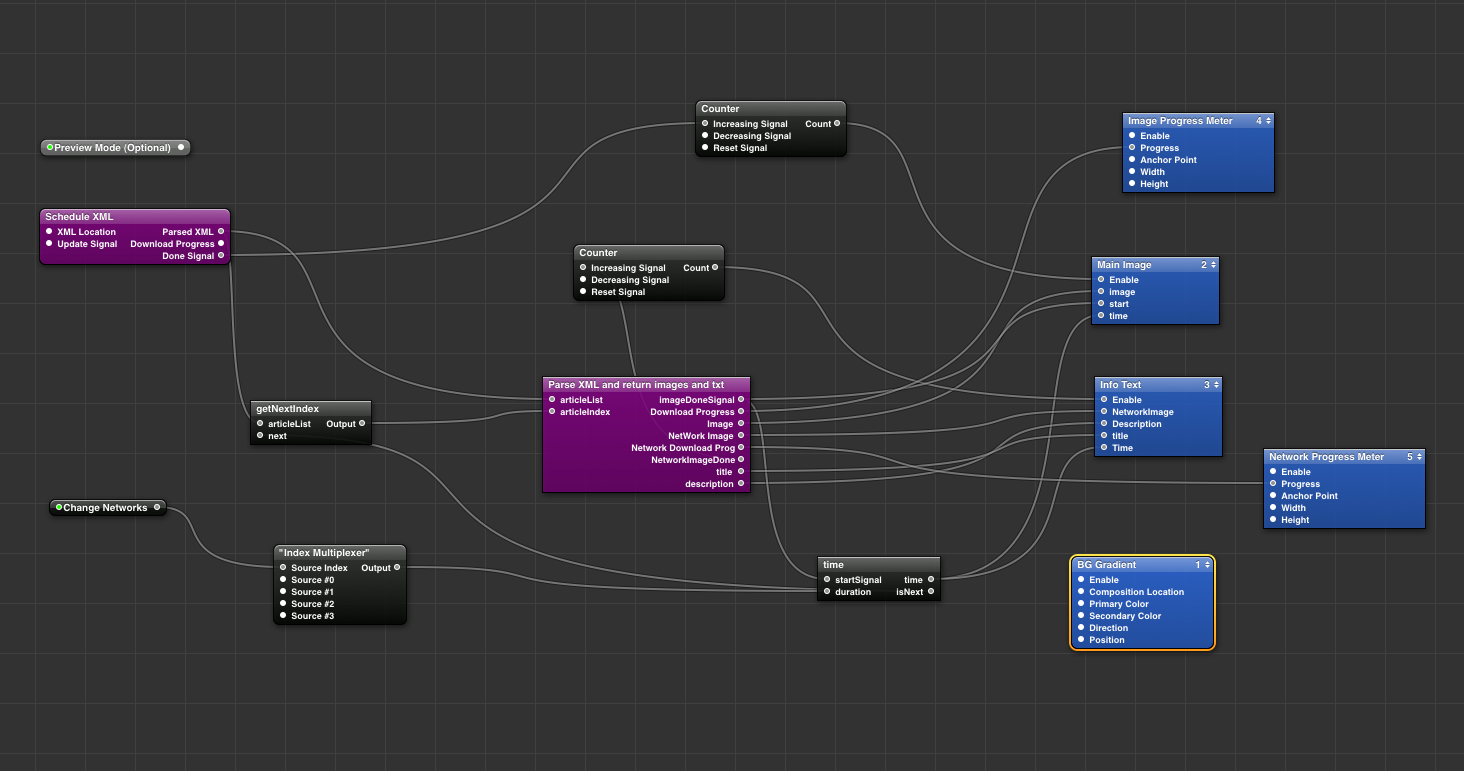
<p>I think the easiest way to understand it, is it lets you plug things into other things to produce very cool things, without the need to write a single line of code. These things are called patches and <a href="http://www.apple.com">Apple</a> provide a whole library of them (even more in <a href="http://en.wikipedia.org/wiki/Mac_OS_X_Snow_Leopard">Snow Leopard</a>). These patches wrap low level functionality in them like <a href="http://en.wikipedia.org/wiki/OpenGL">OpenGL</a> , <a href="http://en.wikipedia.org/wiki/Core_Image">Core Image</a>, <a href="http://en.wikipedia.org/wiki/Core_Video">Core Video</a>, <a href="http://en.wikipedia.org/wiki/Bonjour_%28software%29">Bonjour Services</a>, Apple Remote Access, Midi, XML loading and parsing etc, without you needing to understand the underlying technologies. You can also write your own patches including the ability to incorporate <a href="http://en.wikipedia.org/wiki/JavaScript">JavaScript</a> to effect the patches results. A patch is like a function, you pass it some information and it returns results, without you needing to care what happens inside.</p>

<p>So, with all these patches, you create a composition, which is a file with a .qtz extension. Here's an example of what a composition looks like:</p>

<p><a href="https://meleleh.pages.dev/blogs/radiolabs/images/composition.png"><img src="https://meleleh.pages.dev/blogs/radiolabs/assets_c/2009/10/composition-thumb-500x263.png" alt="Quartz Composition" style="float:left;margin-bottom:20px;"/></a></p>

<p style="clear:both;">A composition can be ran stand-alone, exported as a <a href="http://www.apple.com/quicktime/">QuickTime</a> movie, or used in a <a href="http://en.wikipedia.org/wiki/Cocoa_%28API%29">Cocoa application</a>. It can also be used as a Screen Saver or <a href="http://www.apple.com/itunes/">iTunes</a> visualization simply by dragging it into the correct folder on your Mac. A patch can also be nested in a patch, so as you can imagine the compositions can get quite complex.</p>

<p>One of the limitations of the initial version of QC was that you could only load <a href="http://en.wikipedia.org/wiki/RSS">RSS feeds</a> and not arbitrary XML. Luckily this had been addressed in the new version, so as well as all the other awesome new patches, there's one that lets you provide a path to some XML, and handles downloading and parsing into a structure, as well as download progress information and a flag for when the data is ready.</p>

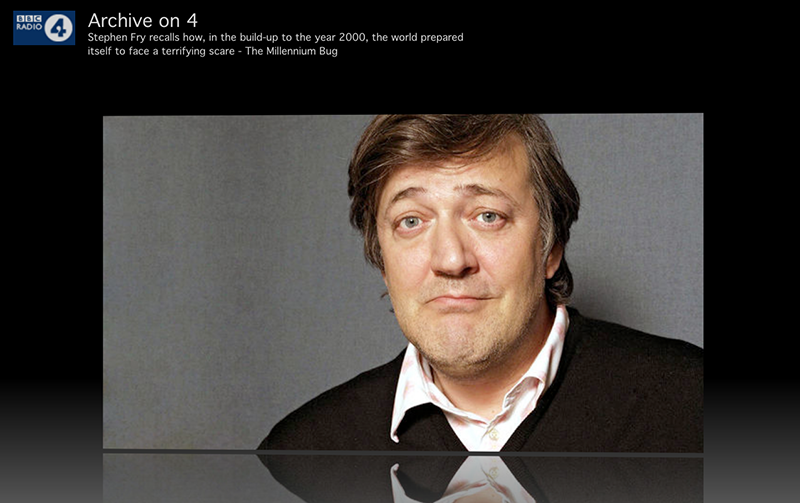
<p>With this new functionality as well as other new patches, I have created a composition that rolls through the <a href="https://meleleh.pages.dev/radio/">BBC's National Radio networks</a> and displays who is currently on air, as well as downloading and displaying the network logo and a pretty image for that show. Here's a screen grab:</p>

<p><a href="https://meleleh.pages.dev/blogs/radiolabs/images/scrnsaver.png"><img src="https://meleleh.pages.dev/blogs/radiolabs/assets_c/2009/10/scrnsaver-thumb-500x314.png" alt="Quartz Composition" style="float:left;margin-bottom:20px;" /></a></p>

<p style="clear:both;">You can download the composition here:</p>

<p><a href="https://meleleh.pages.dev/blogs/radiolabs/assets/BBCRadioNow1.1.zip">
<strong>BBCRadioNow1.1.zip</strong></a></p>

<p>To install you need to:</p>

<ol style="margin-bottom:20px;">
<li>Make sure you are running OSX 10.6 (It won't work otherwise)</li>
<li>Unzip the downloaded file</li>
<li>Move the <em>BBC Radio Now.qtz</em> file into your Screen Savers directory. <pre>/Users/&#60;username&#62;/Library/Screen Savers</pre></li>
<li>NOTE: You  may need to create the <em>Screen Savers</em> directory if it doesn't exist</li>
</ol>

<p>Now you can go to the Screen Savers settings page in system preferences, and you will be able to choose <em>BBC Radio Now</em> from the left hand menu. You can also adjust the duration in which the radio stations are switched via the options tab. Oh and remember, if you're not connected to the internet then you won't see anything.</p>

<p style="font-size:80%;">Disclaimer: I made this as an unsupported demo for my own learning. If you find any problems and fixes, please post them in the comments</p>]]>
        
    </content>
</entry>

<entry>
    <title>What&apos;s your musical taste?</title>
    <link rel="alternate" type="text/html" href="https://meleleh.pages.dev/blogs/radiolabs/2009/10/whats_your_musical_taste.shtml" />
    <link rel="service.edit" type="application/atom+xml" href="https://meleleh.pages.dev/cgi-perlx/blogs/mt-atom.cgi/weblog/blog_id=100/entry_id=148093" title="What's your musical taste?" />
    <id>tag:www.bbc.co.uk,2009:/blogs/radiolabs//100.148093</id>
    
    <published>2009-10-02T11:08:01Z</published>
    <updated>2009-10-02T12:58:03Z</updated>
    
    <summary>I&#8217;ve been thinking about musical taste and how to describe it so I asked the team here &#8220;&#8230;to describe your musical tastes, however you like, and then send/give it to me&#8221;. Responses ranged from Spotify playlists to descriptions to diagrams...</summary>
    <author>
        <name>Tristan Ferne</name>
        <uri>https://meleleh.pages.dev/radio/</uri>
    </author>
    
        <category term="Music" />
    
    <content type="html" xml:lang="en" xml:base="https://meleleh.pages.dev/blogs/radiolabs/">
        <![CDATA[<p>I&#8217;ve been thinking about musical taste and how to describe it so I asked the team here <i>&#8220;&#8230;to describe your musical tastes, however you like, and then send/give it to me&#8221;</i>. Responses ranged from Spotify playlists to descriptions to diagrams and I thought they were interesting enough to share.</p>

<p>From in-depth description &#8230;</p>

<p><i>"Some bands in no particular order: The Beatles, Elvis, Bowie, Talking Heads, Elvis Costello, Jonathan Richman, Orange Juice, Iggy Pop, Velvet Underground, The Specials, The Only Ones, The Clash, Radiohead, The Pixies; generally I like all Punk and New Wave (especially the one-hit wonders) between 76 and 84 - after that the horror of the New Romantic era put me off listening to music on the radio; another strand is early 60s girl bands like The Shangri-Las, The Crystals, The Shirelles - well, all of them really; also a big fan of Louis Jordan and that whole 40s jumpin&#8217; jive sound. I used to do the Camden live music pub circuit, both playing and to listen to the other bands. My classical taste is limited, though I know I&#8217;m more Beethoven and Bach than Mozart or Schubert. "</i></p>

<p><i>"Interesting&#8230; when I started thinking about my taste I often like specific artists, but not necessarily the whole genre they&#8217;re in, e.g, in jazz music I like Monk and Bill Evans, in jazz funk I like Herbie Hancock and Mahavishnu Orchestra. In dance music I like specific DJs like Sasha, John Digweed, but not Judge Jules or Pete Tong. Here it&#8217;s the DJs that are important, more than individual artists and producers. Deep house and garage - the early-mid 90&#8217;s US variety, not the later UK garage, or any of the other myriad garage genres. I like Tangerine Dream (before they went bad in the mid-90&#8217;s) and Klaus Schulze - &#8220;Berlin school&#8221; electronic music. What else? Classical music - Bach, Mozart, Beethoven (but more the string quartets than the symphonies)."</i></p>

<p>To brief ones&#8230;</p>

<p><i>" Eclectic, Eccentric and Elitist."</i></p>

<p>Then there was a bootleg album cover with <i>"Lou Reed at a tacky Adelaide hotel (with - I think - Malcolm Young from AC/DC) after the first (and best) concert I ever went to"</i>. Or more visual representations&#8230;</p>

<span class="mt-enclosure mt-enclosure-image" style="display: inline;"><img alt="Connecting moods and music" src="https://meleleh.pages.dev/blogs/radiolabs/images/moods.jpg" width="600" height="450" class="mt-image-center" style="text-align: center; display: block; margin: 0 auto 20px;" /></span>
<p><i>"Here&#8217;s a stab at my taste. I realise that my taste is pretty much completely mood based. I have used genres to stop this taking months. I also kept it top level, as I could also have joined things like &#8220;Happy&#8221; and &#8220;Busy&#8221; together to produce a different result."</i></p>

<span class="mt-enclosure mt-enclosure-image" style="display: inline;"><img alt="Connections and influences" src="https://meleleh.pages.dev/blogs/radiolabs/images/connections.jpg" width="600" height="450" class="mt-image-center" style="text-align: center; display: block; margin: 0 auto 20px;" /></span>
<p><i>&#8220;I had to stop at some point so it&#8217;s not comprehensive. But it&#8217;s all about connections&#8221;</i></p>

<span class="mt-enclosure mt-enclosure-image" style="display: inline;"><img alt="Record diary" src="https://meleleh.pages.dev/blogs/radiolabs/images/diary.jpg" width="600" height="456" class="mt-image-center" style="text-align: center; display: block; margin: 0 auto 20px;" /></span>
<p><i>&#8220;If asked i&#8217;d show people last fm i suppose but thats not entirely accurate.this is a bit more reflective [a spotify playlist of my 500 favourites]
and this [photo above] is highly accurate for one period in my life - my record diary when i was 13-17. or in 100words..at least today I like late80sindiepop,beatles,sunshinepop,folkrock,northernsoul,ska,late70sandlate80shiphop,70sdisco,abba,spectoresquegirlgroups,and cilladustysandieuk girlgroups, the first 50 releases on creation, roughtrade, postcard, 4AD, and Mute and lots of versions of Amazing Grace.&#8221;</i></p>

<span class="mt-enclosure mt-enclosure-image" style="display: inline;"><img alt="Graphing taste" src="https://meleleh.pages.dev/blogs/radiolabs/images/graph.jpg" width="600" height="424" class="mt-image-center" style="text-align: center; display: block; margin: 0 auto 20px;" /></span>
<p><i>"I like <em>nothing</em> from before 1960. First attempt had 1930 as year zero, but I realised I didn&#8217;t like anything from then! X axis shows when the music&#8217;s from, Y axis shows the time I first liked the group. I have been ruthless about exercising things I don&#8217;t like anymore. This isn&#8217;t to show how cool I always have been, but because this is a snapshot of &#8216;now&#8217;"</i></p>

<p>Obviously this is a small and select sample but some common themes emerged. About half were discursive and half were visual in some way. Most people mentioned specific bands or artists and musical genres, followed by record labels, songs and albums. There were lots of tag-like descriptions, <i>&#8220;early 60s girl bands&#8221;</i> for instance, identifying more niche genres or scenes and also mood-like descriptions. And there was quite a lot of personal history, obviously your taste changes over time. Also interesting was that some people defined their taste in terms of dislikes.</p>

<p>Paul over at the <a href="http://musicmachinery.com/2009/09/26/draw-a-picture-of-your-musical-taste/">Music Machinery blog</a> noticed I&#8217;d posted my musical taste to Flickr and he asked his readers to send him their representations of musical taste. So I thought I&#8217;d do the same over here. What are your musical tastes? How would you best describe them? Do you feel comfortable telling us? Is it too hard to describe? Answers in the comments or on Flickr (tag them <a href="http://www.flickr.com/photos/tags/mymusictaste/">MyMusicTaste</a>) please.</p>]]>
        
    </content>
</entry>

</feed>