<?xml version="1.0" encoding="utf-8"?>
<feed xmlns="http://www.w3.org/2005/Atom">
    <title>Journalism Labs</title>
    <link rel="alternate" type="text/html" href="https://meleleh.pages.dev/blogs/journalismlabs/" />
    <link rel="self" type="application/atom+xml" href="https://meleleh.pages.dev/blogs/journalismlabs/atom.xml" />
    <id>tag:www.bbc.co.uk,2009-04-24:/blogs/journalismlabs/128</id>
    <updated>2010-05-27T23:03:11Z</updated>
    <subtitle>This is Journalism Labs, a blog about BBC FM&amp;T Journalism Design and Development. This is where we&apos;ll be sharing our thoughts on new and better ideas for journalism on the web.</subtitle>
    <generator uri="http://www.sixapart.com/movabletype/">Movable Type 4.1</generator>

<entry>
    <title>Pub?</title>
    <link rel="alternate" type="text/html" href="https://meleleh.pages.dev/blogs/journalismlabs/2010/05/pub.html" />
    <id>tag:www.bbc.co.uk,2010:/blogs/journalismlabs//128.219225</id>


    <published>2010-05-27T14:33:37Z</published>
    <updated>2010-05-27T23:03:11Z</updated>


    <summary>Journalism Labs, launched at the end of 2008, was a six month experiment to share the work of the technical and design teams behind the BBC News, Sport and Weather websites. The experiment is now over and we&apos;ve decided to...</summary>
    <author>
        <name>FM&amp;T Journalism</name>
        
    </author>
    
    
    <content type="html" xml:lang="en" xml:base="https://meleleh.pages.dev/blogs/journalismlabs/">
        <![CDATA[<p>Journalism Labs, launched at the end of 2008, was a six month experiment to share the work of the technical and design teams behind the BBC News, Sport and Weather websites.</p>

<p>The experiment is now over and we've decided to close the blog.   We will continue to share our work on the <a href="https://meleleh.pages.dev/blogs/bbcinternet/">BBC Internet Blog</a> and on <a href="https://meleleh.pages.dev/blogs/theeditors/">The Editors</a> Blog.  Watch out for some exciting developments this year.  </p>

<p>Thank-you for all your contributions.  </p>

<p>As Gene Hunt said when all was said and done... "Pub?"</p>]]>
        
    </content>
</entry>

<entry>
    <title>The scheduled sporting calendar</title>
    <link rel="alternate" type="text/html" href="https://meleleh.pages.dev/blogs/journalismlabs/2009/08/the_scheduled_sporting_calenda.html" />
    <id>tag:www.bbc.co.uk,2009:/blogs/journalismlabs//128.127054</id>


    <published>2009-08-13T16:33:11Z</published>
    <updated>2009-08-14T11:11:20Z</updated>


    <summary>Back in March when we relaunched the F1 section of the sport site we ran a small trial around making the broadcast data available for people to download into their online calendars. We had many positive feedback emails around this...</summary>
    <author>
        <name>James Howard</name>
        
    </author>
    
    <category term="icalfootballf1sportcalendar" label="ical football F1 sport calendar" scheme="http://www.sixapart.com/ns/types#tag" />
    
    <content type="html" xml:lang="en" xml:base="https://meleleh.pages.dev/blogs/journalismlabs/">
        <![CDATA[<p>Back in March when we relaunched the <a href="http://news.bbc.co.uk/sport1/hi/motorsport/formula_one/default.stm">F1 section</a> of the sport site we ran a small trial around making the broadcast data available for people to <a href="http://news.bbc.co.uk/sport1/hi/motorsport/formula_one/calendar/default.stm">download into their online calendars</a>.</p>

<p>We had many positive feedback emails around this - people were planning their weekends around the F1 coverage - and so I did a little digging around to see what other people were up to around the BBC.</p>

<p><a href="http://derivadow.com/2008/08/09/whens-the-sailing-on-introducing-genre-schedules/">Tom Scott</a> and <a href="https://meleleh.pages.dev/blogs/radiolabs/2008/07/some_ical_views_onto_programme.shtml">Duncan Robertson</a> wrote about the work that they did over a year ago on schedules. Duncan wrote on the <a href="https://meleleh.pages.dev/blogs/radiolabs/">radio labs blog</a>:</p>

<p>"<a href="http://en.wikipedia.org/wiki/ICalendar">iCalendar </a>is a standard for calendar data exchange. It is most notably used by Apple's iCal application, Microsoft's Outlook and Google Calendar, to import and export calendar information."</p>

<p>The one that caught my eye though was the athletics schedule that has been created - ideal with the <a href="http://berlin.iaaf.org/index.html">world athletics</a> just round the corner.</p>

<p><a href="https://meleleh.pages.dev/programmes/genres/sport/athletics/schedules/upcoming.ics">https://meleleh.pages.dev/programmes/genres/sport/athletics/schedules/upcoming.ics</a></p>

<p>As Duncan suggested in his post, I had a play around with the URLs to see what I could get specifically for sport.</p>

<p>This is what I managed to get for football:</p>

<p><a href="https://meleleh.pages.dev/programmes/genres/sport/football/schedules/upcoming.ics">https://meleleh.pages.dev/programmes/genres/sport/football/schedules/upcoming.ics</a></p>

<p>Be warned, this is all football on the BBC, TV and radio. It's a lot.</p>

<p>Then (with some advice from my colleague Alex) managed to break the feed down by platform:</p>

<p><a href="https://meleleh.pages.dev/programmes/tv/genres/sport/football/schedules/upcoming.ics">https://meleleh.pages.dev/programmes/tv/genres/sport/football/schedules/upcoming.ics</a></p>

<p><a href="https://meleleh.pages.dev/programmes/radio/genres/sport/football/schedules/upcoming.ics">https://meleleh.pages.dev/programmes/radio/genres/sport/football/schedules/upcoming.ics</a></p>

<p>which is a lot more manageable</p>

<p>Here are few others I found:</p>

<p><a href="https://meleleh.pages.dev/programmes/genres/sport/cricket/schedules/upcoming.ics">https://meleleh.pages.dev/programmes/genres/sport/cricket/schedules/upcoming.ics</a><br />
<a href="https://meleleh.pages.dev/programmes/genres/sport/golf/schedules/upcoming.ics">https://meleleh.pages.dev/programmes/genres/sport/golf/schedules/upcoming.ics</a><br />
<a href="https://meleleh.pages.dev/programmes/genres/sport/rugbyleague/schedules/upcoming.ics">https://meleleh.pages.dev/programmes/genres/sport/rugbyleague/schedules/upcoming.ics</a><br />
<a href="https://meleleh.pages.dev/programmes/genres/sport/rugbyunion/schedules/upcoming.ics">https://meleleh.pages.dev/programmes/genres/sport/rugbyunion/schedules/upcoming.ics</a><br />
<a href="https://meleleh.pages.dev/programmes/genres/sport/formulaone/schedules/upcoming.ics">https://meleleh.pages.dev/programmes/genres/sport/formulaone/schedules/upcoming.ics</a><br />
<a href="https://meleleh.pages.dev/programmes/genres/sport/motorsport/schedules/upcoming.ics">https://meleleh.pages.dev/programmes/genres/sport/motorsport/schedules/upcoming.ics</a></p>

<p>I subscribed (don't use import!) to these feeds using the 'add by URL' function in <a href="http://www.google.com/calendar/">Google calender</a></p>

<p>Other calendars are available! Not every format or bowser is suported at the moment but please feel free to have a play.</p>

<p><span class="mt-enclosure mt-enclosure-image" style="display: inline;"><img alt="calendar.gif" src="https://meleleh.pages.dev/blogs/journalismlabs/calendar.gif" width="476" height="766" class="mt-image-center" style="text-align: center; display: block; margin: 0 auto 20px;" /></span></p>

<p>BBC schedules are published up to 7 days in advance so these don't show the whole football or F1 season. And it is TV and radio information. No additional red button or online only broadcasts.</p>

<p><a href="http://news.bbc.co.uk/sport1/hi/motorsport/formula_one/calendar/default.stm">The version we did for the F1 site</a> has all the races and sessions that were being broadcast in for the season, which judging by the feedback, was what people wanted.</p>

<p>Let me know if you find this a useful feature. We already have feeds of programme and iplayer information on the sport site but having the broadcast information updated into an online version - and then maybe onto your mobile - seems like a good way to help avoid clashes with other commitments. Like holidays or work.</p>

<p>Major events like the <a href="http://www.vancouver2010.com/">Winter Olympics</a> and the <a href="http://www.fifa.com/worldcup/index.html">World Cup</a> are ideal opportunities, although maybe the information being available a bit further in advance would be useful.</p>

<p>This is BBC broadcast data and not fixture data - I have already had requests in the office for full <a href="http://www.rbs6nations.com/en/matchcentre/match-centre_fixtures-results.php">6 nations fixtures</a> and individual files for every football club. Not to mention <a href="http://news.bbc.co.uk/sport1/hi/motorsport/motorbikes/default.stm">motoGP</a> and all major golf tournaments.</p>

<p>Maybe next season.</p>

<p>James Howard<br />
Executive Product Manager, Sport<br />
</p>]]>
        
    </content>
</entry>

<entry>
    <title>A slightly different ball game</title>
    <link rel="alternate" type="text/html" href="https://meleleh.pages.dev/blogs/journalismlabs/2009/08/a_slightly_different_ball_game.html" />
    <id>tag:www.bbc.co.uk,2009:/blogs/journalismlabs//128.121529</id>


    <published>2009-08-07T16:31:50Z</published>
    <updated>2009-08-07T16:55:09Z</updated>


    <summary>Almost as soon as the F1 season had started and had settled down, minds were refocussed on what we needed to achieve on the sport site for the new football season. When the deal was signed for BBC Sport to...</summary>
    <author>
        <name>James Howard</name>
        
    </author>
    
    <category term="football" label="football" scheme="http://www.sixapart.com/ns/types#tag" />
    
    <content type="html" xml:lang="en" xml:base="https://meleleh.pages.dev/blogs/journalismlabs/">
        <![CDATA[<p>Almost as soon as the <a href="http://news.bbc.co.uk/sport1/hi/motorsport/formula_one/default.stm">F1 season</a> had started and had settled down, minds were refocussed on what we needed to achieve on the sport site for the new football season.</p>

<p>When the deal was signed for <a href="http://www.telegraph.co.uk/sport/football/2325106/Sky-and-BBC-win-Football-League-deal.html">BBC Sport to have Football League and Carling Cup highlights on the site</a>, we saw it as an excellent opportunity to revisit the  club pages and the divisional indexes - as well as revisiting the way we do live coverage of each match.</p>

<p>Lewis Wiltshire on the sport site <a href="https://meleleh.pages.dev/blogs/sporteditors/2009/08/the_right_to_highlight.html">has explained some of  the restrictions </a>(we only have the highlights for 7 days and can only be put up 24 hours after matches).</p>

<p>There will be goals from every match and a round up of action from the Championship, League 1 and League 2 . Highlights will be on the site for 7 days and available to watch 24 hours after matches finish. The <a href="http://news.bbc.co.uk/sport1/hi/football/scot_prem/default.stm">SPL pages</a> have also been updated.</p>

<p>We knew that some of our club pages still hadn't been worked on since or last design iteration of teh Sport site and weren't doing a great job of showing off all the content that we had for fans.</p>

<p>The basic rule of thumb that we are using is that club specific information - stories, video, audio, data - goes into the main central column and information that was more generally about football on the site - The Gossip column, blog posts, broadcast information, iplayer details - goes into the right hand column.<span class="mt-enclosure mt-enclosure-image" style="display: inline;"><img alt="programmes.gif" src="https://meleleh.pages.dev/blogs/journalismlabs/programmes.gif" width="324" height="668" class="mt-image-right" style="float: left; margin: 0 20px 20px 0;" /></span></p>

<p>All of these pages (over 100) have now been redesigned to accomodate video and more data that is specific to the clubs. We still have a few more modules to roll out once we have that data.</p>

<p>Our live coverage of all matches in the <a href="http://news.bbc.co.uk/sport1/hi/football/eng_prem/default.stm">Premier League</a>, <a href="http://news.bbc.co.uk/sport1/hi/football/eng_div_1/default.stm">Championship</a>, <a href="http://news.bbc.co.uk/sport1/hi/football/eng_div_2/default.stm">League 1</a> and <a href="http://news.bbc.co.uk/sport1/hi/football/eng_div_3/default.stm">League 2 </a>as well as the SPL also needed looking at. In the past we had a few pages where match data appeared and some of it was overwritten on a weekly basis.</p>

<p>The concept we worked to was known as 'one page/URL per match'. A single, permanent 'match page' for every game in the major league and cup competitions. Hopefully something that fans can use a reference to see who really did get that assist in that crucial midweek match.<span class="mt-enclosure mt-enclosure-image" style="display: inline;"><img alt="live_scores.gif" src="https://meleleh.pages.dev/blogs/journalismlabs/live_scores.gif" width="324" height="130" class="mt-image-right" style="float: right; margin: 0 0 20px 20px;" /></span></p>

<p>As a process we start with the <a href="http://news.bbc.co.uk/sport1/hi/football/eng_div_1/8185178.stm">preview of the match</a>, maybe written a couple of days previous to the game, and then the live data - the score, live text, team line ups and substitutions, goal scorers, bookings, possession, corners etc -  gets added to the page just before kick off. And finally the match report, reaction and video highlights are added. <span class="mt-enclosure mt-enclosure-image" style="display: inline;"><img alt="next3.gif" src="https://meleleh.pages.dev/blogs/journalismlabs/next3.gif" width="324" height="226" class="mt-image-right" style="float: right; margin: 0 0 20px 20px;" /></span></p>

<p>Live video will be added when relevant and there will be a "live as it happens" table that allows users to see the latest positions of clubs as goals are scored. </p>

<p>Work has also been done to improve the mobile offering so from today we are offering the option of customising your homepage. You can opt for club News, Results and fixtures on a per club basis (as opposed to divisional). Further roll outs will include the live text per match as well. No video on mobile though.</p>

<p>With fixtures coming thick and fast across these divisions - there are 36 in the Championship in the first 11 days and 30 odd <a href="http://news.bbc.co.uk/sport1/hi/football/league_cup/fixtures/default.stm">Carling Cup</a> matches - there should be a wealth of goals for you to watch. </p>

<p>Next big event for sport: <a href="http://www.vancouver2010.com/">Winter Olympics from Vancouver</a>. </p>

<p><br />
James Howard<br />
Executive Product Manager, Sport</p>]]>
        
    </content>
</entry>

<entry>
    <title>BBC News widget becomes default news provider on iGoogle UK</title>
    <link rel="alternate" type="text/html" href="https://meleleh.pages.dev/blogs/journalismlabs/2009/07/bbc_news_widget_becomes_defaul.html" />
    <id>tag:www.bbc.co.uk,2009:/blogs/journalismlabs//128.115761</id>


    <published>2009-07-28T11:38:10Z</published>
    <updated>2009-07-28T17:07:37Z</updated>


    <summary>Google has just launched a new version of their iGoogle UK portal and any user signing up for the first time will now get a new optimised BBC News widget as a pre-installed feature on their portal page. Users with...</summary>
    <author>
        <name>Olaf Geuer</name>
        
    </author>
    
    <category term="bbcnews" label="BBC News" scheme="http://www.sixapart.com/ns/types#tag" />
    <category term="bbcsport" label="BBC Sport" scheme="http://www.sixapart.com/ns/types#tag" />
    <category term="gadget" label="gadget" scheme="http://www.sixapart.com/ns/types#tag" />
    <category term="google" label="Google" scheme="http://www.sixapart.com/ns/types#tag" />
    <category term="igoogle" label="iGoogle" scheme="http://www.sixapart.com/ns/types#tag" />
    <category term="widget" label="widget" scheme="http://www.sixapart.com/ns/types#tag" />
    
    <content type="html" xml:lang="en" xml:base="https://meleleh.pages.dev/blogs/journalismlabs/">
        <![CDATA[<p>Google has just launched a new version of their <a href="http://www.google.co.uk/ig">iGoogle UK portal</a> and any user signing up for the first time will now get a new optimised BBC News widget as a pre-installed feature on their portal page. Users with existing iGoogle accounts can find and install the widget from <a href="http://www.google.co.uk/ig/directory?q=BBC+official+news&amp;root=%2Fig&amp;dpos=top">iGoogle listings</a> by searching for 'BBC official news' or similar terms. </p>

<p>There are, of course, already quite a few BBC News widgets out there - mostly simple feed readers created by users.  However, the <a href="http://www.google.co.uk/ig/directory?url=bbcnewsgadget.googlecode.com%2Fsvn%2Ftrunk%2FGadget%2Fbbc_igoogle_ukedition12.xml">'BBC News - Official UK Edition'</a> widget has been specially built, and is maintained by the BBC, to meet strict standards and offer an optimised user experience for those who subscribe to this service. Features in the first version of the widget include the top stories from News, the latest video and audio, a 'canvas view' for additional headlines, and share functionality.</p>

<p>As this first version of the widget is optimised for iGoogle, users will need an iGoogle account for it to work properly. To sign up or add the widget to an existing account, just <a href="https://www.google.com/accounts/ServiceLogin?continue=http://www.google.co.uk/ig&amp;followup=http://www.google.co.uk/ig&amp;service=ig&amp;passive=true&amp;cd=GB&amp;hl=en&amp;nui=1&amp;ltmpl=default_gm">select this link and follow the on screen instructions</a>.</p>

<p><strong>Key functionalities</strong></p>

<p>The BBC News widget includes the following key features:</p>

<ul>
	<li>BBC News top stories and latest video and audio headline<br /></li>
</ul><span class="mt-enclosure mt-enclosure-image" style="display: inline;"><img alt="BBCNews_iGoolge_gadget_full.jpg" src="https://meleleh.pages.dev/blogs/journalismlabs/BBCNewsiGoogle/BBCNews_iGoolge_gadget_full.jpg" class="mt-image-center" style="margin: 0pt auto 20px; text-align: center; display: block;" width="280" height="358" /></span>

<ul>
	<li>The 'expand' icon on the top right or 'More Stories' link at the bottom take users to an extended view as shown below<br /></li>
</ul><span class="mt-enclosure mt-enclosure-image" style="display: inline;"><img alt="BBCNews_iGoolge_gadget_morestories.jpg" src="https://meleleh.pages.dev/blogs/journalismlabs/BBCNewsiGoogle/BBCNews_iGoolge_gadget_morestories.jpg" class="mt-image-center" style="margin: 0pt auto 20px; text-align: center; display: block;" width="288" height="82" /></span>

<ul>
	<li>One of the key features of the new iGoogle portal is the so called 'Canvas View'. This extended view shows additional headlines from BBC News and BBC Sports<br /></li>
</ul><span class="mt-enclosure mt-enclosure-image" style="display: inline;"><img alt="BBCNews_iGoolge_canvas_500px.jpg" src="https://meleleh.pages.dev/blogs/journalismlabs/BBCNewsiGoogle/BBCNews_iGoolge_canvas_500px.jpg" class="mt-image-center" style="margin: 0pt auto 20px; text-align: center; display: block;" width="500" height="408" /></span>

<ul>
	<li>A pop-up menu at the top offers the option to share the widget and recommend it to other users<br /></li>
</ul><span class="mt-enclosure mt-enclosure-image" style="display: inline;"><img alt="BBCNews_iGoolge_gadget_share.jpg" src="https://meleleh.pages.dev/blogs/journalismlabs/BBCNewsiGoogle/BBCNews_iGoolge_gadget_share.jpg" class="mt-image-center" style="margin: 0pt auto 20px; text-align: center; display: block;" width="280" height="110" /></span>

<p><strong>Future Plans</strong></p>

<p>We might consider future versions of this application which could include additional inline content and enhanced functionalities. We also hope to make it more widely available in the near future to be able to offer the widget on additional platforms to iGoogle, technology and resources allowing. Please watch this space for updates...</p>

<p>We are keen to hear your comments and what functionalities you would like to see in future versions of this product.</p>

<p>Install the BBC News widget:<br />
<a href="http://www.google.co.uk/ig/directory?url=bbcnewsgadget.googlecode.com%2Fsvn%2Ftrunk%2FGadget%2Fbbc_igoogle_ukedition12.xml">Add to iGoogle</a><br />
More information about BBC widgets:<br />
<a href="https://meleleh.pages.dev/widgets">BBC widgets</a><br />
Further information about iGoogle:<br />
<a href="http://www.google.com/support/websearch/bin/topic.py?hl=en&amp;topic=1592">iGoogle help</a><br />
Some alternative platforms:<br />
<a href="http://uk.my.yahoo.com/">MyYahoo</a>, <a href="http://www.netvibes.com/">netvibes</a>, <a href="http://www.pageflakes.com/">pageflakes</a></p>

<p><em>Olaf Geuer, Senior Product Manager, FM&amp;T Journalism</em></p>]]>
        
    </content>
</entry>

<entry>
    <title>A Week in the Life of BBC Sports Stats</title>
    <link rel="alternate" type="text/html" href="https://meleleh.pages.dev/blogs/journalismlabs/2009/06/a_week_in_the_life_of_bbc_spor.html" />
    <id>tag:www.bbc.co.uk,2009:/blogs/journalismlabs//128.104056</id>


    <published>2009-06-26T10:04:02Z</published>
    <updated>2009-06-26T12:23:34Z</updated>


    <summary>I lead a small team of developers charged with keeping the nation&apos;s sports fans informed with the latest sports scores, results, tables and fixtures (or, depending on your sport, tournaments, order of play, leaderboards, rankings, race meetings ...). We have...</summary>
    <author>
        <name>Mike Hilton</name>
        
    </author>
    
    
    <content type="html" xml:lang="en" xml:base="https://meleleh.pages.dev/blogs/journalismlabs/">
        <![CDATA[<p>I lead a small team of developers charged  with keeping the nation's sports fans informed with the latest sports scores, results, tables and fixtures (or, depending on your sport, tournaments, order of play, leaderboards, rankings, race meetings ...).</p>

<p>We have some great partners who supply us with 'raw' stats data across the breadth of sports and competitions that you demand.  Our job is to group, collate, filter and format the information, and get it out to you on all the platforms you might want to access it from as swiftly as possible.</p>

<span class="mt-enclosure mt-enclosure-image" style="display: inline;"><img alt="sports_stats005.jpg" src="https://meleleh.pages.dev/blogs/journalismlabs/sports_stats005.jpg" class="mt-image-none" style="" width="599" height="458" /></span>  

<p>Maybe that doesn't sound too difficult - and in essence maybe it's not.  But the devil is in the detail - postponements, abandonments, aggregate score away goals rules, play-offs, Duckworth-Lewis, goals scored, disqualifications, time penalties, point deductions.  I could go on.   We aim to uphold on behalf of BBC Sport,  accuracy, timeliness, and clarity across the breadth of our statistics outputs.</p>

<p>The other challenge we have is to ensure we have resilience in every component of our system - network and delivery systems, file download, feed parsers, database servers, message brokers, output renderers, plus content delivery systems and network. We don't always get it right - like the time we lost our web outputs for a couple of hours on a busy midweek evening programme of football when contractors cut through a fibre cable outside Television Centre.</p>

<p>As well as the custodians of your sports stats, most of the team are just as enthusiastic and fanatical about sport as you are - with most of us routinely checking our outputs as sports fans rather than technical team - complementing the activities of our editorial colleagues in Sport, and of course, the close scrutiny of you, our audience !</p>

<p>So what does a typical week look like for us?  Well for some people, the end of the domestic football season signals heralds a period of mourning, loss and discombobulation.  But, for many others, life beyond football does go on.  And often, the summer is as busy - if not more so, than the regular football season.</p>

<p>The week just gone has seen us covering (Royal) Ascot (and the new Ffos Las) horse racing results, Confederations Cup and European U21 championship football fixtures, live scores, and results, WTA tennis results from Eastbourne.</p>

<p>We also complemented our usual domestic and international automated cricket live scorecard and results service with coverage for the Men's and Women's ICC World Twenty20 competitions, provided US Open golf leaderboard and clubhouse scores for the Sport website, and delivered live score updates for the British &amp; Irish Lions first test in South Africa, as well as for various Rugby League matches in the Engage Super League, Northern Rail Cup etc. to most of our output platforms.  </p>

<span class="mt-enclosure mt-enclosure-image" style="display: inline;"><img alt="sports_stats003.jpg" src="https://meleleh.pages.dev/blogs/journalismlabs/sports_stats003.jpg" class="mt-image-left" style="margin: 0pt 20px 20px 0pt; float: left;" width="330" height="599" /></span>

<p>And of course there was the small matter of preparations for publishing the new domestic season's football fixtures at 10am sharp on Wednesday, final testing, preparations, and live launch (Draws, Order of Play, Live Scores and Results) for our handling a new data feed for this year's Wimbledon tennis championships to simplify the delivery chain and number of dependent systems involved in getting stats for our biggest tennis tournament of the annual calendar.  This is one of the few sporting events whose live scores/results find their automated way onto the BBC Homepage.</p>

<p>Plus of course, there was still motor racing - and the final (maybe?) British Grand Prix at Silverstone - where our new for 2009 Formula 1 web, mobile, Ceefax and digital text practice, qualifying and race results, live leaderboard, and standings stats services were in the spotlight as Sebastian Vettel romped home to re-ignite this year's Driver's world championship. </p>

<p>With what was admittedly an unusually busy week, thoughts turn tomorrow to planning ahead of the Vancouver 2010 Winter Olympics where we are investigating new data feeds and ways of enhancing the service we are able to offer around video and stats as we look towards the London 2012 Summer games.</p>

<p>Like most people, in the current economic climate, we have tighter business constraints and have to plan and prioritise everything we do with even greater care.  We're already working on some improvements to our cricket stats on mobile phones and for our live cricket web page, and making changes to the way we handle football matches on the BBC Sport web and mobile sites to improve the pre-match, live, and post- match experience.</p>
<span class="mt-enclosure mt-enclosure-image" style="display: inline;"><img alt="sports_stats006a.jpg" src="https://meleleh.pages.dev/blogs/journalismlabs/sports_stats006a.jpg" class="mt-image-right" style="margin: 0pt 0pt 20px 20px; float: right;" width="360" height="441" /></span>
<p>With football being a near 7 day a week sport these days, ensuring we support streamlined and where possible, automated editorial and production workflows, is just as important for the team as is managing latency considerations around getting live scores data for every match to all platforms in a consistent and timely fashion. </p>

<p>We'd like to start making more use of (interactive) graphics to help tell the story behind big - or routine sports events and to make some stats a bit more accessible and engaging.  We'd also like expose some of our mine of stats data to a wider audience for you to explore yourselves and have done some interesting innovation work that we're hoping we can make live later this year.</p>

<p>What would you like us to do to make your enjoyment of (BBC) Sport and sports stats even better?  We'd love to know.</p>

<p><str><i>Mike Hilton,</i></str><b><i><str>&nbsp; Lead</str>, Feeds Team</i><br /></b></p>]]>
        
    </content>
</entry>

<entry>
    <title>Election Presenter Optional</title>
    <link rel="alternate" type="text/html" href="https://meleleh.pages.dev/blogs/journalismlabs/2009/06/european_elections.html" />
    <id>tag:www.bbc.co.uk,2009:/blogs/journalismlabs//128.92431</id>


    <published>2009-06-04T13:29:25Z</published>
    <updated>2009-06-04T16:17:39Z</updated>


    <summary>Elections are back, and this time they&apos;re European. Whenever an election is on the horizon, a small group of us from across BBC News gather. We meet to discuss how best to cover it on each of the BBC&apos;s outlets,...</summary>
    <author>
        <name>Gareth Owen</name>
        
    </author>
    
    
    <content type="html" xml:lang="en" xml:base="https://meleleh.pages.dev/blogs/journalismlabs/">
        <![CDATA[<p>Elections are back, and this time they're European.</p>

<p>Whenever an election is on the horizon, a small group of us from across BBC News gather.  We meet to discuss how best to cover it on each of the BBC's outlets, and in the new, fully integrated world that is BBC News, the focus often seems to come to the best new idea for how we can join the TV programme up with the website.</p>

<p><span class="mt-enclosure mt-enclosure-image" style="display: inline;"><img alt="EuroElection2.jpg" src="https://meleleh.pages.dev/blogs/journalismlabs/EuroElection2.jpg" width="599" height="335" class="mt-image-center" style="text-align: center; display: block; margin: 0 auto 20px;" /></span></p>

<p>For Sunday night's European election programme we're trying something very new...</p>

<p>Have you ever watched Jeremy Vine (or in the past Peter Snow) trying to explain something on election night and wanted to have a go yourself?...</p>

<p>[You can see where this is going... we're hoping the answer is yes for at least some of you]</p>

<p><strong>...Well now you can!</strong></p>

<p>This Sunday Emily Maitlis will be illustrating the make-up of the EU Parliament with the help of a massive touch screen (pictured above), and the BBC News Website's EU Parliament feature (below).</p>

<p><span class="mt-enclosure mt-enclosure-image" style="display: inline;"><a href="http://news.bbc.co.uk/1/shared/bsp/hi/elections/euro/09/flash/html/eu.stm"> <img alt="Euro_Web2.jpg" src="https://meleleh.pages.dev/blogs/journalismlabs/Euro_Web2.jpg" width="599" height="459" class="mt-image-center" style="text-align: center; display: block; margin: 0 auto 20px;" /></a></span></p>

<p>Then, if you want to play with it yourself, you can, at <a href="http://news.bbc.co.uk/1/hi/in_depth/europe/2009/election_09/">bbc.co.uk/elections09</a>.&nbsp; The results will be updated live, but the 2004 results are already there.</p>

<p>We're hoping to learn from how this is used in our planning for the next UK General Election, so if you have any comments, please let us know.</p>

<p><i><b>Gareth Owen</b>, Senior Product Manager, BBC News Website</i></p>]]>
        
    </content>
</entry>

<entry>
    <title>Relaunching the News &amp; Sport mobile sites</title>
    <link rel="alternate" type="text/html" href="https://meleleh.pages.dev/blogs/journalismlabs/2009/05/relaunching_the_news_sport_mob.html" />
    <id>tag:www.bbc.co.uk,2009:/blogs/journalismlabs//128.81827</id>


    <published>2009-05-06T15:55:00Z</published>
    <updated>2009-05-06T16:50:35Z</updated>


    <summary>Over the last year, I&apos;ve been really encouraged that usage of the BBC mobile site has virtually doubled. BBC Mobile now reaches around 4m UK users and much of the ongoing growth has been driven by the appeal of BBC...</summary>
    <author>
        <name>Gavin Gibbons</name>
        
    </author>
    
    <category term="cpsmobilenewssportrelaunch" label="CPS Mobile News Sport relaunch" scheme="http://www.sixapart.com/ns/types#tag" />
    
    <content type="html" xml:lang="en" xml:base="https://meleleh.pages.dev/blogs/journalismlabs/">
        <![CDATA[<p>Over the last year, I've been really encouraged that usage of the BBC mobile site has virtually doubled. BBC Mobile now reaches around 4m UK users and much of the ongoing growth has been driven by the appeal of BBC News and Sport content, which currently accounts for the bulk of traffic on the mobile site.</p>

<p>Back in 2008, Journalism embarked on a significant project to deliver a quicker, richer and easier to manage mobile service, to build upon the considerable achievements of the existing news and sport sites. </p>

<p>The project presented a number of challenges for the team, not least because it involved rationalising the systems used to produce the site. It's now managed and produced directly from the same system BBC journalists have been using for years, to publish content to the desktop sites. So it kind of felt like returning mobile to the mothership.</p>

<p><span class="mt-enclosure mt-enclosure-image" style="display: inline;"><img alt="Mobile_sites3.jpg" src="https://meleleh.pages.dev/blogs/journalismlabs/Mobile_sites3.jpg" width="805" height="725" class="mt-image-left" style="float: left; margin: 0 20px 20px 0;" /></span></p>

<p><br>So now that we've re-launched the News and Sport mobile sites, how does this actually benefit the audience? </p>

<p>One of the biggest improvements is not something immediately obvious: Speed. Stories will now update around 60 seconds after journalists hit publish. That's comparable to the desktop site. My guess is that footy fans will be the first to notice the difference... live text commentaries will appear more...well, more 'live'. </p>

<p>Many Sport fans would already accept that the BBC's scores and results service on mobile is pretty quick, but faster publish times across News and Sport stories will also have a positive effect on the provision of breaking news stories. Let's face it, if users can't access the very latest content, they'll go elsewhere. </p>

<p><span class="mt-enclosure mt-enclosure-image" style="display: inline;"><img alt="Related_content.jpg" src="https://meleleh.pages.dev/blogs/journalismlabs/Related_content.jpg" width="225" height="265" class="mt-image-right" style="float: right; margin: 0 0 20px 20px;" /></span></p>

<p>The new sites also surface more content, which strategically brings us more in line with W3C's One Web approach. So the 'More Top Stories' link has been scrapped, in favour of displaying those additional stories themselves. Headline browsing can be done at homepage level, without waiting to load unknown stories via the Next Story link. </p>

<p>At the bottom of each story page, we've also included related stories, special reports and comment forms in place of the 'Next Story'. So, although the 'Next story' links have gone, the links to a richer experience around the story you're reading should be a more useful replacement.<br></p>

<p><span class="mt-enclosure mt-enclosure-image" style="display: inline;"><img alt="Menu_new2.jpg" src="https://meleleh.pages.dev/blogs/journalismlabs/Menu_new2.jpg" width="191" height="265" class="mt-image-left" style="float: left; margin: 0 20px 20px 0;" /></span></p>

<p>Navigating this greater depth of content should also be an easier task - such as jumping between the News and Sport homepages - and users will notice the familiar navigation panel from the desktop site. Also, improved access to more buried content now really complements the excellent new customisable BBC mobile homepage.</p>

<p>But it's not just great news for our audience; it's also been designed to streamline editorial workflows, as it means one less system for journalists to learn, making it easier to manage.</p>

<p>Operational support is also simplified and mobile now enjoys equality with the hi-web, in that full 24/7 support is now part of the deal. So dependability is a key feature, which is vital for Journalism. A multi-platform approach using a single system should intrinsically be more resilient, with fewer boxes involved in the publishing chain.</p>

<p>If all of this sounds rather mundane, then fear not, because there's still plenty of scope for innovation around news and sport on mobile. We need to be flexible about how we engage with existing and new audiences - and there are some fantastic initiatives underway which we hope will excite mobile users and deliver value for money.</p>

<p>It now puts us in a much better position to more rapidly iterate in future, so the journey is far from over. Beyond launching the service for international users in a couple of months and retiring the old PDA site, the next features to be added will be contextual audio / video (eg video links within stories), improved pictures, a much more useful sports results service and device-specific optimisation of the browser service. And watch out for greatly improved weather and travel sites on mobile - coming soon...<br />
</p>]]>
        
    </content>
</entry>

<entry>
    <title>Mapping the news</title>
    <link rel="alternate" type="text/html" href="https://meleleh.pages.dev/blogs/journalismlabs/2009/05/mapping_the_news.html" />
    <id>tag:www.bbc.co.uk,2009:/blogs/journalismlabs//128.80884</id>


    <published>2009-05-06T11:39:09Z</published>
    <updated>2009-05-06T14:03:20Z</updated>


    <summary> &quot;Great idea...and computing technology at its best,&quot; on the one hand and on the other: &quot;Don&apos;t like it. Too fussy and can&apos;t really see the relevance.&quot; These are two of the e-mails we&apos;ve had from our users commenting on...</summary>
    <author>
        <name>John Walton</name>
        
    </author>
    
    
    <content type="html" xml:lang="en" xml:base="https://meleleh.pages.dev/blogs/journalismlabs/">
        <![CDATA[<p> "Great idea...and computing technology at its best," on the one hand and on the other: "Don't like it. Too fussy and can't really see the relevance." </p>

<p>These are two of the e-mails we've had from our users commenting on the usefulness, or otherwise, of the dynamic maps we've started to publish on the BBC News website over the last few weeks using<a href="http://www.microsoft.com/virtualearth/"> Microsoft Virtual Earth</a> and an editing system set up by <a href="http://airlock.com/">Airlock.</a></p>

<p><span class="mt-enclosure mt-enclosure-image" style="display: inline;"><img alt="g20map.jpg" src="https://meleleh.pages.dev/blogs/journalismlabs/g20map.jpg" width="599" height="449" class="mt-image-none" style="" /></span></p>

<p>The maps give us a new way to set out our content and have also helped to give a sense of location or a sense of scale to stories from <a href="http://news.bbc.co.uk/2/hi/uk_news/7975220.stm">the G20 in London</a>, the <a href="http://news.bbc.co.uk/2/hi/uk_news/7986352.stm">Italian earthquake disaster, </a>to <a href="http://news.bbc.co.uk/1/hi/world/south_asia/8000645.stm">the Indian elections</a>. Most, but by no means all, of the feedback has been complementary but for all we think these maps have added to our news coverage, we are aware that they are still only a work in progress.</p>

<p>Ease of navigation was a major concern for many readers, and more is already being done behind the scenes by colleagues in FM&T to improve the presentation and navigation of the BBC content we place on the maps. </p>

<p>But there was one surprise that stood out from the feedback. </p>

<p>So far all the maps have been produced using Microsoft Virtual Earth and many readers assumed that the BBC was responsible for the maps themselves not just the editorial content placed on top of them - which was a tiny bit unfortunate when some of those  who saw the G20 map pointed out that "Waterloo Strain Station" (see image above) isn't really that bad a place... </p>

<p>But we're glad to have dipped our toes in the water of dynamic mapping and already have a raft of ideas of what we'd like to do with them next.</p>]]>
        
    </content>
</entry>

<entry>
    <title>Making the new BBC Weather site</title>
    <link rel="alternate" type="text/html" href="https://meleleh.pages.dev/blogs/journalismlabs/2009/05/making_the_new_bbc_weather_sit.html" />
    <id>tag:www.bbc.co.uk,2009:/blogs/journalismlabs//128.80189</id>


    <published>2009-05-05T09:50:28Z</published>
    <updated>2009-05-06T10:59:42Z</updated>


    <summary>I was introduced to the project to deliver a new BBC Weather website in early 2008 and spent the following 12 months running it. It has been an interesting experience! We took over responsibility for the BBC Weather website in...</summary>
    <author>
        <name>Peter Deslandes</name>
        
    </author>
    
    
    <content type="html" xml:lang="en" xml:base="https://meleleh.pages.dev/blogs/journalismlabs/">
        <![CDATA[<p>I was introduced to the project to deliver a new BBC Weather website in early 2008 and spent the following 12 months running it. It has been an interesting experience!</p>

<p>We took over responsibility for the <a href="https://meleleh.pages.dev/weather">BBC Weather</a> website in 2007 and began work on a new version of it almost immediately. We had a really clear vision & scope from Weather and a strong set of designs based on audience research and thorough user-testing. For various reasons we decided to run it in a more specifically <a href="http://en.wikipedia.org/wiki/Agile_software_development">agile</a> way than had been done in FM&T J before.</p>

<p>We put together a team, including a business analyst who produced a full set of written requirements. The developers, from a broad range of teams within the department, produced high-level timescale estimates from the requirements. This was all quickly prioritised by the stakeholders and a release schedule was drawn up in place of the usual project plan. The schedule just says what we expect to release when, and is easily adjusted if priorities change.</p>

<p><span class="mt-enclosure mt-enclosure-image" style="display: inline;"><img alt="WeatherProjectPostItNotes.jpg" src="https://meleleh.pages.dev/blogs/journalismlabs/images/WeatherProjectPostItNotes.jpg" width="800" height="600" class="mt-image-right" style="float: right; margin: 0 0 20px 20px;" /></span>A space was found that the project team could occupy together. We had wall space for all sorts of visual project aids such as the designs, post it notes and 6" x 4" record cards that had each of the high level requirements written on them. These are some of the things that make agile projects work well as you can review the project status quickly with other members of the team and scribble on the designs and notes if necessary. The high level requirements are then used on a weekly basis to plan a few days of work in small increments.</p>

<p>A preview version of the site became available in September 2008. Between then and the actual launch date we continued to work on it, tweaking things and adding more content until we were finally ready to go live in March 2009.</p>

<p>The "agile" life doesn't seem to be for everyone. The little-and-often development process, which requires everyone to think in little bits, can take some getting used to. Perhaps less-noticed is that collocation is not always welcome, sometimes moving people away from such comforts as friends, a much-loved view or perhaps a slightly faster walk to the train home.</p>

<p>However, the effectiveness of a dedicated, collocated team certainly appears to outstrip that of others and easily justifies the cost of making the effort to change. Furthermore, I am fairly confident that the immersive nature of collocation has brought many other benefits. I'm not sure if the term "peer pressure" really applies, although it is used a lot in agile theory - I'd rather talk about "peer motivation" - but there is no doubt that the constant attention of colleagues and the quick verbal exchange of information results in a higher quality of output, both in terms of the coding and the design. This all adds up to project success.</p>

<p><span class="mt-enclosure mt-enclosure-image" style="display: inline;"><img alt="NewWeatherSiteScreenShot.jpg" src="https://meleleh.pages.dev/blogs/journalismlabs/images/NewWeatherSiteScreenShot.jpg" width="430" height="287" class="mt-image-left" style="float: left; margin: 0 20px 20px 0;" /></span>As I write this we are preparing the results of a project review. It is pleasing to note how many agile concepts have been identified as positive factors. There are still lessons to learn but we certainly benefited from the things we did well.</p>

<p>Next up is a series of audience reviews of the work so far while we continue to improve and update the new site and the infrastructure. There are still some old-style pages to be moved, and we will be adding new features and a brand new feeds system. The mobile Weather site will also get a makeover very soon.</p>

<p><small><br />
Peter Deslandes is Product Manager for Weather in FM&T Journalism.<br />
</small></p>]]>
        
    </content>
</entry>

<entry>
    <title>Revolving headlines on Digital Text</title>
    <link rel="alternate" type="text/html" href="https://meleleh.pages.dev/blogs/journalismlabs/2009/04/revolving_headlines_on_digital.html" />
    <id>tag:www.bbc.co.uk,2009:/blogs/journalismlabs//128.80186</id>


    <published>2009-04-30T11:06:31Z</published>
    <updated>2009-04-30T12:28:19Z</updated>


    <summary>This week sees the launch of an important iteration to the BBC&apos;s Digital Text service on Freeview - revolving headlines at the top level.  We actually implemented the same update on the Sky platform back in March, but wanted to...</summary>
    <author>
        <name>Tristram Biggs</name>
        
    </author>
    
    <category term="dttfreeviewdsatskyinteractivebbciredbuttonheadlinesbbc" label="DTT Freeview DSat Sky interactive bbci &quot;red button&quot; headlines bbc" scheme="http://www.sixapart.com/ns/types#tag" />
    
    <content type="html" xml:lang="en" xml:base="https://meleleh.pages.dev/blogs/journalismlabs/">
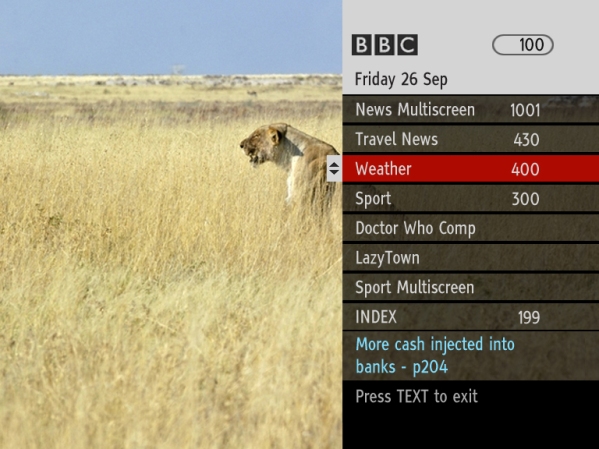
        <![CDATA[<p>This week sees the launch of an important iteration to the BBC's Digital Text service on Freeview - revolving headlines at the top level.  We actually implemented the same update on the Sky platform back in March, but wanted to wait before telling everyone until we had launched it on Freeview - meaning more than 85% of Digital TV users in the UK benefit.</p>

<p><span class="mt-enclosure mt-enclosure-image" style="display: inline;"><a href="https://meleleh.pages.dev/blogs/journalismlabs/2009/04/30/images/dtt_biz_600.jpg"><img alt="dtt_biz_600.jpg" src="https://meleleh.pages.dev/blogs/journalismlabs/2009/04/30/images/dtt_biz_600-thumb-599x449.jpg" width="599" height="449" class="mt-image-center" style="text-align: center; display: block; margin: 0 auto 20px;" /></a></span></p>

<p>The project really marks another step in our march to <a href="http://www.digitaluk.co.uk/">Digital Switch Over</a> (DSO), the government-backed initiative to convert the UK to a digital only TV broadcast infrastructure.  DSO will mean the eventual demise of Ceefax for the whole country by 2012, and one of our long term projects is to manage the transition of millions of Ceefax users to the BBC's Digital Text service.</p>

<p>DSO has meant the introduction of some new content to the Red Button service, including <a href="https://meleleh.pages.dev/blogs/pressred/2009/03/flightarrivalsandweather.shtml">Flight Arrivals</a>.  But it also means migrating some Ceefax functionality to Red Button too, in this case an element of dynamism into the top level that we felt was missing.</p>

<p>Now, on pressing red, a viewer watching any BBC channel can automatically see the latest News, Business, Sport and Entertainment headlines, as well as (where applicable) Weather warnings - without navigating to the individual indexes to find them.  Just as they've been able to do on Ceefax for years.  Sometimes moving into the future involves looking to the past. <br />
<small><br />
Tristram Biggs is Executive Product Manager for TV Platforms in FM&T Journalism.</small></p>]]>
        
    </content>
</entry>

<entry>
    <title>The greatest car chase in the world</title>
    <link rel="alternate" type="text/html" href="https://meleleh.pages.dev/blogs/journalismlabs/2009/03/the_greatest_car_chase_in_the.html" />
    <id>tag:www.bbc.co.uk,2009:/blogs/journalismlabs//128.69720</id>


    <published>2009-03-31T15:46:29Z</published>
    <updated>2009-03-31T16:11:28Z</updated>


    <summary>The first Grand Prix is over and the wires have been burning with emails flying back and forth late at night between developers, product managers and editorial on the weekends action. A few late nights for everyone but we feel...</summary>
    <author>
        <name>James Howard</name>
        
    </author>
    
    <category term="f1" label="F1" scheme="http://www.sixapart.com/ns/types#tag" />
    <category term="formula1" label="Formula 1" scheme="http://www.sixapart.com/ns/types#tag" />
    <category term="sport" label="Sport" scheme="http://www.sixapart.com/ns/types#tag" />
    
    <content type="html" xml:lang="en" xml:base="https://meleleh.pages.dev/blogs/journalismlabs/">
        <![CDATA[<p>The first <a href="http://news.bbc.co.uk/sport1/hi/motorsport/formula_one/7970430.stm">Grand Prix</a> is over and the wires have been burning with emails flying back and forth late at night between developers, product managers and editorial on the weekends action. A few late nights for everyone but we feel it has been worth it to get the live experience as smooth as possible for users of the site.</p>

<p><img src="https://meleleh.pages.dev/blogs/journalismlabs/2009/03/31/images/melbourne.jpg"></p>

<p>'Live on the web' is an important part of Sport and we wanted to develop some of the work that was  around the <a href="http://news.bbc.co.uk/sport1/hi/olympics/default.stm">Olympics</a> last year for the new <a href="http://news.bbc.co.uk/sport1/hi/motorsport/formula_one/default.stm">F1 season</a>.</p>

<p>Rolling out our dynamic text updates was a crucial part of the project (no need to manually refresh the page and helps save all those f5 buttonsand prevent RSI) and we will be looking at rolling this out across the rest of our live sport coverage.</p>

<p>Live Video (for the UK user) now means multiple streams and Higher Quality Video. From our intial stats for video usage can see that:</p>

<p>&bull; Users watched our new high quality live streams for much longer than standard quality streams - with an average of 37 mins for main race coverage<br />
&bull; Sport video and audio (excl. live streams) got as many unique users as the opening day of the Olympics (incl. live streams)<br />
&bull; Live coverage for the race grabbed approx. 183,000 AV requests - higher than the Euro 2008 final between Germany and Spain (approx. 169,000)<br />
&bull; Hiqh quality video accounted for 1 in 5 AV requests in practice and qualifying and 1 in 7 on race day</p>

<p>which is pretty good for a first weekend. Hopefully people will give them a go and I am expecting some offices to come to a standstill on Friday afternoons when the F1 circus hits the <a href="http://news.bbc.co.uk/sport1/hi/motorsport/formula_one/calendar/default.stm">European time zones</a>. Live practice over lunch. Excellent.</p>

<p><br />
Around most sporting events there are a massive number of feeds that have to be dealt with - mostly around <a href="http://news.bbc.co.uk/sport1/hi/motorsport/formula_one/results/default.stm">sport statistics</a> - and we wanted to push them a little bit more this time. The leaderboard is updated regularly by the sport editorial team and further enhances the live page - data, text and video.</p>

<p>From the rest of the Beeb we are using feeds from <a href="http://news.bbc.co.uk/weather/">weather</a> (a crucial part of a Grand Prix weekend), <a href="https://meleleh.pages.dev/iplayer/categories/sport/formula_one">iplayer</a>, <a href="https://meleleh.pages.dev/programmes">programmes</a> and search terms to try and reflect all of the content the BBC are doing on race weekends.</p>

<p>The <a href="http://news.bbc.co.uk/sport1/hi/motorsport/formula_one/circuit_guide/default.stm#top">circuit guides</a> have been a real collaborative effort with an external company - concentrating on the 3D anaimations and in-car video synched with Mark Webber's commentary. We will add a more in depth blog covering technical and product issues on this.</p>

<p><img src="https://meleleh.pages.dev/blogs/journalismlabs/assets_c/2009/03/circuit-thumb-430x306.gif"></p>

<p>As a small trial we also wanted to look at making broadcast data available in formats that users may find useful (ical, Outlook, google calendar etc). One of my colleagues, Tom Scott, <a href="https://meleleh.pages.dev/blogs/radiolabs/2008/07/some_ical_views_onto_programme.shtml">trialled some feeds around programme info</a> and it is something we will be looking at around sport.</p>

<p>Our trial seems to have gone well, with hundreds of feedback emails asking for the whole season (we just trialled Australia) suggesting other events we could look at (<a href="http://news.bbc.co.uk/sport1/hi/rugby_union/7345284.stm">The Lions</a>! Football!) and on which browsers / apps it didn't work.</p>

<p>There was also some immediate feedback on the presentation of  the F1 coverage overall on <a href="/http://search.twitter.com/search?q=BBC+F1">Twitter</a> - amazing how many people in the UK seem to follow sport on laptop and TV at the same time.</p>

<p>We will be making ongoing changes to the Sport site in the next few months looking specifically around navigation and the build up to the <a href="https://meleleh.pages.dev/blogs/sporteditors/2007/11/post_23.html">new football league season</a> that will present some other challenges around video.</p>

<p><img src="https://meleleh.pages.dev/blogs/journalismlabs/2009/03/31/images/footer.gif"></p>

<p>Today we have launched the first stage of this with a footer on the site which displays an A-Z list of all the sports that are covered on the Sport website. We will be making additions and changes to the navigation as we move towards a more flexible model.</p>]]>
        
    </content>
</entry>

<entry>
    <title>Giving data a human face</title>
    <link rel="alternate" type="text/html" href="https://meleleh.pages.dev/blogs/journalismlabs/2009/03/a_data_project_that_we.html" />
    <id>tag:www.bbc.co.uk,2009:/blogs/journalismlabs//128.63160</id>


    <published>2009-03-13T09:07:50Z</published>
    <updated>2009-03-13T10:49:49Z</updated>


    <summary>A data project that we&apos;ve been working on for a while took on a more human face last week. The UK fatalities in Afghanistan and Iraq is a data-led interactive that was first published on the BBC News website about a...</summary>
    <author>
        <name>Bella Hurrell</name>
        
    </author>
    
    
    <content type="html" xml:lang="en" xml:base="https://meleleh.pages.dev/blogs/journalismlabs/">
        <![CDATA[<p>A data project that we've been working on for a while took on a more human face last week.</p>

<p><a href="http://news.bbc.co.uk/1/hi/uk/7912865.stm">The UK fatalities in Afghanistan and Iraq</a> is a data-led interactive that was first published on the BBC News website about a year ago.</p>

<p><img alt="casualties.jpg" src="https://meleleh.pages.dev/blogs/journalismlabs/casualties.jpg" width="203" height="203" class="mt-image-right" style="float: right; margin: 0 0 20px 20px;" />Before that we had a basic web page which provided a <a href="http://news.bbc.co.uk/1/hi/uk/3696978.stm">simple list of names</a>, but such an important story demanded more of our attention. So after much digging and data checking we published a <a href="http://news.bbc.co.uk/1/hi/uk/3847051.stm">sortable table</a>.<br>&nbsp;<br>This was followed by a <a href="http://news.bbc.co.uk/1/hi/uk/7531254.stm">dynamic visualisation</a> of the figures in Flash. Last week we added the <a href="http://news.bbc.co.uk/1/hi/uk/7912865.stm">In Pictures</a> page, which is an aggregation of thumbnail images of all those who have been killed in the conflicts. </p>

<p>This latest page strengthens the coverage, adding another dimension that makes it far more personal, rather than purely a functional way to view the raw data. </p>

<p>Projects like the military casualties interactive work best when championed by one or two people - journalist John Walton has carried this one forward in a persistent way alongside a host of other projects. </p>

<p>But one niggly issue with data projects is the resource required to keep them all up to date. We have a number now (<a href="http://news.bbc.co.uk/1/hi/business/7789784.stm">recession tracker</a>, <a href="http://news.bbc.co.uk/1/hi/education/league_tables/default.stm">school league tables</a>, <a href="http://news.bbc.co.uk/1/shared/spl/hi/in_depth/uk_house_prices/html/houses.stm">house price database</a>, <a href="http://news.bbc.co.uk/1/hi/uk/7777635.stm">teen homicides </a>to name a few) all requiring either ad hoc, weekly, monthly, quarterly or annual updates, not to mention regular development. It's quite a commitment for projects that may go for some time without high-profile exposure.</p>

<p>On a recent visit to the BBC newsroom former LA Times data journalist Eric Ulken told me the LA Times faced similar problems when looking at resourcing of the<a href="http://www.latimes.com/news/local/crime/homicidemap/"> LA homicide map</a>. At one point the future of the project was in doubt, but thankfully some extra money was found to take it forward.</p>

<p>Finally I should reference some of the inspirations for our casualties project: Washington Post's <a href="http://projects.washingtonpost.com/fallen/">Faces of the Fallen</a> was possibly the first widely known memorial site for US soldiers killed in the conflicts in Iraq and Afghanistan, and the New York Times <a href="http://www.nytimes.com/ref/us/20061228_3000FACES_TAB1.html">Casualties of War</a> has some impressive mosaic image functionality.</p>]]>
        
    </content>
</entry>

<entry>
    <title>BBC News Radar</title>
    <link rel="alternate" type="text/html" href="https://meleleh.pages.dev/blogs/journalismlabs/2009/02/bbc_news_radar.html" />
    <id>tag:www.bbc.co.uk,2009:/blogs/journalismlabs//128.57746</id>


    <published>2009-02-19T10:00:00Z</published>
    <updated>2009-02-19T10:10:27Z</updated>


    <summary>The first post on this blog promised that we&apos;d discuss prototypes and experiments among other things. Well, today&apos;s post is about one such prototype that we&apos;d like to share with you: BBC News Radar (http://radar.journalismlabs.com) I&apos;ve been working at the...</summary>
    <author>
        <name>Jake MacMullin</name>
        
    </author>
    
    <category term="radarprototypebetainnovation" label="Radar Prototype Beta Innovation" scheme="http://www.sixapart.com/ns/types#tag" />
    
    <content type="html" xml:lang="en" xml:base="https://meleleh.pages.dev/blogs/journalismlabs/">
        <![CDATA[<p>The <a href="https://meleleh.pages.dev/blogs/journalismlabs/2008/12/about_bbc_journalism_labs.html"> first post</a>
on this blog promised that we'd discuss prototypes and 
experiments among other things. Well, today's post is about one such prototype 
that we'd like to share with you: BBC News Radar (<a title="http://radar.journalismlabs.com" href="http://radar.journalismlabs.com/">http://radar.journalismlabs.com</a>) </p>

<p></p><span class="mt-enclosure mt-enclosure-image" style="display: inline;"><img alt="Grab of Radar" src="https://meleleh.pages.dev/blogs/journalismlabs/images/radar.jpg" class="mt-image-none" style="" width="432" height="289" /></span>

<p> I've been working at the BBC for the last 2 years where I mainly work on 
the deep, dark internals of the main content management system used to produce 
the news and sport websites (as well as many other sites) - but that's another 
story for another day. Today, I'd like to share something&nbsp; that I've 
been working on in my 'spare' time at the BBC.</p>

<p>One of the things that first struck me when I started at the BBC was the 
sheer scale of the news web site. Whilst I knew the site was popular and I was 
aware that the BBC produced a lot of content, I have to admit I wasn't aware of 
just how frequently new content is published on the site and how often existing 
content is updated. You might also be surprised at how frequently and constantly 
that we publish new content on the news site: almost literally 'every minute of 
every day' (although there tends to be slightly less content published in the 
early hours of the morning in the UK, as we don't force all our journalists to 
work all night).</p>

<p>One reason you may not be aware of how frequently we publish new content is 
that until now there has been no one place you can go to see all of the stories 
we publish on the news site. You can always monitor the <a title="http://news.bbc.co.uk" href="http://news.bbc.co.uk/">front page</a> or subscribe to <a title="http://news.bbc.co.uk/1/hi/help/3223484.stm" href="http://news.bbc.co.uk/1/hi/help/3223484.stm">RSS 
feeds</a> of each of the various indexes you might be interested in - but you'll only see a 
small sub-set of all of the stories we publish.</p>

<p> The <a title="http://radar.journalismlabs.com" href="http://radar.journalismlabs.com/">BBC News Radar</a> displays a list of recently published stories from any section of the BBC News web site. It displays both stories that have just been published for the first time and 
stories that have been recently updated. We've had an internal application of 
the same name within the BBC for some time - so I can not claim any credit for 
the idea of displaying all of our new content in one place. This prototype has 
been developed to explore the idea of providing a publicly available version of 
this application. We look forward to hearing your feedback.</p>]]>
        
    </content>
</entry>

<entry>
    <title>Will viewers choose their own running order?</title>
    <link rel="alternate" type="text/html" href="https://meleleh.pages.dev/blogs/journalismlabs/2008/12/journalism_and_iptv.html" />
    <id>tag:www.bbc.co.uk,2008:/blogs/journalismlabs//128.51816</id>


    <published>2008-12-22T11:25:38Z</published>
    <updated>2008-12-22T15:59:10Z</updated>


    <summary><![CDATA[ Historically FM&amp;T Journalism has focused primarily on&nbsp;web development. &nbsp;The reasons for this are many and none of them are any of my business but it is odd, because the first experiments that BBC News made with 'On Demand' started...]]></summary>
    <author>
        <name>Tristram Biggs</name>
        
    </author>
    
    <category term="iptvmicrosoftmediaroombbciceefaxredbuttonbbc" label="iptv microsoft mediaroom bbci ceefax redbutton bbc" scheme="http://www.sixapart.com/ns/types#tag" />
    
    <content type="html" xml:lang="en" xml:base="https://meleleh.pages.dev/blogs/journalismlabs/">
        <![CDATA[<p class="MsoBodyText"><br /><span style="" lang="EN-US">

<object width="425" height="344"><param name="movie" value="http://www.youtube.com/v/tUsf6GSUQzM&hl=en&fs=1"></param><param name="allowFullScreen" value="true"></param><param name="allowscriptaccess" value="always"></param><embed src="http://www.youtube.com/v/tUsf6GSUQzM&hl=en&fs=1" type="application/x-shockwave-flash" allowscriptaccess="always" allowfullscreen="true" width="425" height="344"></embed></object>

</span></p><p class="MsoBodyText"><span style="" lang="EN-US">Historically
<a href="https://meleleh.pages.dev/blogs/journalismlabs/2008/12/about_bbc_journalism_labs.html">FM&amp;T
Journalism</a> has focused primarily on&nbsp;</span><a href="https://meleleh.pages.dev/blogs/mt-static/html/editor-content.html?cs=utf-8" name="vz.g"></a><span lang="EN-US"><a href="http://news.bbc.co.uk/1/hi/technology/6611559.stm">web
development</a></span><span style="" lang="EN-US">.
&nbsp;The reasons for this are many and none of them are any of my business
but it is odd, because the first experiments that BBC News made with 'On
Demand' started in the early 1970s and they were on television sets. &nbsp;The
experiment still exists today and it is called Ceefax.<o:p></o:p></span></p>


<p class="MsoBodyText"><span style="" lang="EN-US">The
principle is relatively simple, take some text Journalists with access to
agency feeds and ask them to write short news stories. &nbsp;Then ask them to
keep them updated, all the time. &nbsp;And so On Demand Journalism was born -
no printing presses or Six O'Clock bulletin to meet, just up-to-date
information when the viewer wanted it. <o:p></o:p></span></p>


<p class="MsoBodyText"><span style="" lang="EN-US">Fast-forward
thirty five years and those principles remain, albeit in a&nbsp;</span><a href="https://meleleh.pages.dev/blogs/mt-static/html/editor-content.html?cs=utf-8" name="kq7."></a><span lang="EN-US"><a href="https://meleleh.pages.dev/blogs/theeditors/2008/03/refreshing_changes.html">vastly
improved, richer environment</a></span><span style="" lang="EN-US">&nbsp;on the internet. &nbsp;Now it's the Journalists writing the BBC
News website that feed Ceefax and its digital progeny the&nbsp;</span><a href="https://meleleh.pages.dev/blogs/mt-static/html/editor-content.html?cs=utf-8" name="tp4c"></a><span lang="EN-US"><a href="https://meleleh.pages.dev/digital/tv/tv_interactive.shtml">BBC Red Button
service</a></span><span style="" lang="EN-US">.
&nbsp;And as we know from audience research, it's the Ceefax and Red Button
services that are now seen as clunky and slow, particularly when compared to
their online competitors.<span style="">&nbsp; </span>So why do we
persist with&nbsp;</span><a href="https://meleleh.pages.dev/blogs/mt-static/html/editor-content.html?cs=utf-8" name="pkxq"></a><span lang="EN-US"><a href="https://meleleh.pages.dev/blogs/bbcilabs/2008/11/selkirk_westlondon.html">switching
off analogue TV</a>?</span><span style="" lang="EN-US">
Well the Red Button service is actually far richer than Ceefax could ever hope
to be, but both services are at a disadvantage because of the underlying
technology shared by analogue and digital, whether it be terrestrial, satellite
or cable: Broadcast. <o:p></o:p></span></p>


<p class="MsoBodyText"><span style="" lang="EN-US">Television
has always been about communities, the sports audience in the pub</span><span class="MsoCommentReference"><span style="font-size: 8pt;" lang="EN-US"><a class="msocomanchor" id="_anchor_1" onmouseover="msoCommentShow('_anchor_1','_com_1')" onmouseout="msoCommentHide('_com_1')" href="#_msocom_1" language="JavaScript" name="_msoanchor_1"></a><span style=""></span></span></span><span style="" lang="EN-US">,&nbsp;</span><a href="https://meleleh.pages.dev/blogs/mt-static/html/editor-content.html?cs=utf-8" name="fo:."></a><span lang="EN-US"><a href="http://www.ultimatedallas.com/episodeguide/shot.htm">the
'watercooler moment'</a></span><span style="" lang="EN-US"> &nbsp;in the office or at school the next day, and now an increasing
community around the&nbsp;</span><a href="https://meleleh.pages.dev/blogs/mt-static/html/editor-content.html?cs=utf-8" name="xv191"></a><a href="https://meleleh.pages.dev/blogs/technology/2008/05/tv_becomes_social_again.html"><span style=""><span lang="EN-US">iPlayer, DVRs, Twitter etc<span style=""></span>.</span></span></a><!--[if !supportNestedAnchors]--><a href="https://meleleh.pages.dev/blogs/mt-static/html/editor-content.html?cs=utf-8" name="xv19"></a><!--[endif]--><span style=""><span style="color: black;" lang="EN-US">&nbsp;&nbsp;</span></span><span class="MsoCommentReference"><span style="font-size: 8pt;" lang="EN-US"><!--[if !supportAnnotations]--><a class="msocomanchor" id="_anchor_2" onmouseover="msoCommentShow('_anchor_2','_com_2')" onmouseout="msoCommentHide('_com_2')" href="#_msocom_2" language="JavaScript" name="_msoanchor_2"></a><span style=""></span></span></span><span style="color: black;" lang="EN-US">But if you free the device from the one-to-many
model used for it's first 70 years the communities can be reached from within
the TV itself, and the possibilities for programming are immense.</span><span style="" lang="EN-US"> <o:p></o:p></span></p>


<p class="MsoBodyText"><span style="" lang="EN-US">This
is our motivation for exploring partnerships with companies involved with IPTV,
and why we co-developed a prototype-application with Microsoft that was&nbsp;</span><a href="https://meleleh.pages.dev/blogs/mt-static/html/editor-content.html?cs=utf-8" name="mo9w"></a><span lang="EN-US"><a href="http://informitv.com/articles/2008/09/16/microsoftandemuse/">on show at
IBC</a></span><span style="" lang="EN-US">
&nbsp;earlier this year. &nbsp;</span><a href="https://meleleh.pages.dev/blogs/mt-static/html/editor-content.html?cs=utf-8" name="i1tp"></a><span lang="EN-US"><a href="http://www.microsoftmediaroom.com/">Microsoft Mediaroom</a></span><span style="" lang="EN-US"> &nbsp;is set-top box software
that (among other things) allows IP based assets to be overlaid on top of a
broadcast signal on a TV set. &nbsp; <o:p></o:p></span></p>


<p class="MsoBodyText" style="margin-bottom: 14.15pt;"><span style="" lang="EN-US">Immediately this allowed us to replicate a
number of things we offer on the web, on a home TV set. &nbsp; A quick list
would include: <o:p></o:p></span></p>

<ul><li><!--[if !supportLists]--><span style="font-size: 9pt; font-family: Symbol;" lang="EN-US"><span style=""><span style="font-family: &quot;Times New Roman&quot;; font-style: normal; font-variant: normal; font-weight: normal; font-size: 7pt; line-height: normal; font-size-adjust: none; font-stretch: normal;">  </span></span></span><!--[endif]--><span style="" lang="EN-US">On demand video content</span><span style="" lang="EN-US"></span></li><li><span style="" lang="EN-US">Live video content (unlimited
by bandwidth constraints we could offer one of as many streams as was
navigationally prudent)</span></li><li><span style="" lang="EN-US"></span><!--[if !supportLists]--><span style="font-size: 9pt; font-family: Symbol;" lang="EN-US"><span style=""><span style="font-family: &quot;Times New Roman&quot;; font-style: normal; font-variant: normal; font-weight: normal; font-size: 7pt; line-height: normal; font-size-adjust: none; font-stretch: normal;"></span></span></span><!--[endif]--><span style="" lang="EN-US">On demand text and data content</span></li></ul>


<span class="mt-enclosure mt-enclosure-image" style="display: inline;"><img alt="ondemand.jpg" src="https://meleleh.pages.dev/blogs/journalismlabs/2008/12/22/iptv/ondemand.jpg" class="mt-image-none" style="" height="196" width="349" /></span>

<br /><ul><li><span style="font-size: 9pt; font-family: Symbol;" lang="EN-US"><span style=""><span style="font-family: &quot;Times New Roman&quot;; font-style: normal; font-variant: normal; font-weight: normal; font-size: 7pt; line-height: normal; font-size-adjust: none; font-stretch: normal;">&nbsp;</span></span></span><span style="" lang="EN-US">Feeds of user generated content</span></li></ul>

 <span class="mt-enclosure mt-enclosure-image" style="display: inline;"><img alt="feedsofuser.jpg" src="https://meleleh.pages.dev/blogs/journalismlabs/2008/12/22/iptv/feedsofuser.jpg" class="mt-image-none" style="" height="198" width="351" /></span><br />


<p class="MsoBodyText" style="margin: 0cm 0cm 14.15pt 35.35pt; text-indent: -14.15pt;"><!--[if !supportLists]--><span style="font-size: 9pt; font-family: Symbol;" lang="EN-US"><span style=""><span style="font-family: &quot;Times New Roman&quot;; font-style: normal; font-variant: normal; font-weight: normal; font-size: 7pt; line-height: normal; font-size-adjust: none; font-stretch: normal;"></span></span></span><br /><span style="" lang="EN-US"></span></p><ul><li><span style="" lang="EN-US">Simple personalisation (local News, Sport and Weather based on
postcode) <o:p></o:p></span></li></ul>

<p class="MsoBodyText" style="margin-bottom: 14.15pt;"><span style="" lang="EN-US">Features that would be useful to
Journalism were included, regardless of whether we have the back-end systems to
support them at the moment: <br /></span></p><ul><li><span style="" lang="EN-US">Simple linking from one video
asset to another ("You've watched this - and <i style="">this </i>is related/background/might make you laugh")</span><br /></li></ul><br /><span class="mt-enclosure mt-enclosure-image" style="display: inline;"><img alt="simplelinking.jpg" src="https://meleleh.pages.dev/blogs/journalismlabs/2008/12/22/iptv/simplelinking.jpg" class="mt-image-none" style="" height="201" width="354" /></span>


<ul><li><!--[if !supportLists]--><span style="font-size: 9pt; font-family: Symbol;" lang="EN-US"><span style=""><span style="font-family: &quot;Times New Roman&quot;; font-style: normal; font-variant: normal; font-weight: normal; font-size: 7pt; line-height: normal; font-size-adjust: none; font-stretch: normal;"></span></span></span><span style="" lang="EN-US">Deeper linking from one part of
one video asset to another asset ("If you need a bit of help getting your
head around watching this, then watch <i style="">this
first</i>&nbsp;and then come back here")</span></li></ul><br /><span class="mt-enclosure mt-enclosure-image" style="display: inline;"><img alt="deeperlinking.jpg" src="https://meleleh.pages.dev/blogs/journalismlabs/2008/12/22/iptv/deeperlinking.jpg" class="mt-image-none" style="" height="199" width="354" /></span><p class="MsoBodyText" style="margin-left: 35.35pt; text-indent: -14.15pt;">

</p><ul><li><!--[if !supportLists]--><span style="font-size: 9pt; font-family: Symbol;" lang="EN-US"><span style=""><span style="font-family: &quot;Times New Roman&quot;; font-style: normal; font-variant: normal; font-weight: normal; font-size: 7pt; line-height: normal; font-size-adjust: none; font-stretch: normal;"></span></span></span><span style="" lang="EN-US">Send (a link to) the video to a friend's mobile or TV <o:p></o:p></span></li></ul>

<p class="MsoBodyText" style="margin-bottom: 14.15pt;"><span style="" lang="EN-US">Features not included (yet) <o:p></o:p></span></p>

<ul><li><!--[if !supportLists]--><span style="font-size: 9pt; font-family: Symbol;" lang="EN-US"><span style=""><span style="font-family: &quot;Times New Roman&quot;; font-style: normal; font-variant: normal; font-weight: normal; font-size: 7pt; line-height: normal; font-size-adjust: none; font-stretch: normal;">  </span></span></span><!--[endif]--><span style="" lang="EN-US">Social networking ("Enjoyed
Question Time this week? &nbsp;Link to it on Facebook straight from your TV.")<br /> </span></li></ul>

<ul><li><!--[if !supportLists]--><span style="font-size: 9pt; font-family: Symbol;" lang="EN-US"><span style=""></span></span><span style="" lang="EN-US">Alerts ("Your friend Jenny says - Stop watching Eastenders, look at
this giant squid they've caught in <st1:place w:st="on"><st1:country-region w:st="on">Australia</st1:country-region>"</st1:place>) <o:p></o:p></span></li></ul>

<p class="MsoBodyText" style="margin-bottom: 14.15pt;"><span style="" lang="EN-US">The demo continues to be shown by
Microsoft at trade shows worldwide, as an advertisement for the flexibility of
their platform, and I continue to show it off within the BBC as a device to get
people talking about what IPTV can offer Journalism in the future.<o:p></o:p></span></p>

<p class="MsoBodyText" style="margin-bottom: 14.15pt;"><span style="" lang="EN-US">What's been most exciting about the project
has been seeing how Journalists react when they understand how they could allow
their viewers to lead their own way through a story.<span style="">&nbsp; </span><o:p></o:p></span></p>

<p class="MsoBodyText" style="margin-bottom: 14.15pt;"><span style="" lang="EN-US">The traditional News package about Karen
Matthews (for instance) tells the story from the Journalist's point of
view.<span style="">&nbsp; </span>There are different treatments of
this depending on whether you are watching The One, Newsround, Newsnight, ITN
or Sky News.<span style="">&nbsp; </span></span></p><p class="MsoBodyText" style="margin-bottom: 14.15pt;"><span style="" lang="EN-US">Or, you can split some of
the different sections out in a linear way, on a website, like we did recently.</span></p><span class="mt-enclosure mt-enclosure-image" style="display: inline;"><img alt="karen.jpg" src="https://meleleh.pages.dev/blogs/journalismlabs/2008/12/22/iptv/karen.jpg" class="mt-image-none" style="" height="380" width="318" /></span>

<p class="MsoBodyText" style="margin-left: 35.35pt; text-indent: -14.15pt;">

</p><p class="MsoBodyText" style="margin-bottom: 14.15pt;"><span style="" lang="EN-US">But if you allow the user to navigate the
story themselves, from within the video, you allow them to create new versions
of the story, all built from the same constituent elements and equally valid,
but different in terms of tone or emphasis.<o:p></o:p></span></p>

<p class="MsoBodyText" style="margin-bottom: 14.15pt;"><span style="" lang="EN-US">This comes down to the difference between
On Demand media on the web and on TV, we're really in the dark here at the
moment, as TV Platforms have some way to go to catch up with the web in terms
of complexity of content offering and of audience behavior.<span style="">&nbsp; </span>My hunch is that the two are very different,
and <i style="">eventually</i> the preferred methods
that the audience uses for "telling themselves the story" will be quite
divergent.<o:p></o:p></span></p>

<p class="MsoBodyText" style="margin-bottom: 14.15pt;"><span style="" lang="EN-US">Initial user testing on the model has been
positive.<span style="">&nbsp; </span>Not surprising, and we get
this from all interactive TV research, is the tension between the linear TV
programme the viewer was watching to start with and the interactive area they
enter.<span style="">&nbsp; </span>If this transition is too jarring
then people feel like their 'focus' is being changed for them and they reject
that.<span style="">&nbsp; </span><o:p></o:p></span></p>

<p class="MsoBodyText" style="margin-bottom: 14.15pt;"><span style="" lang="EN-US">The TV is a device that people have a
peculiar relationship with, they are normally in complete control of its
functionality, but they can quickly become mesmerized under its spell.<span style="">&nbsp; </span>We upset this relationship at our peril.</span><br /></p><p class="MsoBodyText" style="margin-bottom: 14.15pt;"><br /></p><p class="MsoBodyText" style="margin-bottom: 14.15pt;"><i>Tristram Biggs is Executive Product Manager for TV Platforms at BBC Future Media &amp; Technology (Journalism)</i><br /></p><p class="MsoBodyText" style="margin-bottom: 14.15pt;"><br /></p>]]>
        
    </content>
</entry>

<entry>
    <title>Muddy Boots</title>
    <link rel="alternate" type="text/html" href="https://meleleh.pages.dev/blogs/journalismlabs/2008/12/muddy_boots.html" />
    <id>tag:www.bbc.co.uk,2008:/blogs/journalismlabs//128.46719</id>


    <published>2008-12-10T12:00:00Z</published>
    <updated>2008-12-10T12:42:06Z</updated>


    <summary>We&apos;ve been experimenting with the Semantic Web using a prototype called Muddy Boots. The question that we&apos;re trying to answer is: Can a computer reliably identify the people and organisations in news stories? This is still work in progress, but...</summary>
    <author>
        <name>Jonathan Austin</name>
        
    </author>
    
    <category term="semanticwebtermextractionknowledgeextractioninnovationlabs" label="Semantic Web Term Extraction Knowledge Extraction Innovation Labs" scheme="http://www.sixapart.com/ns/types#tag" />
    
    <content type="html" xml:lang="en" xml:base="https://meleleh.pages.dev/blogs/journalismlabs/">
        <![CDATA[<p>We've been experimenting with the <a href="http://www.w3.org/2001/sw/">Semantic Web </a>using a prototype called <a href="http://muddyboots.rattleresearch.com/">Muddy Boots</a>. The question that we're trying to answer is: Can a computer reliably identify the people and organisations in news stories? This is still work in progress, but we have a prototype and an API that you're welcome to explore.</p> 

<span class="mt-enclosure mt-enclosure-image" style="display: inline;"><img alt="MainActors.jpg" src="https://meleleh.pages.dev/blogs/journalismlabs/images/MainActors.jpg" class="mt-image-none" style="" width="432" height="191" /></span>

<p>When a journalist refers to someone in a news story they usually give the person's full name and enough information so the reader can understand who they are talking about. If the full name is ambiguous they may have to add a title or give an explanation about who the person is. But sometimes, especially for household names, the reader is expected to infer the identity of the person from the context of the story and by applying a reasonable level of background knowledge.</p> 

<p>Whilst a human reader takes for granted their abilities to pick up journalists' cues and understand context, a computer has to be programmed explicitly. It is difficult to design a system that can identify people from text and disambiguate them. It is even harder to build a system that meets editorial standards of accuracy. However, in theory, it should be possible. So we've been experimenting to develop an approach that could lead to a system that reliably identifies people (and organisations) in stories and marks up their textual names with semantic information. There are four key challenges: </p> 
<ul>
<li>Build working prototypes</li>
<li>Write tests for the prototypes that express editorial standards</li> 
<li>Refine the prototypes to reach defined levels of reliability</li> 
<li>Express the information usefully through <a href="https://meleleh.pages.dev/guidelines/futuremedia/technical/semantic_markup.shtml">semantic mark-up</a></li>
</ul>
 
<p><strong>Prototypes </strong></p> 

<p>The prototypes are ready to share with you. They have been built for us by a company called <a href="http://www.rattlecentral.com/">Rattle Research</a> based in Sheffield. They were a successful participant in the <a href="http://open.bbc.co.uk/labs/">BBC Innovation Labs</a>.</p>
 
<p>There are two systems available. They are both based on <a href="http://dbpedia.org/About">DBpedia </a>(the structured version of Wikipedia) which provides the controlled vocabulary of people and organisations. Therefore, in these prototypes each person in a news story is described by their Wikipedia entry. Potentially, Wikipedia is a good controlled vocabulary source for news because it has wide scope, is open and dynamic. It is certainly useful for prototyping.</p>
 
<ul> 
<li>The first method is called "Muddy". It works by extracting proper names from the story text and then matches them to entries in DBpedia. If a term is ambiguous, the system uses various strategies based on Wikipedia's disambiguation pages and the structure of DBpedia to resolve the conflict. More information can be found on Rattle's website <a href="http://muddyboots.rattleresearch.com/semantic-web-project/how-does-it-work-/">here</a> </li> 
<li>The second method is called "conText". It was initially proposed by Chris Sizemore and is described in detail in his blog post <a href="https://meleleh.pages.dev/blogs/radiolabs/2008/06/wikipedia_plus_lucene_morelikethis.shtml">here</a>. This method uses search technology (Google and Lucene) to enhance the results further. </li> 
</ul> 
<p>The good news for anyone who is not an expert in term or knowledge extraction is that Rattle implemented both methods behind a common abstract <a href="http://muddyboots.rattleresearch.com/semantic-web-project/api-specification/">API</a>. In effect we can treat both methods like black boxes. We don't need to know how they work to use them and evaluate their ability to identify people.</p> 
<p>In addition, Rattle implemented some visualisations so that we can get a feel for how the systems work. Below are some sample stories that have had people and organisations identified. You can also submit additional stories by following the final link.<br /></p> 
<ul> 
    <li><a href="http://muddy.rattleresearch.com/muddy2/articles/284">Blears attacks political bloggers</a> </li> 
    <li><a href="http://muddy.rattleresearch.com/muddy2/articles/735">Obituary: Sir Bill Cotton</a> </li> 
    <li><a href="http://muddy.rattleresearch.com/muddy2/articles/718">Obama's uphill task on US economy</a> </li> 
    <li><a href="http://muddy.rattleresearch.com/muddy2/articles/116">Branagh comeback up for top award</a> </li> 
    <li><a href="http://muddy.rattleresearch.com/muddy2/articles/new">Submit a new Story</a> </li> </ul> 
<p><strong>Testing</strong></p> 
<p>It doesn't take long to see that neither prototype is perfect. Sometimes they miss people and sometimes they get them wrong. But that is the point of the research. How good are they really and can they be improved? Our next step is to measure them against our editorial standards.</p> 
<p>So currently we are working with another Innovation Labs entrant <a href="http://thinktankmaths.com/">ThinkTankMaths</a> to develop some tests. We're going to compare the performance of both systems (and any system that implements Rattle's API) to the performance of human beings. We will also be proposing measures that evaluate the systems from an editorial point of view. For example, is it editorially more acceptable for the system to fail to spot the name of cat owner whose cat gets stuck in a tree than the Prime Minister? And what should the system do when the name of that cat owner is Gordon Brown? </p> 
<p>We will post more about this and our initial findings in the New Year, but in the meantime we'd like to hear your thoughts and feel free to have a look at the API and the prototypes. </p>]]>
        
    </content>
</entry>

</feed>