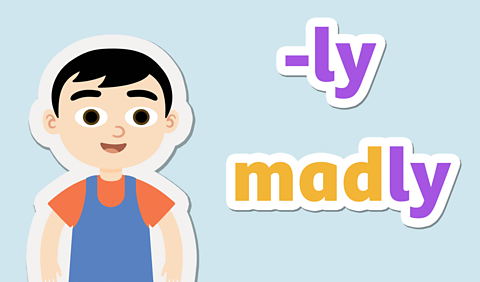
What is a suffix?
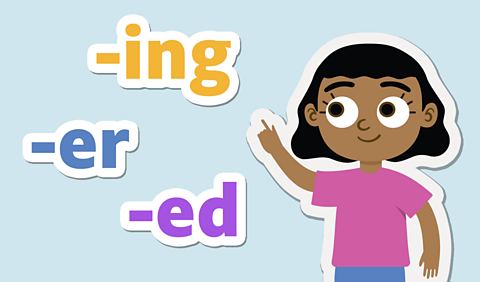
A suffix is a letter or group of letters that goes on the end of a word and changes the word's meaning.
Sometimes they also change the original word's spelling.
When adding a suffix you might have to double the last letter. For example, when adding -ed to 'drop', you need to double the 'p'.
drop → dropped
Some suffixes have specific uses.
Adding -ing can change a noun into a verb.
garden → gardening
While -ed can put a verb in the past tense.
jump → jumped
Watch: Using the suffixes -ed and -ing
Narrator: I've told you, fur doesn't tan even when you're in the garden.
A suffix is a letter, or group of letters, that go on the end of a word.
They change the word's meaning.
'ing' can change a noun into a verb, like gardening.
Make yourself useful.
Huh. There you go.
Oh, why do you have to destroy everything?
The suffix 'ed' puts things in the past tense.
Oh. Now you've destroyed them.
Ah! You know, suffixes sometimes change the original word's spelling, often doubling the last letter like trapped.
Ha! Gotcha!
Activity 1
Use the following words to fill in the gaps in the sentences below. The first one has been done for you.
- playing
- played
- sitting
- moved
- danced
My friend is sitting next to my parents.
I _ _ _ _ _ _ a game with my friends earlier.
I was _ _ _ _ _ _ outside earlier because it was sunny.
Last night I _ _ _ _ _ _ to a new song.
My family _ _ _ _ _ _ house last week.
Activity 2
First, read the words below.
- skipping
- skipped
- working
- worked
- painting
- painted
- looking
- looked
- dropping
- dropped

Now choose one word and write a sentence using that word. For example:
I painted a picture of a sunflower.
Try to do three sentences.
Don’t forget your capital letter to start the sentence and full stop, exclamation mark or question mark at the end.

Activity 3
- Choose one of the root words below and add either -ing or -ed to give it a new meaning.
- wish
- sort
- lean
- watch
For example, ‘wish’ could become ‘wished’ or ‘wishing’.
- Now write a sentence using your new word correctly. For example:
When I blew out the candles, I wished for a new bike.
- Can you do this with one more word?
500 Words
The UK's biggest children's story-writing competition for 5-11 year-olds is open for entries!
More on Prefixes and suffixes
Find out more by working through a topic
- count5 of 5

- count1 of 5
- count2 of 5
- count3 of 5