“Eat your broccoli or you won’t get any pudding” is a common phrase at many family dinner tables - but is it actually doing more harm than good? And how can parents help, ensuring their children learn to eat a balanced diet without steering them into a negative emotional relationship with food?
Bitesize asks Professor Emma Haycraft – an expert on children’s eating habits, for advice on dealing with so-called “picky eaters”.
When does picky eating stop?

Many parents use the phrase “picky” or “fussy” eater when their child is refusing to eat certain foods, even sometimes things they would have happily had for a meal just a few days before, but Emma prefers to avoid using that label. Instead, she says it’s important for parents to understand it as a normal developmental stage.
She says: “We tend to see fussy eating peaking from around two years of age. It's generally accompanied by the increase in autonomy that children start to have around that age, once they've become more independently mobile and choosing which foods they do and don’t want to eat is part of their development.”
The behaviour dates back to prehistoric times
The roots of so-called “picky eating” are thought to be evolutionary and go back to a time when our ancestors were scavenging for food.
Emma, who is professor of psychology and public health at Loughborough University, says: “We needed this mechanism to stop young kids from putting anything and everything in their mouths. It was about survival and protection, but it’s not something we need in current society, living in the UK where food is often in packets and given to us by people who care for us and aren't going to want anything to harm us.
“It’s not conscious - children aren’t trying to make life really difficult. It's actually an inbuilt protective response where the body is saying, ‘That might harm you, you shouldn't eat it.’.”
Why are some foods rejected over others?
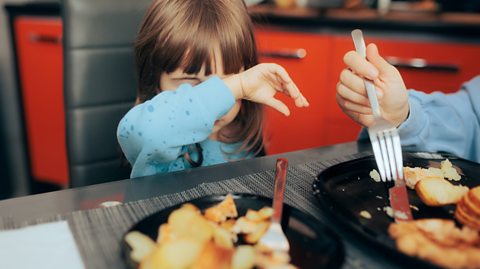
Children tend to be more likely to eat sweet food - favouring fruit over vegetables that might taste bitter. They also trust those foods that tend to provide the same eating experience time after time, such as pasta, chips, rice and bread.
Children’s brains are processing and categorising the world around them, so things that don’t have a consistent flavour and texture can be unsettling to them.
Emma says: “A strawberry for example might be less ripe today than in a couple of days' time, and so it's going to taste different. And that strawberry from last week may be mushier, so the texture has changed. As a young child, that's really inconsistent. They think, ‘Well, that's a bit weird, I’m going to stop eating those.’
“And then it can often generalise so they might think ‘tomatoes are red too so they might taste the same. And red peppers - I'm not eating those either.’ So you can suddenly end up with kids, often temporarily, eliminating entire groups of food.
“With neurodiversity, these preferences can be even stronger so we quite often see associations with very specific foods, selective food groups, but also sometimes brands as well.”
This article goes into more detail on ARFID and food refusal in SEND children
And what are sensory preferences? How eight senses can explain fussy eating
Offer your children a choice
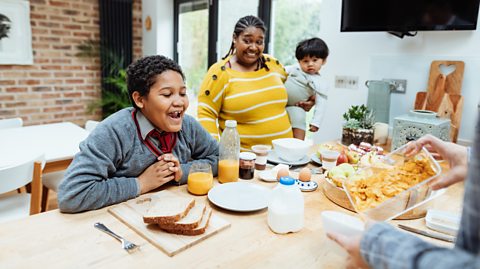
Small changes can make a big difference to your child’s eating habits. Begin by offering them a choice to give them a feeling of control. Instead of asking “Do you want vegetables?”, say “Do you want carrots or broccoli?” or “Do you want your carrots in batons or grated?”.
Some parents find success putting all components, including the typical second course like yoghurt or fruit, on the plate at once. If a child eats the yoghurt first, it may relax them enough to try the savoury items.
Don’t give up offering them the same food
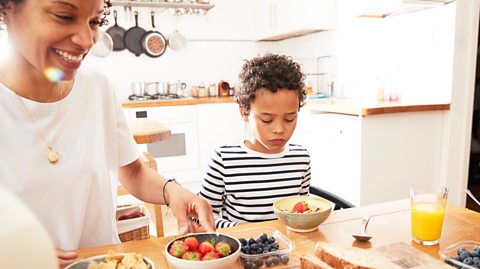
Many parents offer their child a particular food two or three times before giving up when they don’t eat it, but Emma says it can take 15 to 20 times for your child to accept something new. These opportunities don’t all have to involve putting the food item on their plate - you can increase your child’s contact with food without piling on the pressure to eat it.
Emma says: “Playing with foods can be really useful. Let your kids play with a few leftover strands of spaghetti - touching it, smelling it, licking it. The goal doesn’t have to be that the child has chewed it and swallowed it and eaten it.”
For children with neurodiversity, it’s important to adapt to their individual needs, but exposure to different foods without pressure can help increase familiarity.
Try role modelling
Children are more likely to try foods if they see their parents and peers eating them - which is why you might find your kids eat dishes at nursery or school that they would refuse at home.
Emma says parents can be food role models too: “One of the top tips that we always give to parents is that if you want kids to be eating something, they need to see you eating it too. You can do it in a low-pressure, low-fuss way, by putting some broccoli on everybody's plate. And also perhaps the first few times talking about how delicious it is. Not making a big deal out of it, but saying ‘Have you tried this broccoli? It's really yummy.’”
Avoid using sweet foods as a reward
Emma warns that offering something like ice cream if your kid eats some peas can send a message that the vegetable is a chore and the pudding is the only thing worth having. If children need some encouragement to try a food, she recommends using non-food rewards such as stickers or a trip to the park instead.
When should parents worry about their child’s eating?

One of the worst things about children being choosy about food is the worry and guilt parents feel. Emma suggests taking a bigger picture view of the situation rather than focusing on individual meals, but if you continue to be concerned - especially if your child is losing weight - you should consult a medical professional such as a health visitor or GP.
She says: “If children are maintaining a healthy weight then there's probably no immediate cause for concern. We encourage parents to think about what their child’s eating over the whole week.
“If kids are only eating a small variety of foods, what are the food groups they’re getting? Kids will often eat cereals, for example, which are often fortified with lots of vitamins and minerals so actually are quite a good food in terms of nutrients. For most families, a phase of picky or fussy eating is a typical part of development and shouldn’t be a major cause for concern.”

Bitesize Parenting
Fun activities, real-life stories, wellbeing support and loads of helpful advice - we're here for you and your child.

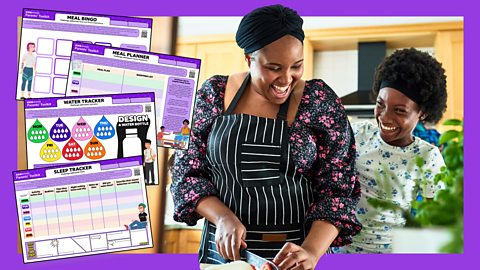
Happy Family Eating... a fun guide for parents
An overview of our detailed resources and guides to helping your child enjoy and understand their food