
Hands-on science: Lightspeed maths resources

Lightspeed maths help page

This page accompanies the Lightspeed activity guide.
For help with working out averages (or means), take a look at either Skillswise or Bitesize.
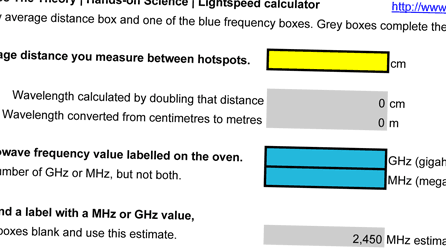
Once you have an average for the distance between the centres of your adjacent melt patches, this page offers you three ways to work out the speed of light: Automatic calculation, Downloadable spreadsheet, Calculation step by step.
Automatic calculation
Note: your web browser must allow Javascript to run this routine.
Downloadable spreadsheet
If you have Microsoft Excel – or any other software that can open .xls files – then you may find the Lightspeed Calculator spreadsheet useful. The spreadsheet lets you examine the formulae more closely if you want to.
Open it and enter the numbers where you're asked to. You need exactly the same information as for the automatic calculation above.
Calculation step by step
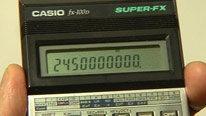
Using a calculator? Find one that copes with 10-digit numbers.
The speed of a wave is found by multiplying the wavelength by the number of waves that happen every second, ie the wave's frequency.
Light waves and microwaves are energy waves that travel at the same speed but have different wavelengths and frequencies.
The distance between margarine melt patches is related to the wavelength of the microwaves (the distance between peaks in the cycle of the energy wave).
- To work out the wavelength, take your average distance between melt dot centres (in centimetres) and multiply it by 2.
- To convert the wavelength to metres, divide it by 100.
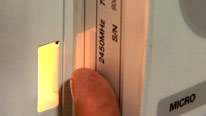
If your oven has a label showing the frequency, you need to convert the figure from either MHz (megahertz) or GHz (gigahertz) to cycles per second, measured in Hz (hertz).
There are 1 million hertz in 1MHz and 1 billion hertz in 1GHz.
- So multiply your label figure by either 1,000,000 (if from MHz) or 1,000,000,000 (if from GHz) to get the number in cycles per second.
No label? Many microwave ovens run at 2.45GHz, which is 2,450MHz or 2,450,000,000Hz.
- Finally, multiply together your wavelength figure (in metres) and the frequency (cycles per second) figure to get a number that is the speed of your microwaves in metres per second (written m/s).
You're aiming for a number around 300,000,000m/s. Unfortunately that's such a big number that some calculators can't display it.
Ask Yan a question

Sorry, but we've had so many great questions that this feature is closed, for now.
Roadshow
Bang LIVE is back and kicking off the year in London at the Big Bang Fair.
Hands-on activity guides
BBC iD
BBC iDBBC navigation
BBC links

BBC © 2014The BBC is not responsible for the content of external sites. Read more.
This page is best viewed in an up-to-date web browser with style sheets (CSS) enabled. While you will be able to view the content of this page in your current browser, you will not be able to get the full visual experience. Please consider upgrading your browser software or enabling style sheets (CSS) if you are able to do so.

